


New Delhi: Artificial intelligence is rapidly emerging as one of the most consequential forces in the global energy system, yet not for the reason that dominates debate. While headlines fixate on the swelling power needs of data centres and AI models, the deeper story lies in how the technology could transform the efficiency, resilience and economics of energy production and consumption. In fact, AI’s role as a tool for optimisation — not just a driver of load — could be the bigger determinant of long-term energy trajectories.
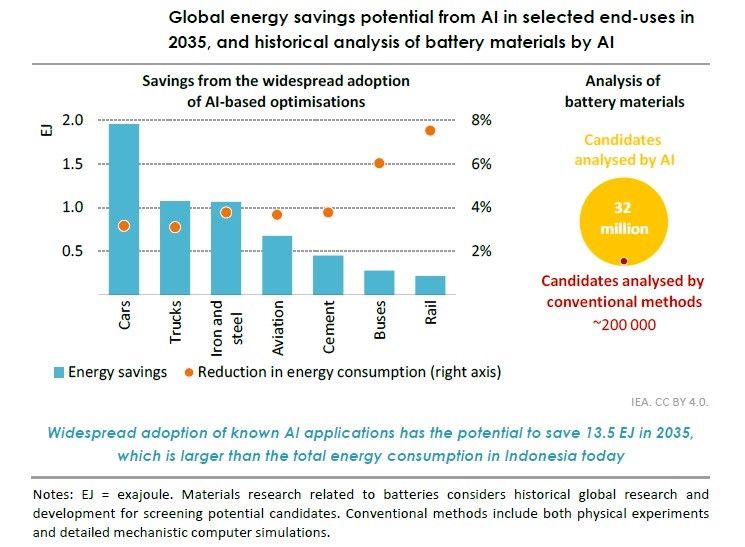
According to the IEA World Energy Outlook, widespread deployment of AI-enabled solutions could lift energy efficiency in the transport and industrial sectors by 3-10% by 2035. In pure energy terms, this equates to roughly 13.5 exajoules of savings — slightly more than Indonesia’s current annual energy demand. If materialized, such gains could prove pivotal in accelerating emission-reduction pathways across economies.
AI is already being woven into the fabric of the global energy value chain. Oil and gas producers are using machine learning to optimize drilling, detect leaks, and schedule predictive maintenance. Electricity generators and grid operators deploy intelligent forecasting for renewables integration, asset health monitoring and dynamic demand-response systems. Across energy-intensive industries, AI is beginning to influence everything from process optimisation in steelmaking to logistics in global supply chains.
These early applications are significant, but the opportunity field stretches far wider. If AI-driven insights are scaled across all major operational and consumption points, it could reduce wasted energy, improve asset utilization, smooth volatility in renewable energy integration and automate resource-intensive operations. In cumulative terms, even modest improvements across millions of nodes in the system could produce structural gains in energy efficiency.
Advantage Not Guaranteed
However, none of this progress is guaranteed, says the IEA report. The barriers to achieving AI’s full value are substantial — and include constraints that go beyond technological capability. Access to reliable, high-resolution datasets remains uneven across countries and companies, often limiting the accuracy of AI predictions.
Digital infrastructure gaps slow adoption in regions where energy efficiency gains could have the biggest marginal impact. Privacy regulation and data governance rules are still evolving and can slow industrial data-sharing necessary for cross-system optimization. Cybersecurity risks, meanwhile, are inevitable in digitalized energy systems and must be managed without compromising reliability.
There is also the risk of behavioural rebound. For instance, increasingly autonomous and AI-enhanced private transport could inadvertently encourage users to prefer cars even in settings where public transit would be more sustainable. Gains in efficiency can be offset if energy-intensive behaviours expand as services become cheaper, more convenient or more automated.
Beyond operational optimization, AI promises to influence the innovation pipeline for the next generation of clean-energy technologies. Many of the most complex scientific barriers — such as finding new catalysts for hydrogen production, designing next-gen battery chemistries or engineering new materials for carbon capture — involve multidimensional searches across enormous datasets. AI is exceptionally well-suited to navigating such search spaces, identifying candidates with desirable characteristics much faster than traditional methods.
Yet this is not an instant route to commercialization. Even if algorithms identify promising potential breakthroughs, prototypes must still be validated in the laboratory, scaled into working demonstrators and proven viable in commercial supply chains. Manufacturing, logistics constraints, raw-material bottlenecks and cost pressures impose hard limits on how quickly even the smartest design can enter the market. Ultimately, “AI is an accelerant — not a magic wand” — and real-world adoption cycles remain long, says the report.
Known Unknowns
While the World Energy Outlook adopts a medium- to long-term lens in mapping future energy pathways, its analytical horizon for AI remains relatively short — and for good reason. AI is a disruptive technology still in a formative phase, surrounded by extraordinary promise, deep uncertainty and considerable hype. Its ripple effects on the economy and society are not yet fully visible. A number of “known unknowns” could significantly alter how AI shapes future energy demand and supply.
- GDP effects & risk of rebound
AI’s impact on economic productivity remains highly uncertain. Some projections anticipate modest gains, while others suggest a step-change in global GDP. Stronger economic expansion could lead to higher energy consumption, even if AI also improves efficiency. Conversely, if investment in AI turns out to be excessive or poorly allocated in the near term, weaker economic performance could cool energy demand.
- Evolution of efficiency
Rapid progress is being made to reduce the computational and energy requirements of AI. Efficient AI chips and leaps in model design can drastically cut the energy footprint of inference and training. Google has already reported a 33-fold decline in energy use per median prompt for its Gemini model in the span of just one year — an example of the pace of improvement that could reshape forecasts.
- Scale & Nature Of Uptake
The extent to which AI is adopted globally remains unclear — but the use cases matter just as much. Text-based AI workloads are relatively energy-light, while image and video generation are far more energy-intensive. A future dominated by agentic AI models that operate autonomously over long online sessions could push consumption sharply upward.
- Impact On Tech Innovation
The biggest medium-term effect may emerge not from operational optimization, but from faster R&D cycles in clean energy. Sudden breakthroughs are possible but should not be assumed; however, even steady incremental acceleration in discovery and deployment could have a large cumulative impact over time.
As these variables evolve, their implications will need to be folded into future forecasting. The IEA World Energy Outlook notes that it will continue to track both direct impacts, such as AI-related power demand, and indirect ones, including the technology’s influence on economic growth, industrial efficiency and innovation in clean-energy systems.
What is clear already is that AI’s eventual contribution to the global energy transition will depend not just on how much power it consumes, but on how effectively it is used to manage, conserve and transform energy.