
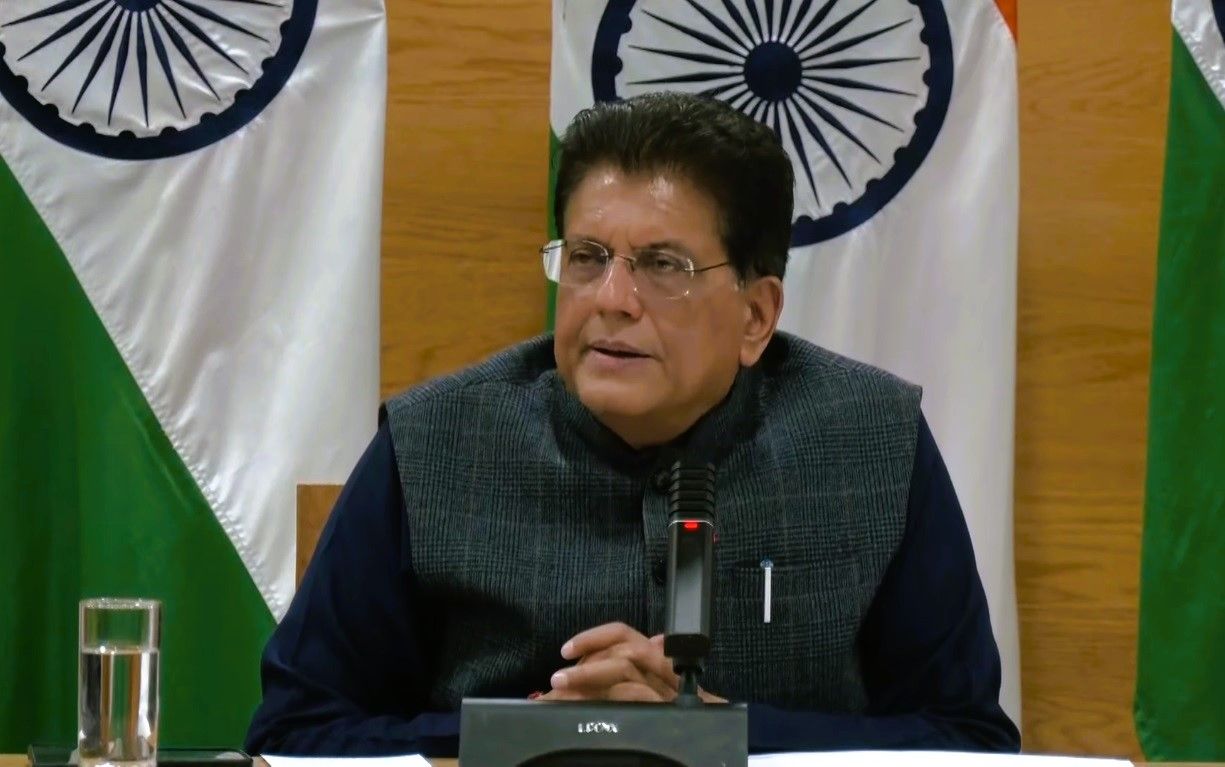

New Delhi: Hailing the India-US interim trade agreement as a major step toward realising the ambitious goal of $500 billion in annual bilateral trade, Commerce Minister Piyush Goyal on Saturday said the deal “fully safeguards” the interests of India’s farmers and reaffirmed that the country has firmly protected its key trade “red lines” in the agreement.
Describing it as “an important day in India’s Viksit Bharat journey”, Goyal, while addressing a press conference in New Delhi, offered a detailed briefing on the pact and emphasised that no genetically modified (GM) products from the US will be allowed into India, which has been a major concern among farmers.
Placing the deal in political and diplomatic context, Goyal said the agreement reflects “the way President Donald Trump and Prime Minister Narendra Modi have presented a vision for the future, considering the relations between the two countries, the diplomacy of both countries, and the friendship of the two leaders”. He noted that discussions on the Bilateral Trade Agreement began in February 2025 and that the joint statement was finalized late Friday night and welcomed across the country. “There is a wave of happiness across the country. There is great enthusiasm in every sector, and it seems that in the coming days, new opportunities will open up,” he said.
At the heart of the agreement, the minister explained, is a sharp reduction in tariffs faced by Indian exporters in the US market. “The 50% reciprocal tariff that was applied on Indian exports in America will now be reduced to only 18%,” Goyal announced, stressing that this rate is lower than those imposed on key competitors. “The US has kept about 35% duty on China, 20% on Vietnam, 20% on Bangladesh, and 19% on Indonesia. We are lower than all competing countries, and this will greatly benefit our exporters in the days to come.”
He added that for many products, tariffs will fall not just to 18% but all the way to zero, opening unprecedented access to the world’s largest economy, which he described as “nearly a $30 trillion economy”.
Explaining the sectoral gains, Goyal said gems and diamonds, pharmaceutical products, and smartphones exported from India will enjoy zero duty in the US. He highlighted that pharmaceutical exports alone are worth around $13 billion annually. A wide range of agricultural and processed food products will also see tariffs reduced from 50% to zero. “Spices, tea, coffee, copra, coconut oil, cashew nuts, fruits like mango, guava, kiwi, papaya, pineapple, mushrooms, bakery products, cocoa-based products, processed foods, banana pulp, citrus juices, guava and mango paste, pineapple jam — on all these items, the reciprocal tariff in America will drop from 50% to zero. Zero,” he emphasised. He said this would directly benefit Indian farmers and agri-exporters across multiple states.
Responding firmly to criticism, Goyal rejected claims that the agreement compromises Indian agriculture. “We have not done any such work that could harm any farmer,” he said. He clarified that India has given no tariff concessions on sensitive agricultural imports from the US. “No genetically modified product will come into India. No concession has been given on meat, poultry, dairy products, soybean, maize, rice, wheat, sugar, cereals, or millets like jowar, bajra, ragi,” he said, adding that fruits produced sufficiently in India, pulses, oilseeds, honey, ethanol, and tobacco have also been kept outside the scope of concessions. “Items that are sensitive in India, which our farmers produce in sufficient quantity, in which we are self-reliant, all those items have been kept out of the scope of this agreement,” he asserted.
Goyal said the deal equally benefits MSMEs, artisans, and labour-intensive sectors. “Our skilled youth, our hardworking workers, our artisans, our Vishwakarmas, our sisters — especially those associated with textiles, leather and footwear, toys, sports goods — will benefit,” he said.
He highlighted that silk products have been brought to zero duty, and sectors such as home décor, furniture, lighting, jewellery, and apparel will gain significant market access in the US at lower tariffs than competitors.
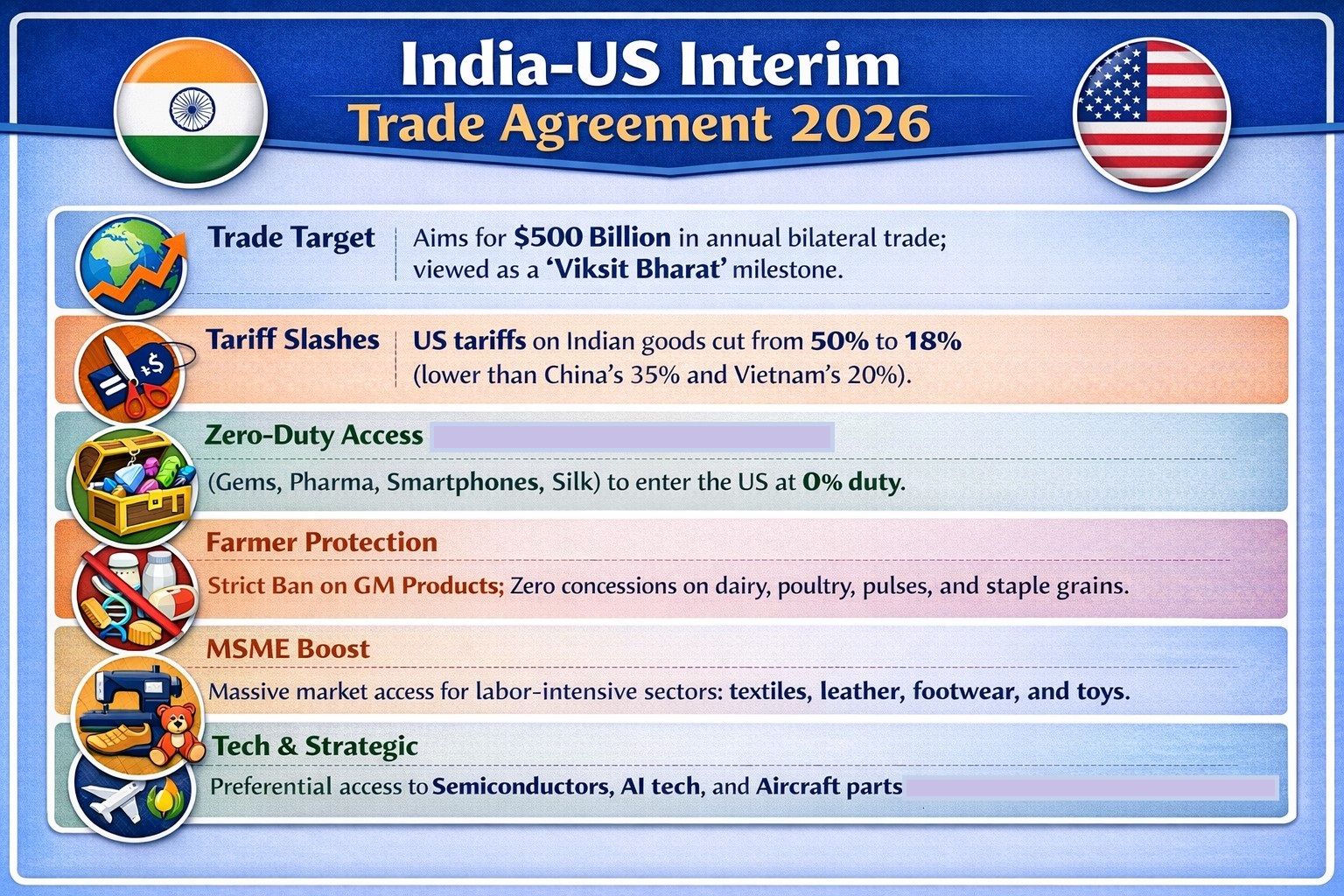
Describing the agreement as “very fair, equitable, and balanced”, the minister added that India will also gain better access to advanced technology products needed for national development, including aircraft, semiconductors, AI-related equipment, and high-end machinery. “India’s consumers will get the benefit, new employment opportunities will be created, and India’s economy will move forward rapidly,” he said.