
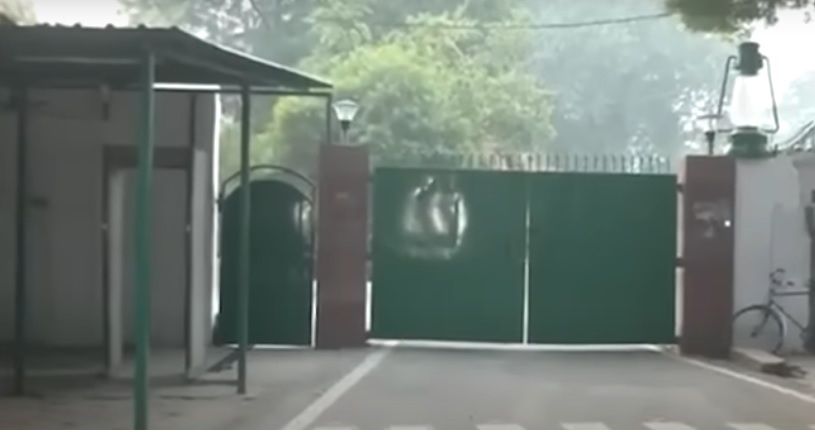

New Delhi: In the intricate and often theatrical world of Indian politics, symbols wield immense power.
The notice to vacate 10 Circular Road in Patna — the bungalow that served as the de facto headquarters for Lalu Yadav’s family for 19 years — is far more than a simple eviction. It is a “meticulously orchestrated” political manoeuver, a “symbolic bulldozer” aimed at dismantling the very identity of the Rashtriya Janata Dal (RJD) and cementing the authority of the ruling National Democratic Alliance (NDA). This act, sanctioned by chief minister Nitish Kumar but driven by his BJP allies, marks a definitive shift in Bihar’s power dynamics, transforming a physical address into a potent metaphor for RJD’s perceived decline.
For over two decades, 10 Circular Road was not just a residence; it was a political institution. It stood as a tangible emblem of RJD’s enduring influence, a place where party loyalists gathered and strategies were forged. That is fast changing now.
Senior journalist and political analyst Arun Sathi captured its profound significance on the Dialogus show, stating, “10 Circular Road had become the identity of Lalu Yadav and Rabri Devi Ji... a symbol for the RJD family and workers.Its iconic status made it a cornerstone of the party’s public image. The decision to revoke it, therefore, is a deliberate strike at the heart of RJD’s legacy.”
Emphasizing that core motive of the move is to send an unambiguous message to the electorate, he remarked: “RJD has now been weakened. Lalu Yadav has been weakened. Tejashwi Yadav has been weakened. Rabri Devi has been weakened.” This is political communication at its most potent, using a building’s vacancy to declare a party’s irrelevance.
The move is a masterclass in realpolitik. While the administrative justification cites rules and the provision of an alternative, smaller residence, the underlying strategy is twofold. First, it aims to project RJD as a party that believes it is above the law, reinforcing a longstanding narrative. Second, and perhaps more crucially, it serves to firmly box-in ally Nitish Kumar, closing off any potential for his return to the RJD fold.
Sathi, however, says, “Nitish Ji has always said this from the stage, that we will not wander here and there now. That is a political thing. And in politics, no door is ever permanently closed for anyone. People who understand politics know this.”
RJD's defiant refusal to vacate, with its state president vowing to resist, sets the stage for a protracted legal and political drama. This raises a critical question: could this heavy-handed tactic backfire? Could the spectacle of the Yadav family’s belongings being forcibly removed generate a wave of public sympathy for the beleaguered opposition? Most political observers in Bihar believe the risk for BJP is minimal. A senior political analyst highlighted the party’s calculated approach, noting, “BJP takes decisions with a lot of ruthlessness... they don’t see how much complaint there will be.” The assessment is that RJD is too organizationally weak and morally compromised to mount an effective counter-offensive that would resonate beyond its core vote bank.
This weakness is perhaps the most damning indictment of RJD’s current state. The party appears unable to transition from a commanding dynasty to a fighting opposition force. Another senior political analyst Santosh Singh offers a stark critique of this passivity, emphasizing that political relevance is won on the streets, not in vacant bungalows. “You have to come out on the street and fight,” he asserted. “This opposition has left the tendency to fight... The public is waiting for a hero... who is ready to go to jail.” His comments underscore a growing perception that the RJD leadership is disconnected from the grassroots energy required to challenge a formidable machine like BJP. Without a visible, agitational presence on issues that matter to the common person — be it unemployment, corruption, or mafia rule — the party’s protests over a luxury bungalow ring hollow.
Ultimately, the saga of 10 Circular Road is a microcosm of the new Bihar. The NDA, with the BJP firmly in the driver's seat, is not just administering the state but actively reshaping its political landscape by dismantling the symbols of its rivals. RJD, meanwhile, is caught in a trap of its own making, struggling to find a compelling response beyond defiant rhetoric.
The government’s focus, as stated by its leaders, is now on employment and industrial development; by forcing RJD to fight over a bungalow, they have successfully framed them as a party stuck in the past, fighting for personal privilege rather than public good.
The bungalow now stands as a stark monument to a political era that has passed, its echoing halls a testament to a decline that is both symbolic and starkly real.