


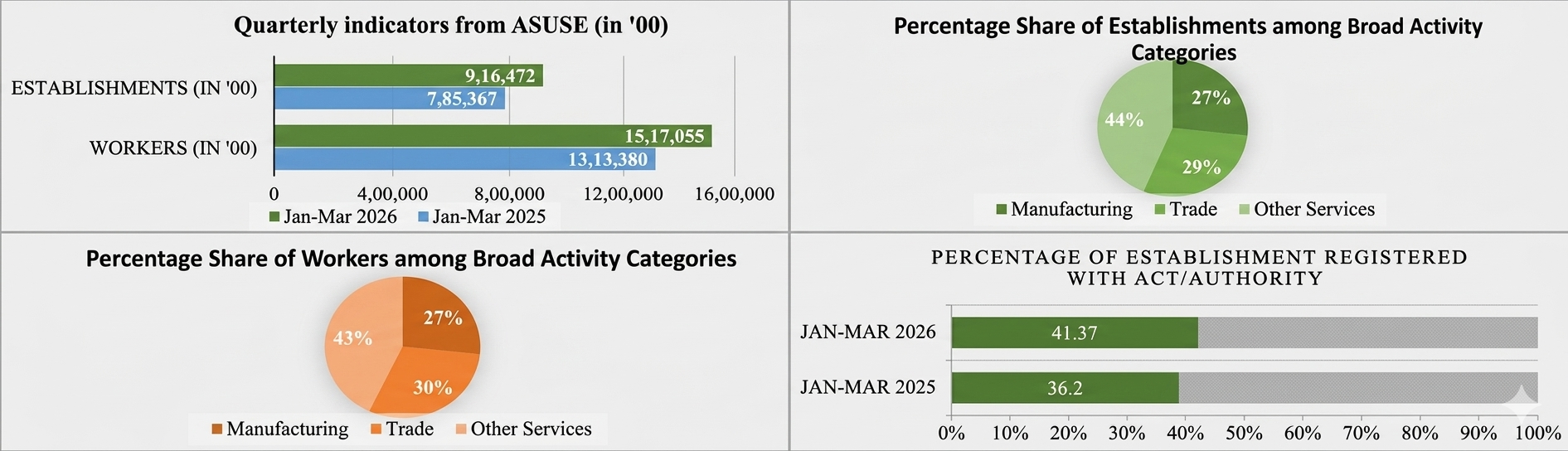
New Delhi: India’s unincorporated non-agricultural sector has sent a powerful signal about the changing character of the country’s grassroots economy. The latest Quarterly Bulletin on Unincorporated Sector Enterprises released by the National Statistics Office shows that the number of establishments crossed nine crore for the first time during the January-March quarter of this year, underlining the scale at which informal entrepreneurship is expanding across the country.
The sector recorded 9.16 crore establishments during the quarter, reflecting a robust 16.69% year-on-year increase. Employment climbed to 15.17 crore, up 15.51% from the corresponding quarter last year. The data reinforce the growing economic relevance of small, unincorporated businesses operating outside the corporate framework but deeply embedded in India’s consumption and employment ecosystem.
What stands out sharply in the latest figures is the dominance of rural India in driving this expansion. Rural establishments grew 20.46%, significantly ahead of the 12.59% growth seen in urban areas. The numbers point to a decisive revival in local entrepreneurship beyond metropolitan centres, fuelled by rising consumption demand, expanding digital connectivity and easier access to financial tools.
The growth trajectory also indicates that economic activity in smaller towns and villages is becoming structurally stronger rather than merely cyclical. As inflation pressures moderate and welfare-linked spending supports household consumption, rural entrepreneurs appear to be responding with greater business formation across trade and services segments.
Services Sector Surge
The services segment emerged as the single biggest growth engine within the unincorporated economy. Establishments in the sector expanded 24.82%, while employment surged more than 31% year-on-year during the quarter. The sharp rise reflects increasing demand for localised service delivery across transport, retail-linked activities, hospitality, repair services and digital commerce support functions.
The data carry wider implications for India’s labour market. At a time when concerns persist around formal job creation, the unincorporated sector continues to absorb a substantial share of the workforce. According to the bulletin, working owners constituted nearly 61% of total workers, highlighting the prevalence of self-employment and family-run enterprises in sustaining economic activity.
Equally significant is the rising participation of women in the workforce. Women accounted for around 29% of total employment in the sector during the quarter, suggesting that smaller enterprises are increasingly emerging as accessible employment avenues for female workers, particularly in semi-urban and rural regions.
The latest survey findings also reinforce the argument that India’s informal economy is no longer technologically detached. Around 81% of establishments reported using the internet for entrepreneurial activities, while a similar proportion adopted cashless payment systems including UPI, online banking and POS-based transactions. The rapid penetration of digital payments has fundamentally altered business practices for millions of small enterprises, improving transaction efficiency and widening market access.
The adoption curve reflects the success of India’s public digital infrastructure push, which has accelerated financial inclusion and enabled even micro-enterprises to integrate with formal economic channels.
Formalisation Gains Pace
One of the most important takeaways from the Bulletin is the gradual formalisation of India’s vast unincorporated economy. Around 41.37% of establishments reported some form of official registration, indicating that a growing number of enterprises are entering the formal regulatory and financial ecosystem.
This transition carries significant long-term implications for tax compliance, access to institutional credit and productivity enhancement. Registered businesses are better positioned to secure loans, participate in supply chains and adopt technology-driven expansion models. The trend also strengthens the government’s broader objective of widening the formal economic base without disrupting employment-intensive small enterprises.
The Bulletin forms part of the Annual Survey of Unincorporated Sector Enterprises conducted under the Ministry of Statistics and Programme Implementation. The survey, which excludes agriculture and construction, captures activity across manufacturing, trade and services sectors in both rural and urban India. Data for the January-March 2026 quarter were collected using tablet-based Computer Assisted Personal Interviewing across more than 1.72 lakh establishments.
The latest numbers reaffirm a crucial reality about the Indian economy: while large corporations dominate headlines and stock markets, the country’s real employment engine continues to be its sprawling network of small entrepreneurs, traders and service providers. Their accelerating expansion suggests that India’s next phase of economic growth may increasingly be shaped from the bottom up rather than the top down.
(Cover photo by Zoshua Colah on Unsplash)