


New Delhi: India’s $390 billion startup engine is facing a reality check, where survival and scale will be dictated not by billion-dollar valuations but by the ability to generate sustainable value, profitability, and global competitiveness. This marks a phase in which the unicorn era is being reset, with investors, founders, and policymakers aligning around disciplined growth and long-term resilience.
After a decade of capital-fuelled expansion, the focus is shifting decisively towards unit economics, operational efficiency, and innovation-led scale. The exuberance that once rewarded rapid valuation growth is giving way to a more sober assessment of business fundamentals.
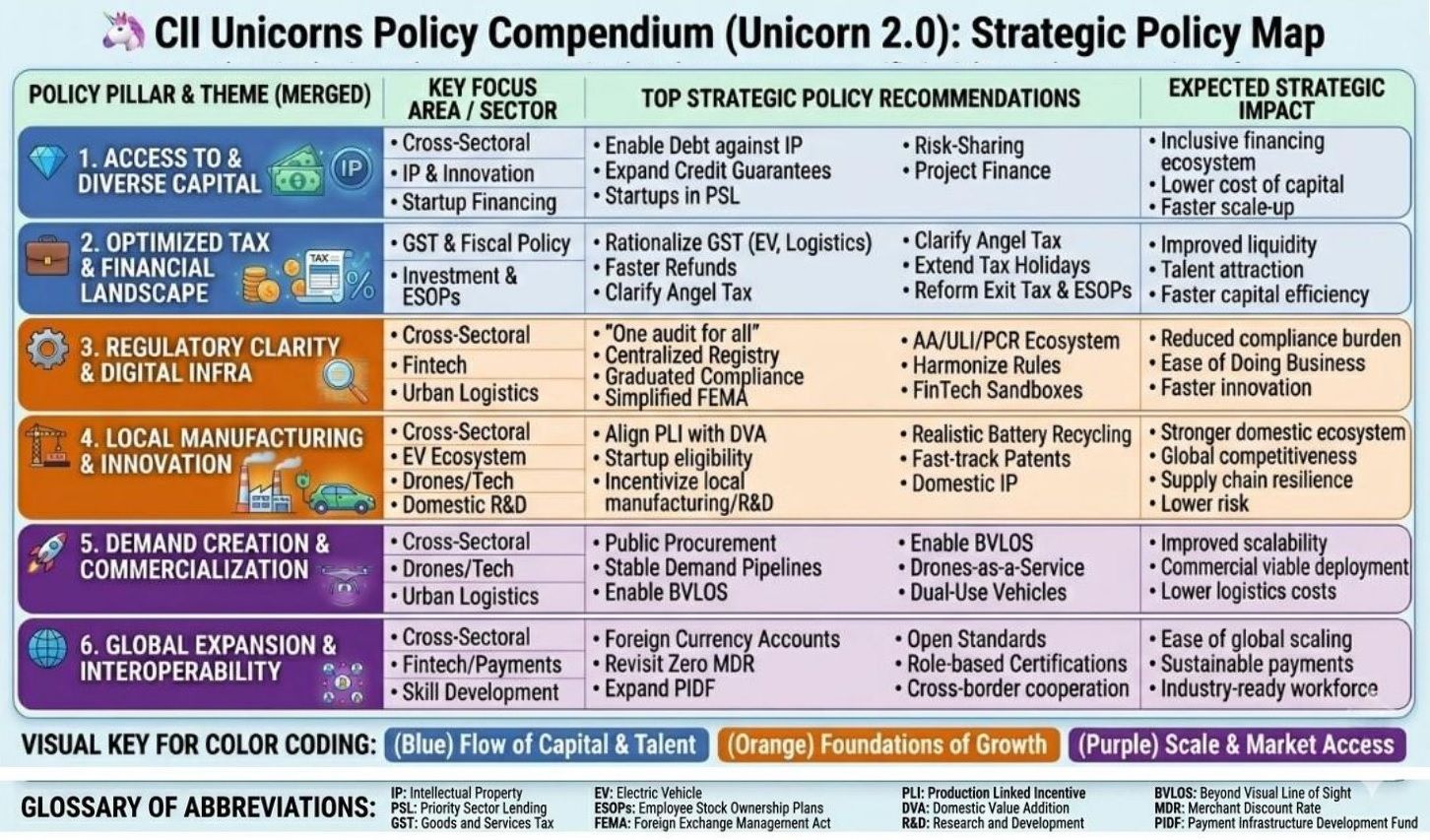
The ‘Policy Compendium for Startups: Journey from Valuation to Value Creation — Unicorn 2.0’, prepared by the Confederation of Indian Industry (CII), captures this broad-based industry consensus, noting that the next phase of India’s startup journey will be defined by value, not valuation.
Over the past decade, the country has emerged as one of the world’s most dynamic innovation hubs, supported by strong digital public infrastructure, a vibrant entrepreneurial base, and a progressive policy environment. Today, India is home to over 120 unicorns with a combined valuation exceeding $390 billion, having collectively raised more than $118 billion in capital, reaffirming its position as the third-largest startup ecosystem globally. “As the ecosystem matures, a clear and necessary shift is underway from valuation-led growth to sustainable value creation,” says the report.
Capital Gaps, Regulatory Frictions
Structural bottlenecks, particularly around financing and regulation, are emerging as the biggest constraints on sustained growth. While equity funding has powered the rise of startups, access to debt and structured finance remains limited, especially for capital-intensive sectors.
“A central theme emerging from the Unicorn Forum’s deliberations is the imperative to shift the narrative and policy focus from valuation-centric growth to value-driven scale. While rapid valuation uplift has been a visible marker of India’s startup success, the next phase of transformation must prioritise deep value creation anchored in sustainable unit economics, operational excellence, innovation depth, and long-term societal impact,” says the report.
Founder insights underscore that enduring enterprise value is created not merely through capital inflows, but through building globally-competitive products, strengthening execution capabilities, and embedding efficiency and accountability into scale-up journeys.
The CII Policy Compendium highlights that multiple and overlapping regulatory frameworks are adding to compliance burdens, creating uncertainty and slowing innovation across sectors.
Sectoral Stress Points
The challenges are particularly acute in high-growth sectors such as electric vehicles, fintech and urban logistics, where policy gaps and financing constraints threaten to derail momentum.
While equity capital has played a critical role in establishing India’s EV ecosystem, access to debt has emerged as a significant bottleneck. EV businesses are inherently capital intensive, with substantial investment required for manufacturing facilities. “This dependence on equity for assets that are traditionally debt-funded increases cost of capital and slows scale up, says the report.
EV companies are typically high growth technology companies inherently investing disproportionately in research and development, with value concentrated in intellectual property.
In urban logistics, regulatory ambiguity is increasing operational risks and costs.
Recent GST 2.0 amendments to the definition of Goods Transport Agency (GTA), particularly the exclusion of e-commerce operators providing local delivery services, have created ambiguity for road transporters using digital platforms for their business. There is a growing risk that standalone transporters using digital mediums for order management and customer interface may be misclassified as LDS and subjected to 18% GST, instead of the 5% applicable to GTA services.
According to the report, “This results in increased litigation risk, higher logistics costs, and unequal tax treatment vis-à-vis traditional transporters.”
Policy Alignment
The CII report makes it clear that without coordinated policy action, India risks losing momentum in its startup-led growth story. Bridging gaps in financing, simplifying regulations, and strengthening infrastructure are seen as critical to unlocking the next wave of innovation.
In the absence of timely policy action, structural constraints across financing, regulation, and infrastructure may continue to limit sectoral scale, delay innovation adoption, and reduce India’s competitiveness in emerging global value chains.
According to Rahul Garg, Chairman of CII Unicorn Forum, “Capital access, regulatory certainty, tax frameworks aligned with innovation cycles, and infrastructure that matches modern business realities, these are the building blocks of the next phase.”
As India advances towards its $5 trillion economy ambition, the report makes it clear that the next generation of winners in the startup ecosystem will be those that convert capital into enduring economic value, not merely headline valuations.
(Cover photo by EmbedSocial on Unsplash)