

New Delhi: Wholesale price inflation surged to a more than three-year high of 3.88% in March, sharply up from 2.13% in February, as the escalating West Asia conflicts triggered a spike in global energy prices and filtered through to domestic costs. This is the sharpest month-on-month increase in WPI since August 2023.
The data underscore the impact of ongoing geopolitical tensions, which have translated into inflationary pressures, particularly through fuel, power, and manufacturing channels.
The latest figures mark the fifth consecutive monthly rise in Wholesale Price Index (WPI)-based inflation, driven largely by a surge in core inflation, even as food price pressures showed signs of easing. The timing of the increase closely aligns with the intensification of the US-Israel-Iran conflict beginning February 28, which disrupted global energy supply chains and pushed crude oil prices dramatically higher.
Global crude prices climbed to $122 per barrel in early March, compared to around $75 before the conflict, representing a sharp escalation that fed directly into domestic inflation. This energy shock was reflected most visibly in the fuel and power category, where inflation rebounded to 1.05% in March from a deflation of -3.78% in February. Within this segment, crude petroleum inflation skyrocketed to 51.57%, reversing a contraction of -1.29% just a month earlier.
The government acknowledged the broad-based nature of the price pressures, stating, “Positive rate of inflation in March 2026 is primarily due to increase in prices of crude petroleum & natural gas, other manufacturing, non-food articles, manufacture of basic metals and food articles, etc.”
Manufactured products, which carry the largest weight in the WPI basket, also contributed significantly to the uptick, with inflation rising to 3.39% from 2.92% in February. The increase reflects higher input costs linked to energy prices, particularly in sectors such as chemicals, metals, textiles, and processed food.
Despite the overall inflationary surge, food prices offered some relief. Inflation in food articles eased to 1.90% from 2.19% in February, while vegetable inflation dropped sharply to 1.45% from 4.73%. On a month-on-month basis, food articles and non-food articles even recorded declines of -0.85% and -0.22%, respectively, indicating some cooling in primary price pressures.
Energy Costs
However, the broader inflation trajectory remains heavily influenced by energy costs. On a monthly basis, WPI rose 1.64% in March, with the primary articles index increasing by 2.28%, driven largely by a 36.16% jump in crude petroleum and natural gas prices. The fuel and power index rose 4.13%, led by an 8.77% increase in mineral oil prices, although a 5.07% decline in electricity prices provided partial offset.
The manufacturing sector recorded a moderate 0.88% monthly increase, with price gains observed across the majority of industrial groups. This indicates that cost pressures are becoming more entrenched across the supply chain, raising concerns about further pass-through into retail inflation.
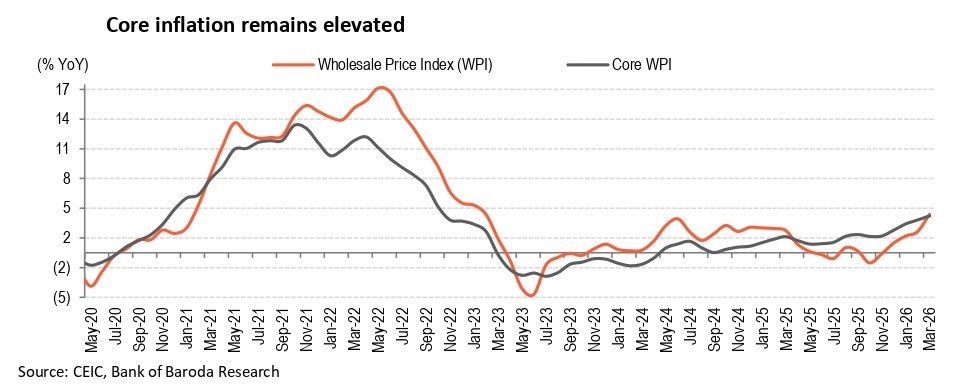
Economists have highlighted the central role of the West Asia conflict in driving these trends. Bank of Baroda economist Sonal Badhan warned of sustained risks, stating, “In April so far, although international oil prices have cooled down from the highs of Mar’26, they still remain significantly elevated compared to last year (50.2% YoY). If a peace deal is not reached soon then a prolonged war can have impact on domestic fuel inflation. Pressure on rupee may also exert some upward pressure.”
In response to the surge in global crude prices, the government moved to cushion consumers by cutting excise duty by ₹10 per litre on petrol and diesel on March 26. The decision aimed to prevent fuel retailers from fully passing on the sharp increase in input costs, as crude prices had risen nearly 75% within a month due to the conflict.
Retail inflation, measured by the Consumer Price Index (CPI), also edged up to 3.4% in March from 3.21% in February, reflecting some spill-over effects into consumer prices. However, it remains relatively contained compared to wholesale inflation.
The Reserve Bank of India has so far maintained a “cautious stance”, keeping the benchmark policy rate unchanged at 5.25% in its latest monetary policy review. While WPI inflation for FY26 averaged just 0.7%, significantly lower than the 2.3% seen in FY25, the recent spike highlights emerging risks from external shocks.
The trajectory of wholesale inflation will likely depend heavily on developments in West Asia. A prolonged conflict could sustain elevated crude prices, exert pressure on the rupee, and intensify inflationary pressures across the economy in the months ahead.
(Cover photo by Stephanie Liao on Unsplash)