

New Delhi: India’s wholesale inflation rose to an 11-month high in February as higher manufacturing and primary commodity prices pushed up factory-gate costs. This comes amid concerns that geopolitical tensions in West Asia, which have severely disrupted global oil supplies, could add further pressure to prices in the coming months.
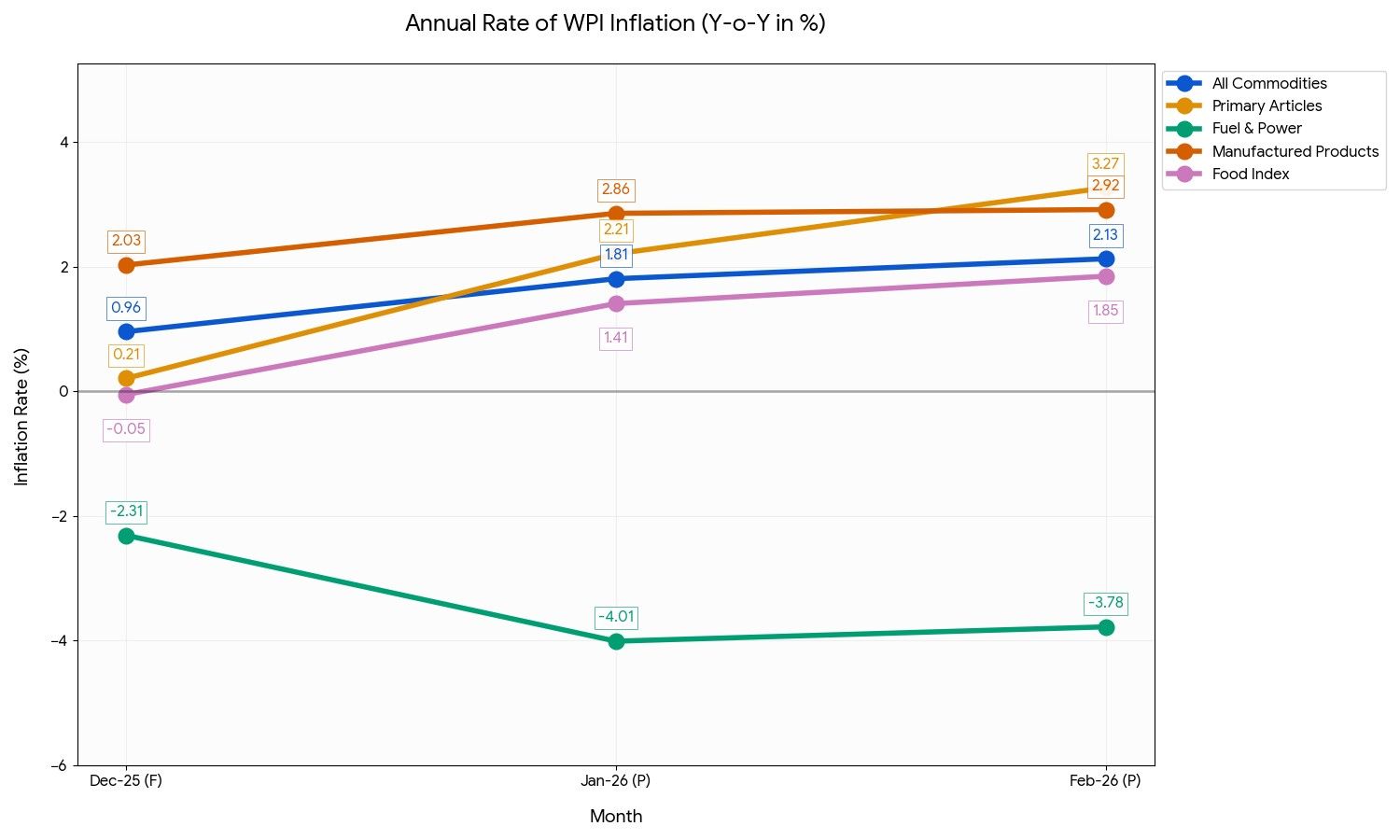
Data released by the Ministry of Commerce and Industry showed inflation based on the Wholesale Price Index (WPI) increased to 2.13% year-on-year in February, compared with 1.81% in January and 0.96% in December, marking the fourth consecutive monthly rise in wholesale prices.
The increase comes at a time when global commodity markets are showing renewed volatility amid the escalating war between Iran and Israel. Any disruption to crude shipments through the Strait of Hormuz — a key corridor for global oil trade — could quickly transmit into domestic fuel and input costs, economists say.
The largest contribution to February’s increase came from manufactured products, which account for more than 64% of the WPI basket. Inflation in this segment rose to 2.92%, slightly higher than 2.86% in January and 2.03% in December, reflecting higher prices in sectors such as other manufacturing, basic metals, textiles and food products.
Economists say the rise in manufacturing inflation suggests that input costs are gradually firming after a prolonged period of relatively subdued wholesale price pressures.
Inflation in primary articles, which include agricultural commodities and minerals, rose sharply to 3.27% in February, up from 2.21% in January and 0.21% in December, indicating stronger price pressures in raw materials. However, on a month-on-month basis the category declined 0.52%, mainly due to lower prices of food articles and minerals. Food article prices fell 1.33%, while mineral prices dropped 1.21% during the month.
In contrast, crude petroleum and natural gas prices increased 4.17%, while non-food articles rose 0.83%, partly offsetting the decline in other primary commodities.
Food inflation under the WPI rose moderately to 1.85% in February, compared with 1.41% in January, even as vegetable inflation eased somewhat during the month.
The fuel and power category continued to act as a drag on overall wholesale inflation. Prices in this segment remained in deflation at -3.78% in February, although the decline was slightly less severe than -4.01% in January.
On a sequential basis, however, the fuel and power index rose 1.17% month-on-month, indicating some recovery in mineral oil prices.
Global Uncertainty
Economists say the trajectory of wholesale inflation could be influenced by global energy markets, which have become increasingly sensitive to geopolitical developments in West Asia.
Nearly one-fifth of global oil trade passes through the Strait of Hormuz, making the route a critical chokepoint for energy supplies. Any disruption to shipments could push crude prices higher, potentially feeding into domestic fuel costs and manufacturing input prices.
Madan Sabnavis, chief economist at Bank of Baroda, has previously noted that rising global commodity prices — particularly metals and energy — can quickly pass through to wholesale prices. The higher cost of manufacturing basic metals and other industrial inputs is feeding into wholesale prices, he said.
For now, however, overall inflation pressures remain relatively moderate. Retail inflation, which is the main indicator tracked by RBI to set interest rates, stood at around 3.2% in February, well within the central bank’s tolerance band.
Still, the steady rise in wholesale inflation over the past four months suggests that underlying price pressures may be gradually building, particularly if global commodity markets remain volatile.