

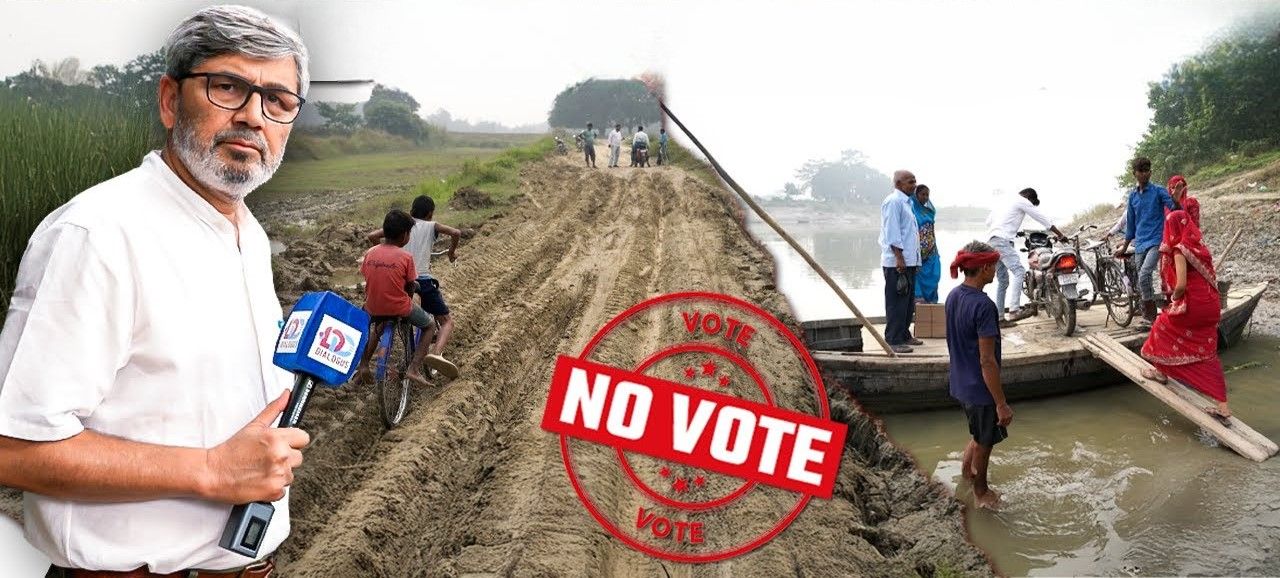
“We will not vote. If Nitish Kumar orders a lathicharge on us, it doesn’t matter. If he pours petrol and burns us alive, it doesn’t matter. We are ready to die for a road. First, we need a road.”
The words hang heavy in the November air — not shouted as a slogan, but spoken with quiet fury. In Thatha village, tucked away behind the Budhi Gandak river in Bihar’s Cheria Barhiarpur assembly constituency, democracy has come to a standstill.
Here, in this island of mud and memory, an entire village has taken an oath: no road, no vote.
With the Dialogus camera rolling, Pawan Kumar heads toward Thatha — but first must cross the Budhi Gandak, a restless river that breathes with the seasons, swelling like anger in the rains and retreating like resignation in winter.
There is no bridge. Only a few wooden boats, patched with tin sheets and prayer, tethered loosely to the bank. Each trip across feels like a wager between life and water.
Beyond the river begins a stretch of earth that refuses to be called a road. Motorcycles groan, sandals sink, children walk barefoot for miles. In the rains, the land turns into a swamp. For weeks, the village is cut off — no school, no doctor, no government, no world.
“We have seen generations born and die without a road,” says Gopal Mahto, 70, his voice as cracked as the soil beneath his feet. “We vote, they promise. We vote again, they forget. This time, we are done.”
Thatha has roughly 3,500 residents — farmers, labourers, fishermen — and yet, by the state’s own administrative map, it sits just four kilometres from the sub-divisional headquarters. “But for us,” says Muneesh Kumar, a young graduate who ferries people on his motorcycle during dry months, “it could be another planet. When the river floods, we might as well not exist.”
When Promises Sink Like Boats
Every election season, the same spectacle repeats. Politicians arrive in white SUVs until the road ends, then switch to boats, then to words. They promise roads, bridges, schools, hospitals. They swear on gods, mothers, and constitutions. And then, like the monsoon water, they recede — leaving behind only slogans and silence.
“We’ve heard every name,” says Muneesh. “Giriraj Singh, our MP, Nitish Kumar, our chief minister — even Modi-ji. But none of them has crossed this river for us.”
The local MLA, villagers say, visits during campaigns and never after. “They come only with cameras,” says Gopal Paswan, the ward panch. “They take photos, show us on TV, and leave. Not one officer from the block or district ever sets foot here.”
This neglect, however, is not accidental — it is systemic. Rural Bihar has long been caught in the gears of administrative apathy. Roads and bridges are built where votes are visible. Villages like Thatha — small, poor, politically fragmented — remain at the periphery of power. Their silence has made them invisible, and now their boycott is their only voice.
“If democracy is a festival, then we are the people outside the gate,” says Muneesh. “We watch the lights, but they never reach us.”
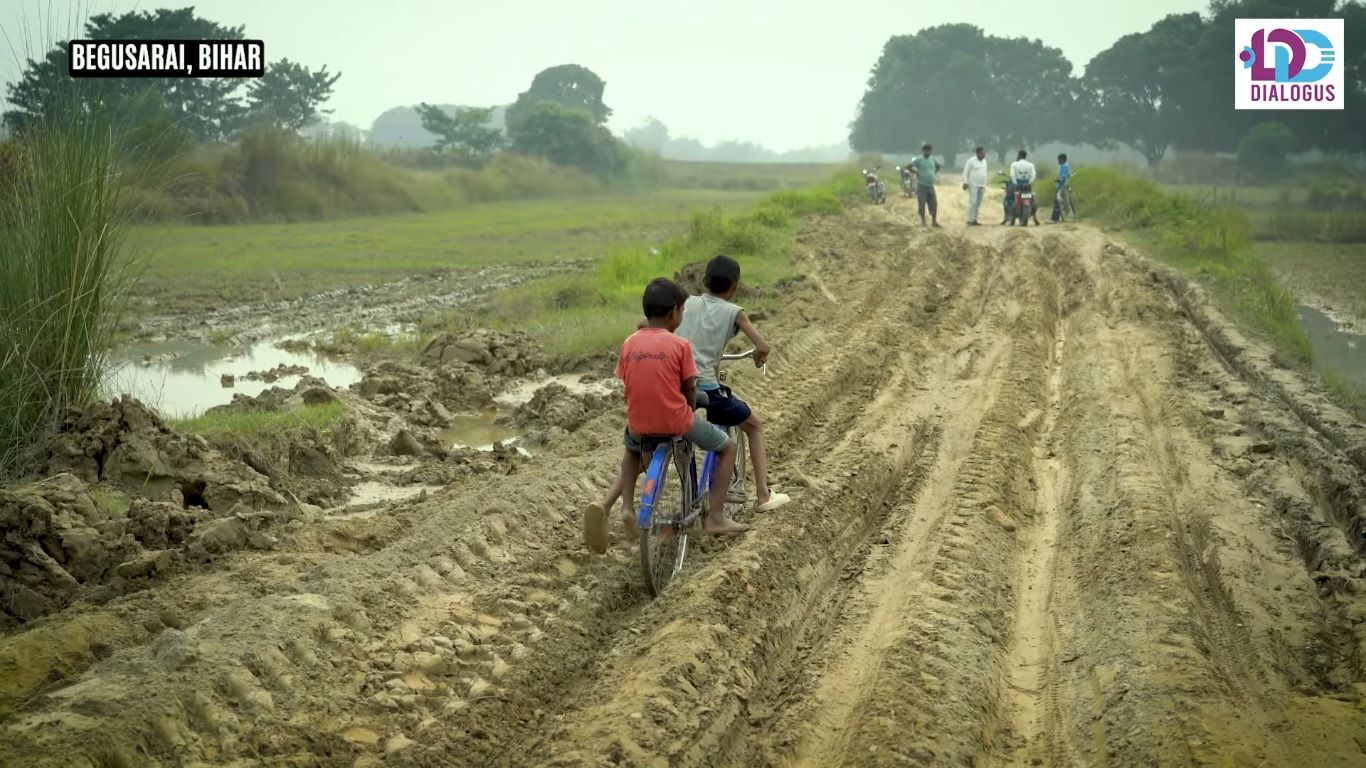
Life in the Blind Spot
The consequences of this neglect are cruelly tangible. Pregnant women cross the river in labour. “I’ve seen deliveries happen on boats,” says a local midwife. “The mother screaming, the baby crying, the boat rocking — and the river flowing as if nothing matters.”
Last monsoon, a teenage boy drowned while trying to cross for his scholarship exam. Two years ago, an old man died of a heart attack before he could reach a hospital. “We carried him on a cot through mud,” recalls Gopal Mahto. “He died before we found a doctor.”
Education, too, has been washed away. Children attend primary school inside the village, but for higher classes, they must cross the river. Many simply drop out. “My son studied till Class 8,” says Sita Devi. “Then he stopped. The boat fare was too much, and I was scared every time he went.”
Drinking water is drawn from hand pumps; the government pipeline works occasionally, spitting out muddy liquid. Electricity flickers in and out, more symbolic than useful. There is no health centre, no government office, no post of a police chowki. The last census team came, filled their forms from the other side of the river, and left.
And yet, amidst this deprivation, liquor flows freely. “Nitish Kumar banned alcohol,” says a young man, laughing bitterly, “but every village brews its own. The police know. They drink it too.” The ban, like the bridge, exists only in official paperwork.
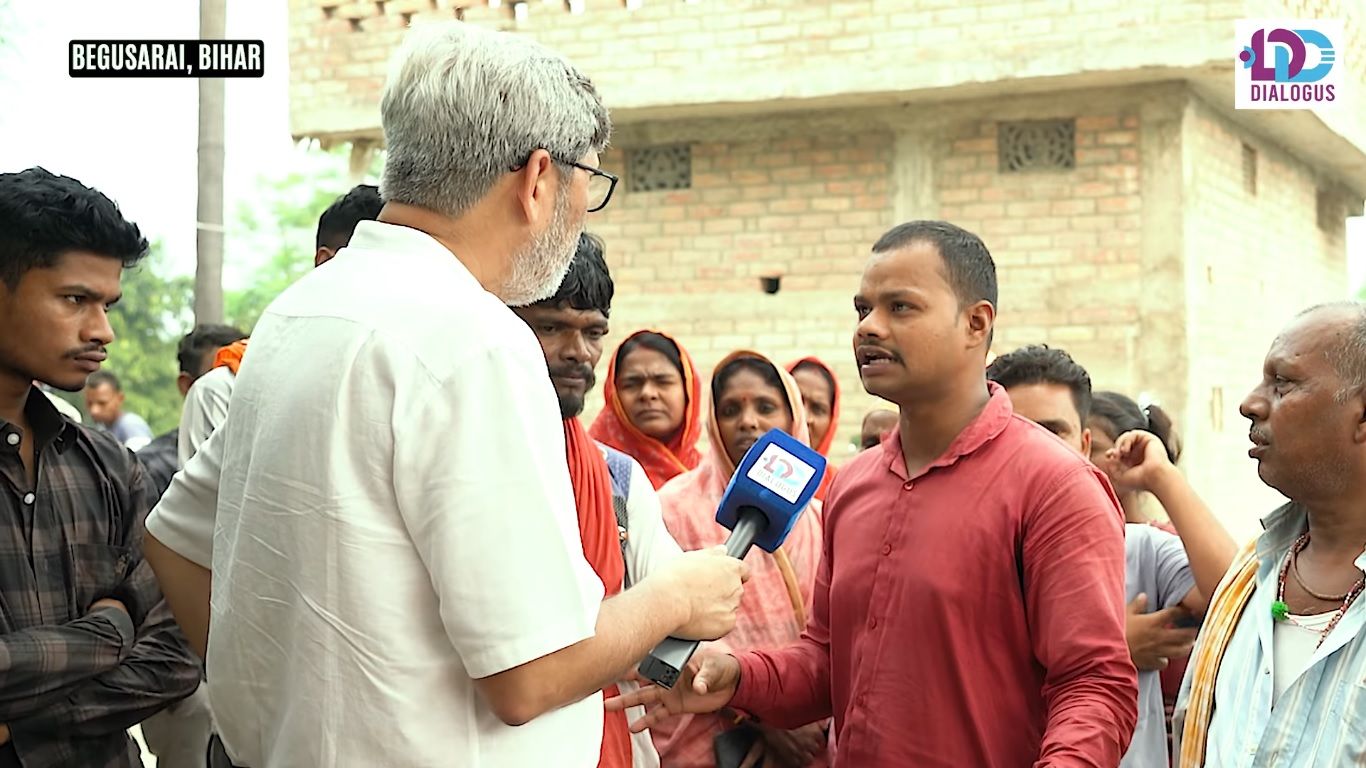
Politics Without Presence
Thatha’s despair is political, but not partisan. The villagers name leaders from all major parties — JD(U), BJP, RJD — and accuse each of abandonment. “Earlier, it was Bhola Babu, who promised to build the road before he died,” says a farmer. “Then Giriraj Singh became MP. We thought he would help. He didn’t. Now we hear about Prashant Kishor — but we’ve only seen him on TV.”
What’s striking is how aware the villagers are of the larger political landscape. They speak of policies, promises, and propaganda with clarity. “Every government talks of vikas (development),” says Muneesh, “but development stops at the riverbank.”
In Bihar’s political arithmetic, Thatha is too small to matter. Constituencies are vast, and politicians prioritize areas with higher population density or caste consolidation. Villages cut off by geography often fall outside campaign maps. For bureaucrats, such places are logistical nightmares — hard to reach, harder to justify budgets for.
A district official, speaking off record, admitted the challenge: “Building a bridge or road there would cost several crores. For one village, it’s politically unrewarding. So the file just keeps moving.”
But what is costlier — building a road or eroding faith in democracy?
For decades, villagers like Gopal Mahto have voted faithfully, believing in the slow promise of change. But the road never came. The bridge never came. Now, for the first time in living memory, faith itself has broken.
“Our forefathers voted, our fathers voted, we voted,” says Mahto. “But we still walk through mud, drink dirty water, and carry our dead across the river. This time, we will not vote. Let them see what it means when people stop believing.”
The decision was taken in a public meeting. Men and women, young and old, stood together and vowed: no one would press the button on the EVM. The polling officials who visit tomorrow will find empty queues and folded arms.
Even the poorest, who depend on ration and pension, say they are ready for consequences. “We are not asking for money,” says Sita Devi. “We are asking for dignity.”
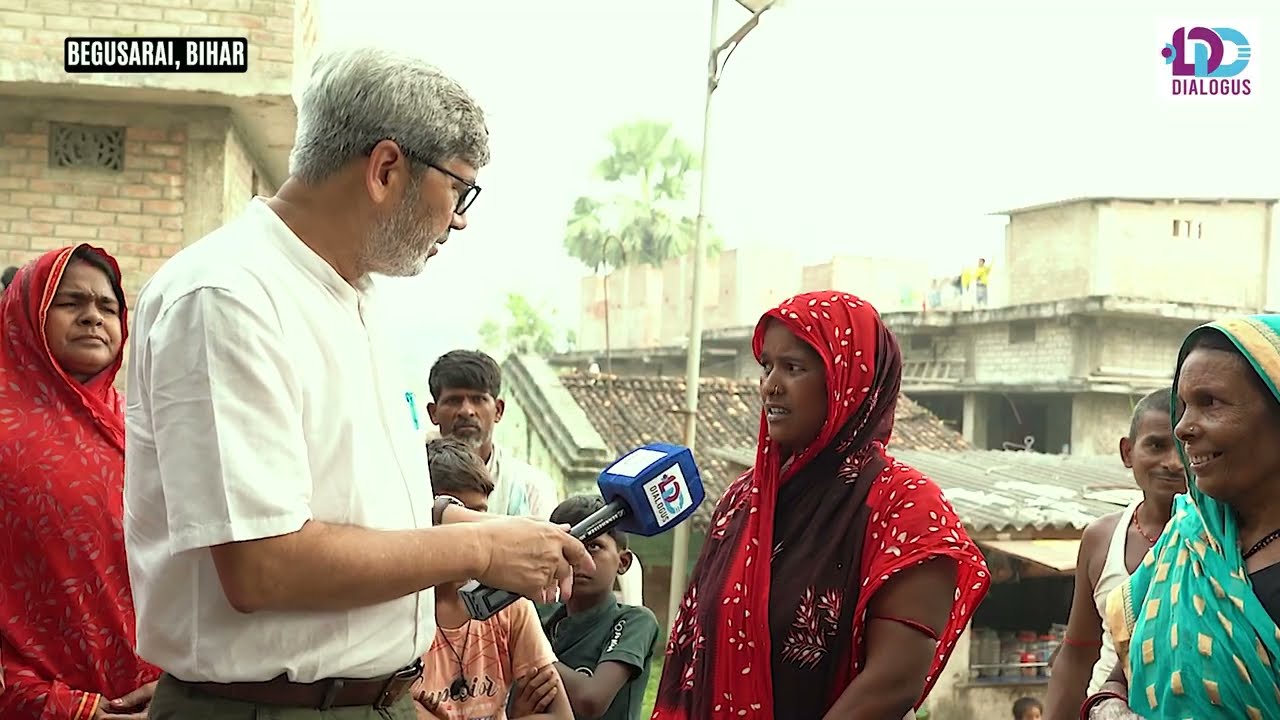
Between Land and Water
As the sun dips behind the horizon, the Budhi Gandak glows orange. Children play by the bank, their laughter swallowed by the wind. On the far side, the world continues — cars, offices, electricity, roads. On this side, Thatha prepares for another night of isolation.
The villagers light small lamps in their courtyards — not for Diwali, but to keep away snakes. The only sound is the river, eternal and indifferent.
For them, the coming election is not a festival of democracy but a reminder of distance. “We are citizens only on paper,” says Muneesh. “The government remembers us for votes, forgets us for everything else.”
In a nation that celebrates highways, expressways, and bullet trains, Thatha stands as a quiet indictment — a place where people are ready to die, not for ideology or religion, but for a four-kilometre road.
Their words may never reach the Chief Minister’s Office or the Prime Minister’s speeches, but they carry the moral weight of truth. “If democracy means equality,” says Gopal Paswan, “then why must we beg for a road while others fly in airplanes?”
No one in Thatha asks for luxury — only a path that connects them to hospitals, schools, and hope. They are not anti-government or anti-nation; they are simply exhausted.
“We don’t hate anyone,” says Muneesh softly. “We just want to live like humans.”
As night settles over the river, the boats sway gently — waiting for another day, another crossing. The lamps flicker in the wind. And in the silence between two worlds, a forgotten village keeps its promise to itself:
no road, no vote.