

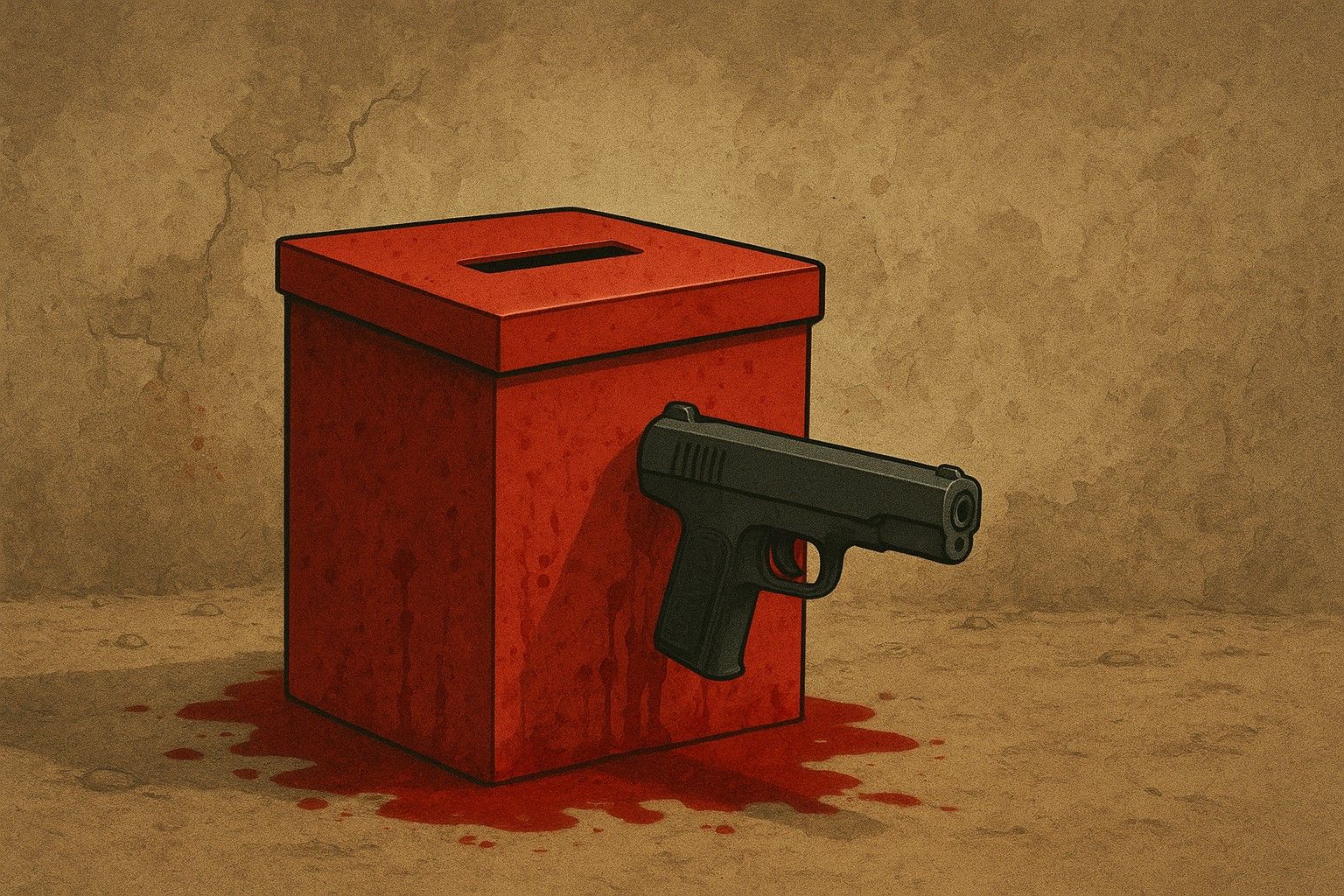
Patna: The murder of Dular Chand Yadav in Mokama, amid Bihar’s ongoing electoral season, has torn through the ruling alliance’s central political narrative of “good governance”. What makes this killing particularly emblematic of Bihar’s chronic governance contradictions is that it unfolded on the very day Prime Minister Narendra Modi warned voters against the “return of Jungle Raj”. By evening, that warning seemed less prophetic and more ironic. As violence erupted in Mokama, Bihar was once again reminded that its political order remains deeply entangled with the forces of caste and crime.
“This is not just one murder, it’s the death of Nitish Kumar’s political claim that Bihar has moved beyond Jungle Raj,” said senior journalist Shiv Pujan Jha on the Dialogus talk show, laying bare the uncomfortable truths Bihar’s leadership prefers to sidestep.
Another senior journalist Amitabh Bhushan, pushing the conversation further, added that the incident “shatters the myth of control — when your own candidate’s name surfaces in a daylight killing, how can you still speak of zero tolerance?”
At the centre of this crisis is Anant Singh, the JDU candidate from Mokama and a controversial strongman with a long history of crimes. Singh’s supporters deny any involvement, but the family of the slain Dular Chand Yadav has accused him directly of orchestrating the killing. Singh, in turn, has blamed his old rival, Suraj Bhan Singh, an RJD-linked figure also known for his muscle power. The web of accusation and counter-accusation has turned the crime into a political minefield, where justice and narrative both hang in balance.
Both Jha and Bhushan emphasized the symbolic weight of Mokama. “This is not just a constituency,” said Bhushan, “it’s a metaphor for Bihar’s political DNA — where caste, power, and violence overlap seamlessly.”
Pressure Cooker Of Caste Rivalry
Jha pointed out that the constituency’s complex demography — two Bhumihar candidates and one Dhanuk — made it a pressure cooker of caste rivalry. The victim, being a Yadav, adds another volatile element. In his words, “Each bullet fired in Mokama ricochets through Bihar’s caste map.”
Politically, the incident could not have come at a worse time for Chief Minister Nitish Kumar. The Dialogus panel noted that his long-standing “sushasan” (good governance) identity is now under an unprecedented strain. Nitish faces a political paradox: if he shields Anant Singh, he legitimizes the very lawlessness he once vowed to end; if he acts against him, he risks alienating his own political machinery in the region. The Dialogus hosts described this as “Nitish’s tightrope moment — between moral authority and political survival.”
On the murder’s electoral implications, the analysts suggested that the killing could reconfigure caste alignments, particularly among upper-caste Bhumihars and OBC groups, threatening to destabilize the NDA’s vote arithmetic. “The murder has cracked the caste compact Nitish relies on,” Jha argued. “Even if the investigation proceeds, the perception damage is irreversible.”
Adding to the gravity of the situation, Bihar has witnessed two other killings — one in Siwan and another in Arrah — within the same 48-hour span. These have been linked to a larger resurgence of political violence in the state. “This is the re-emergence of the ecosystem we thought had ended,” said Bhushan. “From criminal candidates to caste provocations, Bihar’s political bloodstream is showing the same toxins that once defined Jungle Raj.”
Opposition Careful
The opposition, particularly the RJD and Mahagathbandhan, has seized on the opportunity but with caution. Instead of using overt caste rhetoric, they have framed the killing as evidence of Nitish’s administrative failure. This restraint seems strategic — an attempt to appeal to urban and neutral voters while allowing social media voices within caste networks to do the polarization quietly. As Jha summarized, “In Bihar today, caste doesn’t need to shout; it whispers, and everyone still hears it.”
The Mokama murder has therefore become more than a criminal case — it’s a referendum on the political project Nitish Kumar built his legacy on. The incident’s real consequence lies in narrative collapse. “When the chief minister’s promise of law and order is mocked by his own candidate’s alleged actions, the moral distance between Jungle Raj and Sushasan collapses into a single line — a line drawn in blood,” said Bhushan.
For Bihar, Mokama is once again a mirror — reflecting not just the persistence of caste violence, but also the limits of reformist politics in a state where power and impunity have long walked hand in hand. Whether the investigation brings justice or fades into political compromise will determine not just the fate of one murder case, but the credibility of Bihar’s democracy itself.