


New Delhi: The United States is increasingly closing its doors to international students, an approach that risks undermining its own long-term economic strength. Student visa refusal rates have surged to a decade-high 35%, with pronounced disparities that disproportionately exclude applicants from regions such as Africa and South Asia.
A recent study by Shorelight, titled ‘Beyond the Interview: A Decade of Student Visa Denials and What Comes Next, highlights this subtle yet significant shift in the global flow of academic talent, due to the US stance. The report shows that F-1 visa refusal rates have risen steadily over the past decade, reaching 35% in 2025 — up from 31% in 2024 and 23% in 2015.
What may initially appear as routine administrative tightening instead points to a deeper structural transformation. Economists and policy analysts argue that the persistence of high refusal rates, even after post-pandemic recovery, reflects systemic issues within the visa adjudication process.
More concerning is the emergence of what Shorelight describes as a “high-refusal tier”, which disproportionately impacts students from the Global South. Increasingly, access to US education appears to hinge less on merit and more on geographic origin, a distortion that economists warn undermines both fairness and the efficient global distribution of talent.
Shorelight is an educational partner that helps international students apply to enroll in US universities. It provides specialized F-1 student visa guidance
Uneven Geography of Exclusion
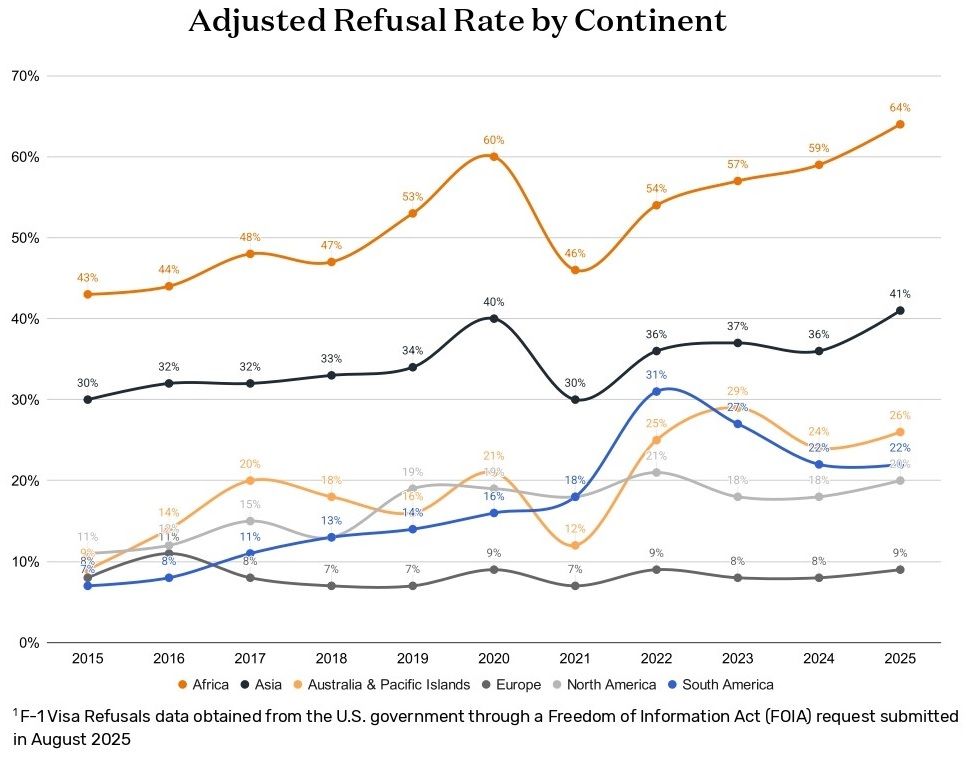
The Shorelight report underscores stark regional disparities. Africa remains the hardest hit, with refusal rates rising from 43% in 2015 to 64% in 2025. Asia has seen a similar, if less dramatic, climb — from 30% to 41% over the same period.
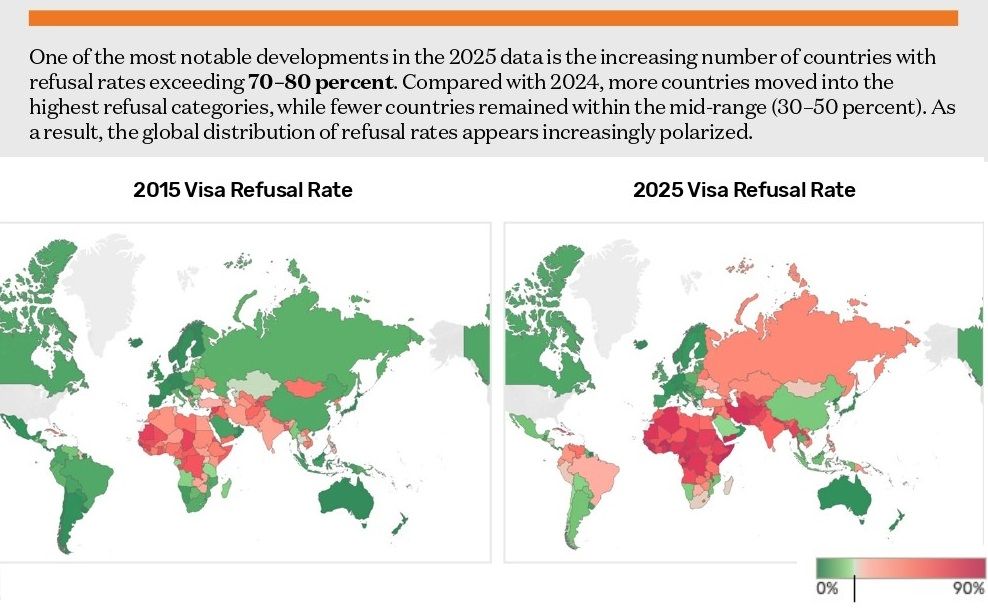
The escalation in South Asia is particularly striking. India’s refusal rate surged from 36% in 2023 to 61% in 2025, while Nepal jumped to 81% and Bangladesh to 73%. These are not marginal shifts; they represent a structural tightening in key talent pipelines.
In Africa, the situation is even more severe. Countries such as Somalia (91%), Sierra Leone (90%), and Burkina Faso (88%) now face near-systemic exclusion. Meanwhile, Western Europe continues to enjoy refusal rates in the low single digits, often between 1% and 5%.
Economists interpret this divergence as evidence of an increasingly fragmented visa regime. Rather than a uniform policy framework, the system appears to operate through localized clusters of high refusal rates. This creates unpredictability and undermines the principle of merit-based selection, introducing inefficiencies into what should be a globally competitive talent market.
Economic Cost of Turning Talent Away
The economic implications are already measurable… and severe. According to the Shorelight report, declining international student inflows resulted in approximately $1.7 billion in lost tuition revenue. With updated data showing a 36% drop in visa issuances, the estimated annual loss rises to nearly $3 billion.
But the impact extends far beyond university finances. Economists highlight the multiplier effect of having international students in universities: their spending supports housing, retail, transport, and local services. A contraction in student inflows ripples across entire regional economies.
More critically, the long-term costs may outweigh immediate losses. International students are a key input into the US innovation ecosystem, contributing to research output, startup formation, and workforce development. A sustained decline in this pipeline risks weakening productivity growth and technological leadership.
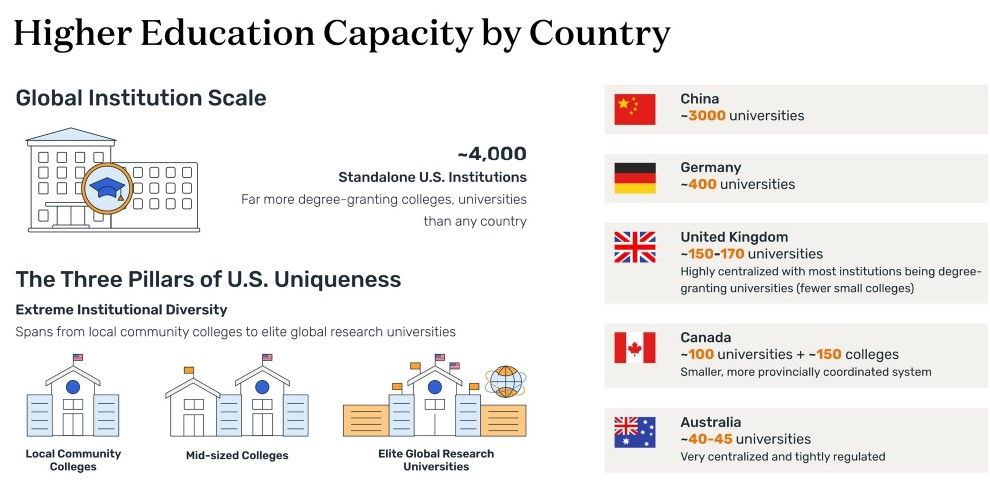
The Shorelight report frames this as a “self-imposed talent embargo”, a policy misalignment in which the US, despite having the institutional capacity to absorb global demand, is actively ceding ground to competitors.
What Comes Next
The forward-looking assessment is unambiguous: without reform, the US risks structural decline in its global education and talent leadership.
Demographic trends amplify the urgency. By 2030, Africa will account for 42% of the world’s youth population, and by 2050, sub-Saharan Africa’s tertiary student population is expected to reach 90 million. Competitor nations such as France and China are already positioning themselves to capture this surge.
Economists argue that current US policy is fundamentally misaligned with these realities. While global demand for education is expanding, the US is tightening access, creating a widening gap between opportunity and policy.
The Shorelight report outlines a clear reform pathway. Expanding “dual intent” for student visas would align policy with actual student aspirations, reducing arbitrary denials. Codifying optional practical training (OPT) would strengthen the link between education and employment, a key decision factor for over 70% of students. Greater transparency in visa decisions would also improve system accountability and predictability.
The broader recommendation is strategic: the US must shift from a defensive posture to a competitive one. In a global race for talent, economists warn, reputation alone is no longer enough. Policy clarity, access, and opportunity will determine the winners.
What is increasingly evident, however, is that delay carries its own cost. The longer high refusal rates persist, the more institutional trust erodes among prospective students and sending countries. Education agents, universities and governments recalibrate quickly; once alternative destinations become entrenched, reversing those flows becomes significantly harder. In that sense, the current moment is not merely a policy challenge but a strategic inflection point.
Unless corrective action is taken soon, the United States risks not just losing students in the short term, but permanently reshaping global education pathways away from its shores, say the authors of the Shorelight report.