


New Delhi: The tectonic plates of global higher education are getting rearranged. While the historical strongholds of the United States and the United Kingdom maintain a formidable presence at the apex of academic achievement, the 16th edition of the QS World University Rankings by Subject reveals a landscape defined by rapid diversification and an intensifying “knowledge arms race” across Asia and the Global South.
Released by global higher education analysts QS Quacquarelli Symonds, this year’s data — the most comprehensive to date — compares more than 21,000 academic offerings from over 1,900 institutions. Spanning 100 higher education systems and 55 specific disciplines, the results provide a granular look at where the world’s intellectual capital is being forged.
“The rankings highlight a global higher education landscape that is becoming both more competitive and more specialised," said Ben Sowter, QS Senior Vice President. “While traditional leaders in the US, UK and parts of Europe continue to dominate many disciplines, we are seeing significant momentum from systems across Asia, the Middle East and Latin America.”
Eastward Tilt
This momentum is best exemplified by the ‘Eastward Tilt’ of the academic world. Singapore stands as the primary avatar for this shift. With 42 entries placing in the global top-10 — the third-highest total worldwide — it has been identified as the world’s most improved system. This is no longer just about the National University of Singapore (NUS); the city-state has created an ecosystem where nearly every ranked programme is a global leader.
China’s trajectory is equally aggressive. The country has doubled its top-10 entries since 2021, showcasing a strategic dominance in both traditional and niche fields. While it continues to challenge for the crown in engineering and technology, it has also claimed leadership in classics and ancient history, where Fudan University and Peking University rank second and third respectively.
Targeted Excellence
A defining trend of the 2026 data is that being a “comprehensive” university is no longer the only path to global prestige. Instead, institutions that focus on singular, high-impact niches are seeing disproportionate gains.
In Australia, the focus on sports-related subjects has yielded world-leading results, with the University of Queensland and the University of Sydney taking the second and third spots globally. In the Middle East, Saudi Arabia’s KFUPM remains the region’s highest-ranked institution by maintaining a top-five global niche in petroleum engineering.
Europe follows a similar pattern of targeted excellence. Switzerland leads the continent with 12 top-five subject entries, with ETH Zurich holding three world number-one positions. In France, the focus remains on elite social sciences, with Sciences Po ranking 3rd in politics and INSEAD taking 4th in business and management studies.
Resilience in Traditional Core
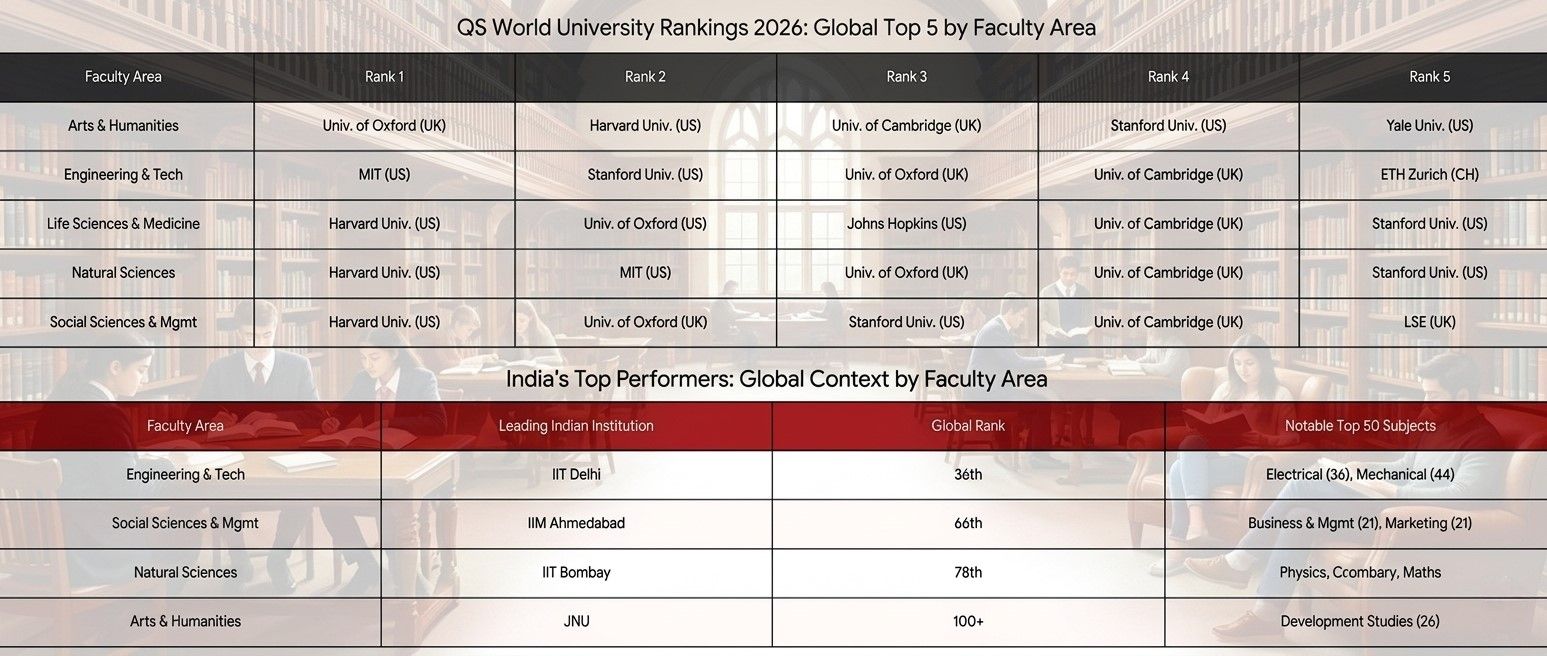
Despite the surge from emerging markets, the ‘Old Guard’ of the West remains a dominant force, albeit a more refined one. The United States continues to be the global hegemon in terms of absolute volume, leading the world with 37 top-ranked subjects and 88 top-three placements. Institutions like Harvard, MIT, and Juilliard continue to set the gold standard in medicine, engineering, and performing arts.
The United Kingdom has also seen a remarkable resurgence, with 40% of its entries rising in the tables this year. It remains a powerhouse of “soft power”, recording 15 first-place positions and 63 top-three placements globally.
In Continental Europe, Italy has strengthened its presence in the top-10, particularly in the humanities, where the Sapienza University of Rome holds the number-one spot globally for classics and ancient history. Spain has also hit a record high, with 10 subjects achieving their best-ever ranks, led by the Complutense University of Madrid in dentistry. Portugal has emerged as Europe’s most improved system, growing by 12% in its overall performance.
The India Story
Perhaps the most striking narrative of the 2026 edition is the unprecedented ascent of India. Recording an improvement rate of 44% — the highest among all major education systems with 10 or more ranked institutions — India has effectively doubled its top-50 placements since 2024. The nation now boasts 27 entries in this elite bracket, spread across 12 distinct institutions.
This surge is no longer confined to the traditional bastions of engineering. While the Indian School of Mines (ISM) University Dhanbad continues to lead with world-class technical output, IIM Ahmedabad has broken new ground, marking India’s debut in the global marketing rankings and securing a high-standing position in business and management. This diversification suggests that the “India Story” is evolving from a supplier of technical labour to a hub of strategic and managerial leadership.
The data reveals a consistent trend: Indian institutions are translating high-velocity domestic growth into academic prestige. By focusing on niche specialisations, from mineral engineering to data science, India is carving out a significant share of global academic influence, moving closer to the $500 billion trade-and-services target that increasingly relies on a high-skill knowledge economy.
Future Horizons
The 2026 rankings underscore that research and reputation are increasingly global ventures. Canada’s University of British Columbia now holds the most entries globally, reflecting a massive breadth of academic output, while McGill University has reclaimed its status as a world leader in mineral and mining engineering.
In the Southern Hemisphere, South Africa continues to anchor the continent’s academic reputation. The University of Cape Town and the University of Witwatersrand lead the African rankings, proving that high-impact research can thrive despite regional economic headwinds. Similarly, the Universidade de São Paulo remains the standard-bearer for Latin America, even as Ecuador records the region’s most rapid rate of improvement.
For students and policymakers, the message is clear: the map of excellence is no longer fixed. The traditional dominance of the North Atlantic is being complemented by a more multipolar world of learning. The prestige of a degree is now measured by specific research impact and the ability to lead in specialized, high-demand disciplines.
(Cover photo by Becca Tapert on Unsplash)