
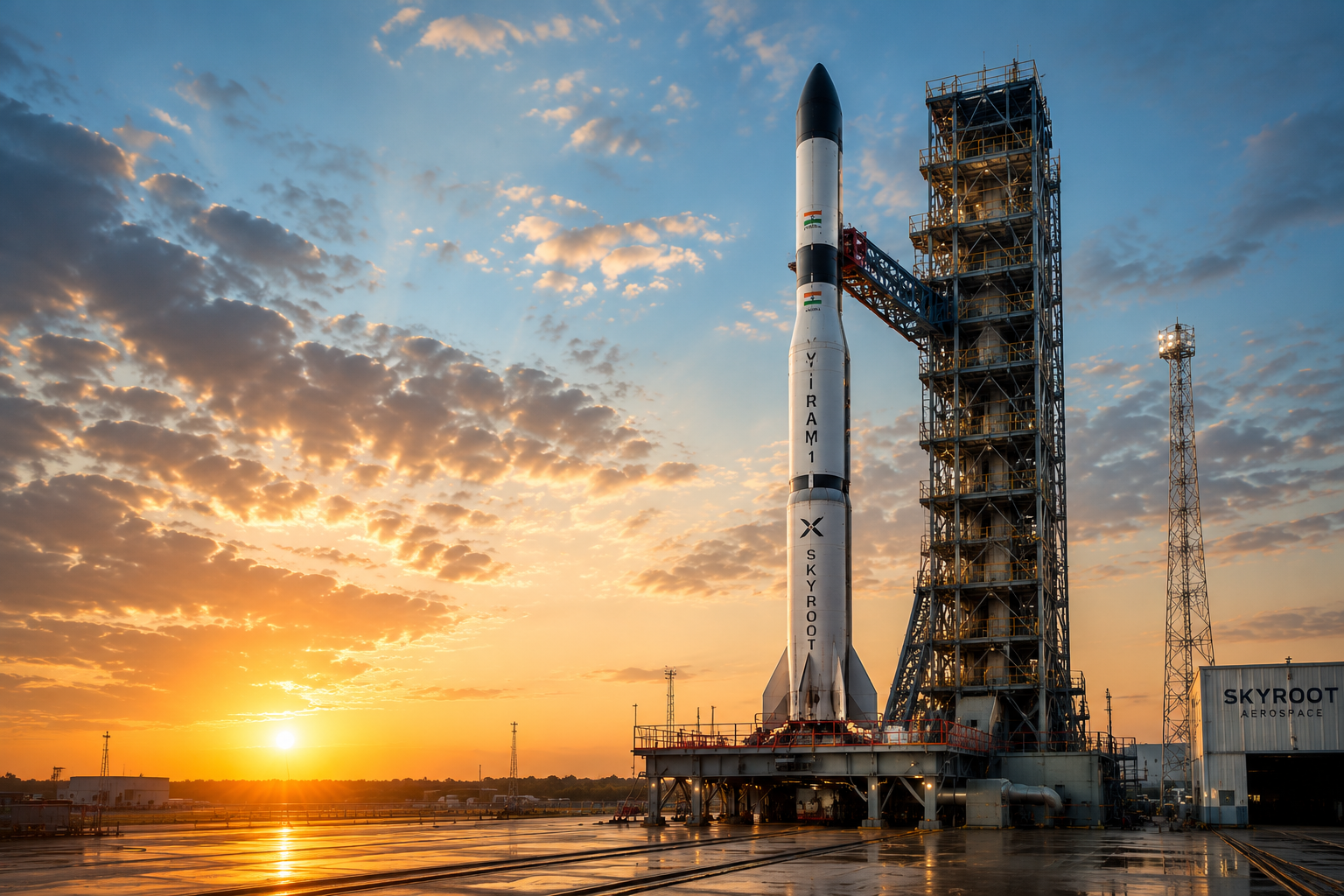

On the eve of what is being hailed as a watershed moment for India’s aerospace industry, Skyroot Aerospace is prepared to launch Vikram-1, the nation’s first privately developed orbital rocket. Scheduled for lift-off tomorrow, July 18, 2026, the mission represents a significant leap from sub-orbital demonstrations to full orbital capabilities, signaling India's readiness to compete in the global commercial satellite launch market.
Breaking the Orbital Barrier
The Vikram-1 mission is more than a technical test; it is a proof of concept for India’s burgeoning private space sector. The launch is finalized for July 18, following months of rigorous preparations. While India has a long history of successful state-led missions through the Indian Space Research Organisation (ISRO), Vikram-1 stands as the first orbital vehicle designed and built entirely by a private entity.
Details on the specific payload and the exact coordinates of the launch site have not been reported in current press releases, but the mission is categorized as a critical test flight. The transition to orbital launches is a complex engineering challenge, requiring the rocket to achieve the precise velocity and altitude necessary to place a satellite into a stable path around Earth. Success tomorrow would validate the years of research and development conducted by the Hyderabad-based startup.
Skyroot’s Strategic Roadmap
Skyroot Aerospace has positioned itself as a leader among a new wave of Indian space-tech startups. The Vikram-1 rocket is the centerpiece of the company’s strategy to provide cost-effective, on-demand launch services for small satellites. The "Vikram" series is named after Dr. Vikram Sarabhai, the father of the Indian space program, underscoring the continuity between India's traditional space heritage and its new commercial future.
This upcoming flight is expected to test the rocket’s multi-stage propulsion systems and its navigation software in a real-world orbital environment. By achieving orbit, Skyroot aims to prove that private enterprises can handle the end-to-end requirements of space missions, from design to execution. This capability is essential for attracting international clients who are increasingly looking for reliable alternatives to traditional government-run launch programs.
A New Era for Indian Enterprise
The social and economic implications of this launch are substantial. This maiden launch is a "historic development" that could catalyze further investment in the domestic aerospace ecosystem. By moving beyond government-funded projects, India is opening doors for private capital to drive innovation in high-tech manufacturing and satellite communications.
The country is "preparing for the test-flight" with high expectations, as the success of Vikram-1 could lower the barriers to entry for other domestic players. This shift is expected to foster a more competitive environment, potentially reducing costs for international clients looking to deploy small satellite constellations in low Earth orbit. As the countdown continues, the mission serves as a bold statement of intent for a nation seeking to capture a larger share of the multi-billion dollar global space economy.