


New Delhi: The global airline industry recorded a slight improvement in accident rates in 2025 even as fatalities rose sharply, highlighting both the “extraordinary safety” of modern aviation and the “disproportionate impact” of a handful of catastrophic events, according to the 2025 Annual Safety Report released by the International Air Transport Association (IATA).
The report found that the overall accident rate declined modestly from 2024 levels and remained near the five-year average, but eight fatal crashes pushed total onboard deaths to their highest level since 2018. Two major disasters alone accounted for more than three-quarters of all fatalities, underscoring how rare events can dramatically affect global safety statistics in an industry that now carries nearly five billion passengers a year.
Commercial aviation recorded 51 accidents across 38.7 million flights in 2025, producing an accident rate of 1.32 per million flights, or roughly one accident for every 759,646 flights. That figure represented an improvement from 2024, when the rate stood at 1.42 accidents per million flights, but it remained slightly above the five-year average rate of 1.27 accidents per million flights recorded between 2021 and 2025.
Despite the modest improvement in accident frequency, the severity of outcomes increased. Eight of the accidents in 2025 were fatal, compared with seven the previous year and a five-year average of six. Those crashes resulted in 394 onboard fatalities worldwide, up from 244 in 2024 and well above the recent five-year average of 198.
The aviation industry’s fatality risk — a measure estimating the probability of death per flight — rose to 0.17 per million flights in 2025, nearly three times higher than the 0.06 recorded in 2024 and above the five-year average of 0.12.
According to the IATA report, the increase was driven largely by two catastrophic events that dominated last year’s fatality statistics. One of those disasters involved Air India Flight 171, which crashed near Ahmedabad on June 12, killing 241 people on board and 19 people on the ground. The accident was the deadliest commercial aviation disaster in nearly 11 years and surpassed the fatality totals of any crash since the disappearance of Malaysia Airlines Flight MH370 in 2014, which carried 239 people.
Another major accident occurred on January 29 near Ronald Reagan Washington National Airport in Washington, D.C., when a mid-air collision involving PSA Airlines Flight 5342 resulted in 64 fatalities. Together, the two accidents accounted for more than 77% of the year’s total loss of life on commercial aircraft.
“These events remain statistically rare relative to the vast number of flights operated each year,” said Willie Walsh, who leads the global airline trade association. “Flying is the safest form of long-distance travel. Accidents are extremely rare and each one reminds us to be even more focused on continuous improvement through global standards and collaboration guided by safety data,” he added.
The aviation industry’s long-term safety trend remains strongly positive. The accident rate has fallen steadily over the past two decades, declining from 3.72 accidents per million flights in 2005 to 1.32 in 2025. At the same time, the five-year rolling average for fatal accidents has improved significantly. Between 2012 and 2016 the industry experienced one fatal accident for roughly every 3.5 million flights. In the most recent five-year period, between 2021 and 2025, the rate improved to one fatal accident for every 5.6 million flights. These statistics illustrate how even a single crash can noticeably shift global safety data in a year when nearly 40 million flights operate worldwide.
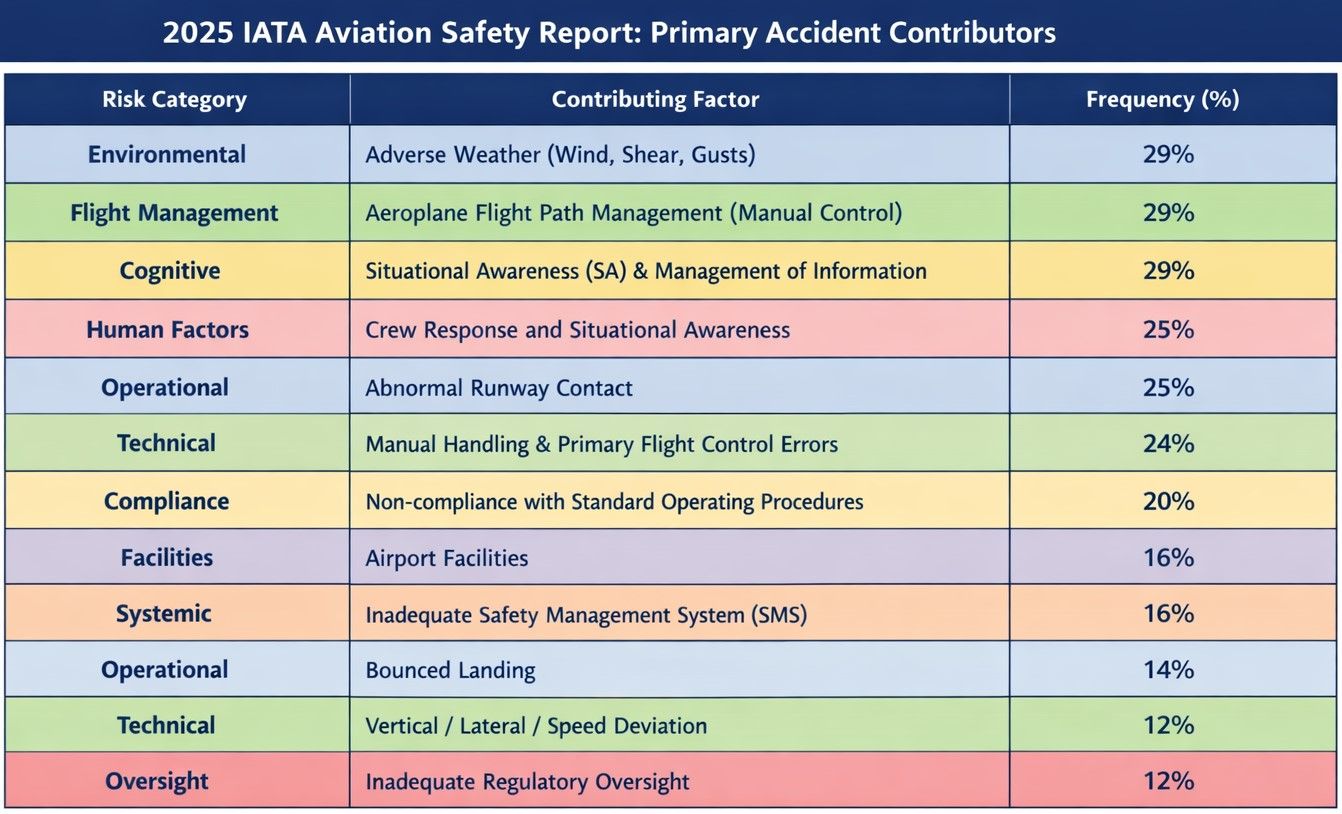
Operationally, the most common types of accidents in 2025 involved tail strikes, landing gear events, runway excursions and ground damage — incidents typically associated with take-off, landing and airport operations. The IATA report noted that there were no loss-of-control-in-flight accidents during the year, only the second time that has occurred in modern aviation data, following a similar outcome in 2020. Loss-of-control incidents have historically been among the deadliest types of aviation accidents.
The findings reinforce the importance of operational discipline and airport infrastructure in maintaining safety margins during the most demanding phases of flight. In several accidents reviewed in the report, investigators found that rigid structures or obstacles near runways increased the severity of crashes that might otherwise have been survivable.
Airport facilities were linked to about 16% of accidents recorded in 2025, highlighting concerns about runway safety areas, obstacles within protected zones, and hazards such as contaminated runway surfaces, poor lighting or inadequate markings.
“Airport infrastructure and runway environments play a critical role in accident outcomes,” Walsh said. “All airports and regulators should continuously review runway safety areas and structures near runways for compliance with global safety standards,” he added.
Regional Variations
Regional safety performance varied widely. Airlines based in Africa recorded the highest accident rate, with seven accidents producing a rate of 7.86 per million flights — though a significant improvement from the previous year but still above the global average. The region also saw an increase in fatality risk after recording none in 2024.
In contrast, airlines in Asia-Pacific improved their accident rate from 1.08 to 0.91 per million flights, while maintaining roughly stable fatality risk levels. Europe recorded 11 accidents and an accident rate of 1.30 per million flights, slightly above the region’s five-year average but with no fatal accidents reported during the year.
North America reported the largest number of accidents, with 16 events producing an accident rate of 1.68 per million flights — higher than both the previous year and the region’s five-year average. The Middle East and North Africa region recorded just one accident, a runway excursion, and continued a streak without fatal accidents that has lasted since 2019.
The report also highlighted significant differences between airlines participating in the industry’s safety audit programs and those that do not. Airlines listed on the registry of the IATA Operational Safety Audit recorded an accident rate of 0.98 per million flights, less than half the 2.55 rate recorded among carriers not participating in the program.
More broadly, airlines that are IATA members reported an accident rate of 0.72 per million flights, compared with 3.09 for non-member airlines.
Beyond accidents, the report raised growing concerns about interference with satellite navigation signals used by aircraft. Incidents involving disruption of the Global Navigation Satellite System (GNSS) have risen sharply in recent years, with reports of signal jamming increasing by 67% since 2023 and cases of GPS spoofing — in which false signals mislead navigation systems — rising by 193%.
Although modern aircraft have multiple redundant navigation systems designed to maintain safety even during interference, aviation authorities warn that the trend could pose a serious operational challenge if left unaddressed.
“Airlines rely on GNSS for safe and efficient flight operations,” Walsh said. “Immediate steps by governments and air navigation service providers are needed to improve situational awareness and enhance mitigation tools for pilots,” he added.
Another issue raised in the report concerns the timeliness and transparency of accident investigations. Under international rules established in Annex 13 of the International Civil Aviation Organization’s Chicago Convention, governments are responsible for investigating accidents and publishing final reports so that safety lessons can be shared across the industry. Yet an analysis of accidents between 2019 and 2023 found that only 63% of investigation reports were completed in accordance with those international obligations. Completion rates varied widely by region, ranging from 81% in the Commonwealth of Independent States to just 19% in Africa.
Despite the challenges highlighted in the report, aviation safety experts emphasize that the scale of global air travel makes the industry’s safety record extraordinary. In 2025, the world’s airlines transported just under five billion passengers across 38.7 million flights, meaning that accidents occurred in only a tiny fraction of journeys.
For regulators and airlines, however, the goal remains unchanged. As Walsh put it while presenting the 2025 Annual Safety Report, “Every accident is one too many. The objective for aviation remains zero accidents and zero fatalities.”
(Cover photo by PickPik)