

New Delhi: India’s oil trade deficit is poised to widen sharply again in 2026-27 financial year, reviving concerns over the country’s external balance at a time when global crude prices are climbing and exports of refined petroleum products are losing momentum. For an economy that still imports more than 85% of its crude oil requirement, the renewed surge in the deficit threatens to deepen pressure on the current account, weaken the rupee and complicate inflation management for policymakers.
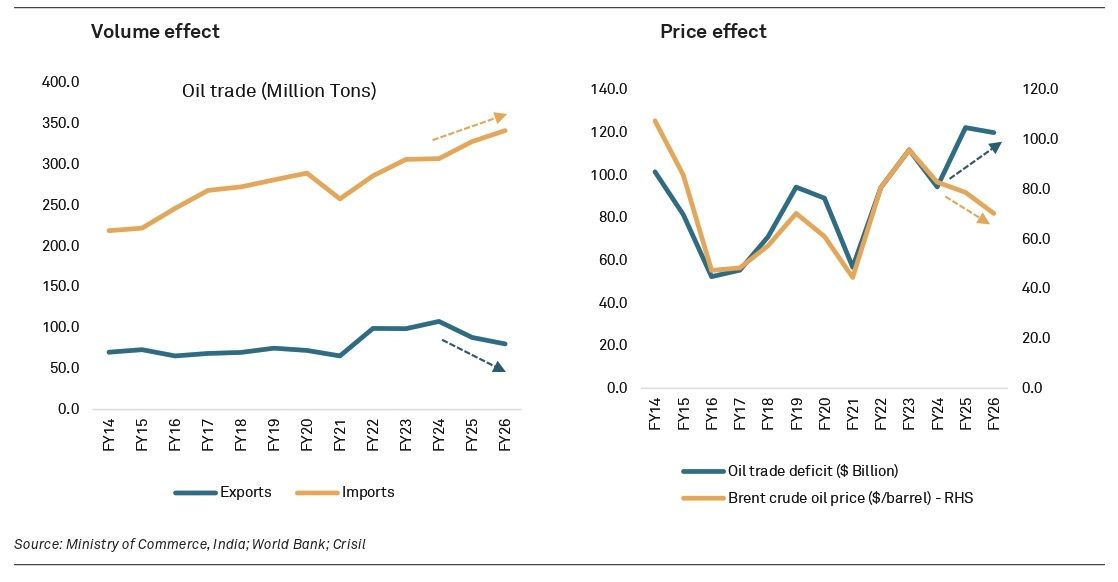
The warning comes at a delicate moment for India’s macroeconomic stability. While lower crude prices had historically helped narrow the oil trade gap, the equation has now broken down as rising import volumes and falling fuel exports begin to outweigh the benefit of softer prices. The reversal marks a structural shift in India’s petroleum trade dynamics rather than a temporary cyclical distortion.
The Crisil Intelligence report, Oil’s Not Well, said the pressure on the oil trade deficit intensified from fiscal 2024 as exports of refined petroleum products declined for two consecutive years even while crude imports continued to rise. The report noted that this was a departure from earlier years when falling crude prices typically compressed the deficit.
India imported nearly 242 million tonnes of crude oil in fiscal 2025, according to data from the Ministry of Commerce and Industry and the Petroleum Planning and Analysis Cell, continuing a long-term upward trajectory driven by expanding domestic energy demand. In contrast, exports of petroleum products have remained largely flat after the sharp post-pandemic surge triggered by exceptional global refining margins following the Russia-Ukraine conflict.
The cooling of global refining spreads has significantly altered the earnings profile of Indian refiners. Private refiners, which had capitalised on discounted Russian crude and booming export demand after the pandemic, are now facing softer overseas appetite and narrowing margins. Public sector refiners, meanwhile, continue to grapple with regulated domestic fuel pricing pressures and volatile input costs.
The report estimated that Brent crude could average $90-95 per barrel in fiscal 2027, sharply higher than the average of $70.3 last fiscal. If that projection materialises, India’s oil import bill could rise substantially even without a dramatic increase in import volumes.
External Risks Rise
The widening oil trade deficit is expected to spill over into the broader current account deficit, potentially reintroducing vulnerabilities that India had largely contained over the past two fiscals. According to the report, India’s current account deficit could rise to 2.2% of GDP this fiscal from an estimated 0.8% last fiscal as higher oil imports combine with possible moderation in remittances from West Asia.
That projection assumes significance because remittances from the Gulf region have historically acted as a natural hedge against elevated crude prices. However, slowing economic activity in some oil-exporting economies and changing labour market conditions may dilute that cushion going forward.
The implications extend beyond trade arithmetic. A higher oil deficit raises the risk of imported inflation in an economy where fuel costs feed into transport, manufacturing and food prices. This is also likely to weigh on the rupee by driving up demand for dollars, increasing the chances of more frequent intervention by the Reserve Bank of India in the foreign exchange market.
India’s energy vulnerability remains acute despite years of policy emphasis on diversification and renewable capacity expansion. While domestic renewable energy installations have accelerated and electric mobility adoption is gradually improving, crude oil continues to dominate transport and industrial fuel consumption.
The structural challenge is amplified by stagnant domestic crude production. Output from ageing oilfields operated by Oil and Natural Gas Corporation and other producers has failed to keep pace with consumption growth, leaving India increasingly dependent on imported barrels.
Global geopolitical tensions are further clouding the outlook for India’s oil trade balance. Escalating instability in West Asia, tightening sanctions regimes and supply discipline by the OPEC and its allies could keep global oil prices elevated for longer than expected. For India, which remains among the world’s largest crude importers, that would translate directly into a larger trade imbalance.
Economists believe the government may increasingly rely on calibrated excise duty adjustments, strategic reserve management and diversified sourcing to cushion the blow. But with domestic demand continuing to expand and refining exports losing steam, India’s oil trade deficit appears headed for another difficult year.