

New Delhi: Odisha has retained its position as India’s fiscally strongest state in the latest Fiscal Health Index released Wednesday by Niti Aayog, underscoring the state’s continued lead in fiscal discipline, revenue mobilization and debt sustainability.
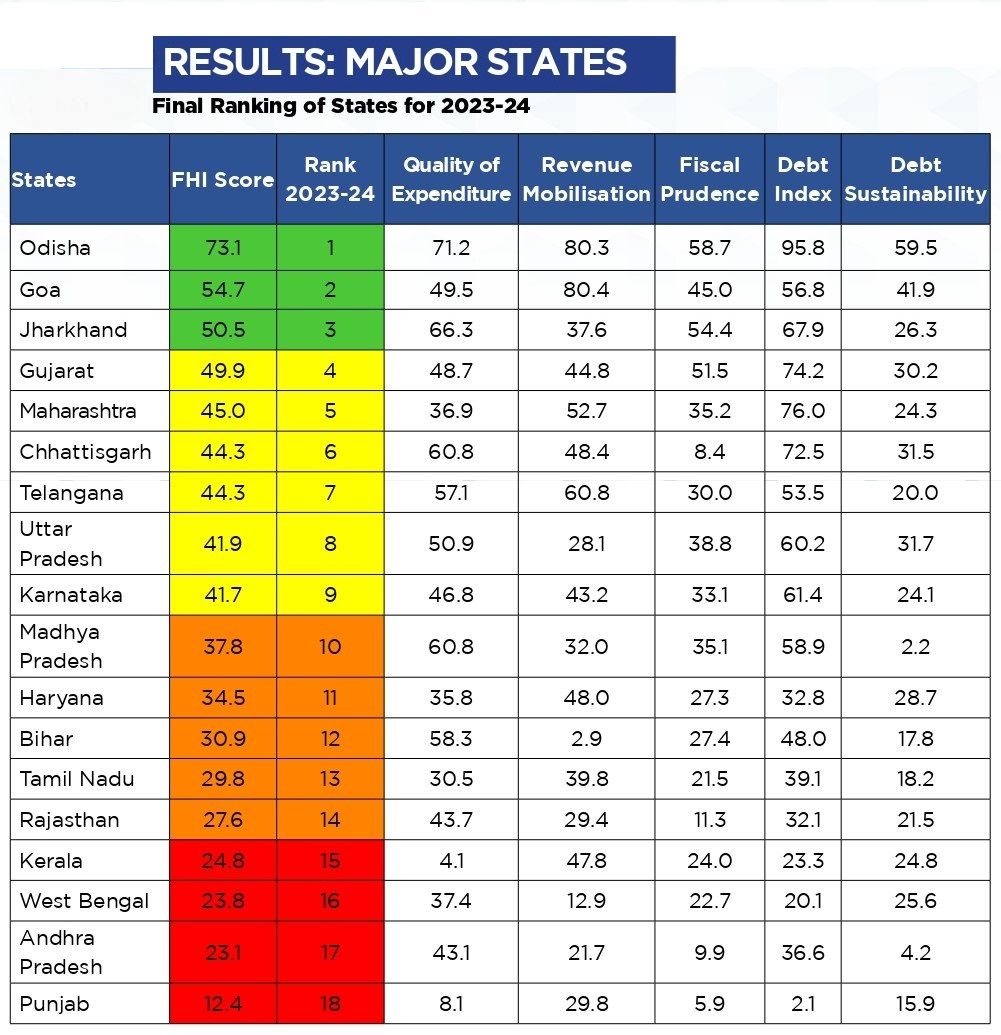
The 2026 Fiscal Health Index, which evaluates the fiscal performance of states for FY2023-24, places Odisha at the top among 18 major states, followed by Chhattisgarh, Goa, Jharkhand and Gujarat. Maharashtra also remained among the leading performers, while Telangana, Uttar Pradesh, Karnataka and Madhya Pradesh completed the top 10 fiscally stronger states.
The report highlights that Odisha, Goa and Jharkhand form the ‘Achiever’ group, characterized by strong own-tax revenue mobilization, relatively high capital expenditure, and prudent deficit management. These states recorded own-tax shares above 60% of total revenue, capital outlays of roughly 4-5% of Gross State Domestic Product (GSDP) and fiscal deficits below 3% of GSDP, while maintaining debt levels under 25% of GSDP and manageable interest burdens.
Among the next tier, Gujarat, Maharashtra, Chhattisgarh, Telangana, Uttar Pradesh and Karnataka were classified as ‘Front-Runner’ states. A further group including Madhya Pradesh, Haryana, Bihar, Tamil Nadu and Rajasthan were categorized as ‘Performers’, indicating moderate fiscal strength with scope for improvement.
The index also highlights a widening divergence in fiscal health across states. Punjab, Andhra Pradesh, Kerala and West Bengal were among the weakest performers, facing structural pressures from weak revenue mobilization and rising debt burdens. These states are characterised by persistent revenue and fiscal deficits, debt levels estimated at roughly 35-45% of GSDP and large interest obligations exceeding 15-20% of revenue receipts. Committed expenditure such as salaries, pensions and interest payments accounts for about 50-60% of their revenue receipts, constraining developmental spending.
The Fiscal Health Index evaluates states across five key parameters: revenue mobilization, quality of expenditure, fiscal prudence, debt levels and debt sustainability. The framework is designed to assess both the current fiscal condition of states and the long-term sustainability of their public finances.
Uttar Pradesh and Bihar were placed in the middle of the rankings among the 18 major states. Uttar Pradesh ranked 11th while Bihar stood at 13th, reflecting moderate performance across fiscal indicators including deficit management and revenue mobilization.
Releasing the report, Niti Aayog Vice-Chairman Suman Bery said strengthening fiscal governance at the state level will be crucial for sustaining India’s growth trajectory, adding that benchmarking tools such as the Fiscal Health Index can help states identify structural fiscal challenges and adopt targeted reforms.
“Sustainable state finances are central to India’s macroeconomic stability, effective service delivery, and long-term growth. As states account for a substantial share of public expenditure and play a critical role in developmental outcomes, their fiscal health has direct implications for national economic resilience, particularly in an environment of elevated global debt and tighter financial conditions,” he said.
“As India progresses towards Viksit Bharat@2027, strengthening state finances will be essential to sustaining high-quality growth, reducing regional disparities, and creating fiscal spaces for priority investments,” he added.
The latest edition of the index expands its coverage beyond the 18 major states to include 10 North-Eastern and Himalayan states, which have been evaluated separately to account for structural differences in their fiscal profiles. Among these, Arunachal Pradesh emerged as the top performer.
According to Niti Aayog, state finances are central to India’s overall fiscal stability as states account for roughly two-thirds of public spending and about one-third of total revenue. The report notes that strengthening fiscal management at the sub-national level will be critical for maintaining macroeconomic stability and sustaining growth.
The analysis also found that many states improved the quality of expenditure, with higher allocations toward capital spending and developmental programmes. However, several states continue to face pressure from rising committed expenditures and debt servicing costs.
The report recommends that states prioritize stronger revenue mobilization, rationalize committed expenditures and improve the composition of capital spending. It also calls for improved public financial management systems, greater transparency in fiscal data and closer monitoring of off-budget borrowings.