

New Delhi: The second phase of the National Monetisation Pipeline (NMP 2.0), projecting an asset monetisation potential of ₹16.72 lakh crore over five years from FY26 to FY30, was unveiled on Monday by Union Finance Minister Nirmala Sitharaman.
The roadmap, prepared by NITI Aayog in consultation with infrastructure ministries, follows the Budget 2025-26 announcement of the Asset Monetisation Plan 2025-30 and significantly scales up the government’s earlier ambitions for unlocking value from public infrastructure.
NMP 2.0 aims to mobilize ₹16.72 lakh crore in aggregate, including an estimated ₹5.8 lakh crore in private sector investment. The targeted amount is more than 2.6 times the ₹6 lakh crore goal set under NMP 1.0, which ran from FY22 to FY25.
According to the government, around 89% of the earlier target was achieved, reflecting strong investor participation and growing institutional appetite for Indian infrastructure assets. The first phase also facilitated the entry of pension funds and sovereign wealth funds into large projects such as the National Highways Authority of India’s toll-operate-transfer bundles and Infrastructure Investment Trusts (InvITs), while enabling the creation of public InvITs that allowed retail investors to participate in infrastructure development.
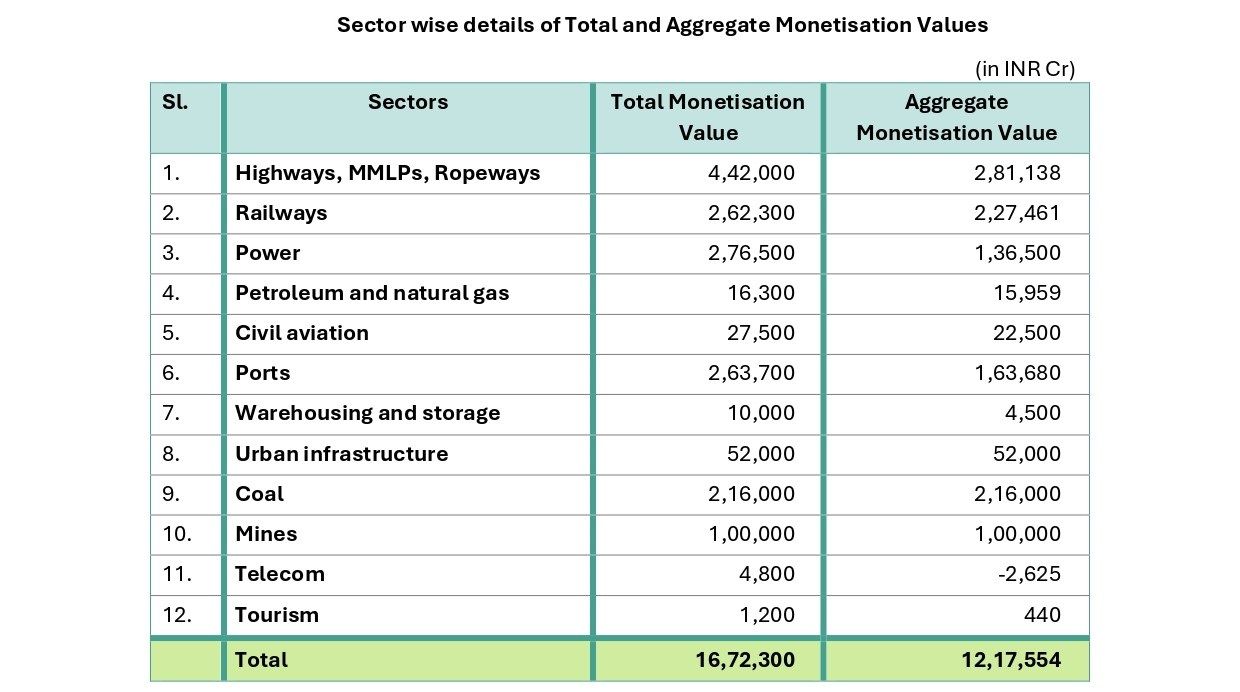
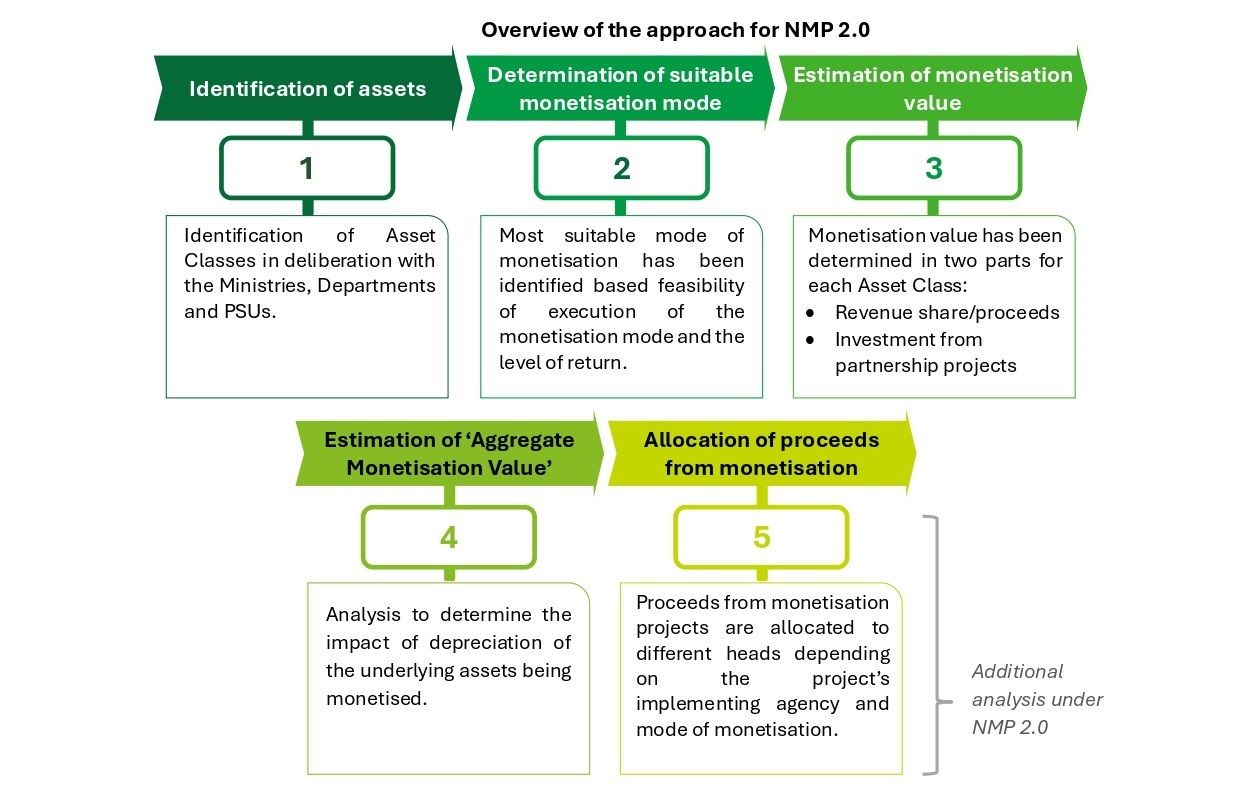
Aggregate Monetisation Value (AMV) is the Total Monetisation Value of the project adjusted to impact of depreciation in the asset during the concession period.
Launching the new phase, the Finance Minister described NMP 2.0 as aligned with the broader Viksit Bharat vision and positioned it as a critical lever for sustaining high capital expenditure without imposing excessive pressure on the budget. She emphasized that monetisation allows the recycling of mature public assets to generate resources for fresh infrastructure creation, thereby optimizing capital deployment. Drawing lessons from the first phase, she urged ministries to simplify processes and standardize documentation to ensure smoother transactions and faster execution.
The asset pipeline under NMP 2.0 spans a wide range of core sectors. Highways, multimodal logistics parks and ropeways together account for the largest share, with an estimated monetisation value of ₹4.42 lakh crore. Railways are expected to contribute ₹2.62 lakh crore, while the power sector’s potential stands at ₹2.76 lakh crore. Ports are projected to generate ₹2.63 lakh crore, coal assets ₹2.16 lakh crore and mining assets ₹1 lakh crore. Urban infrastructure projects are estimated at ₹52,000 crore, civil aviation at ₹27,500 crore and petroleum and natural gas assets at ₹16,300 crore. Warehousing and storage assets are valued at ₹10,000 crore, telecom at ₹4,800 crore and tourism at ₹1,200 crore.
The highways component alone includes the monetisation of 21,300 km of road assets, along with 15 multimodal logistics parks and six ropeways. Other planned transactions include the listing of a minority stake in GAIL Gas, divestment of the Airports Authority of India’s holdings in one subsidiary and four joint-venture airports, development of select land parcels owned by major port authorities and the Food Corporation of India under the public-private partnership (PPP) model, auction of around 94 coal mines and long-term leasing of 38 land parcels owned by Bharat Sanchar Nigam Limited.
Annual phasing of the programme reflects a gradual scaling up. The government estimates monetisation of ₹2,49,493 crore in FY26, rising to ₹3,26,435 crore in FY27, ₹3,46,312 crore in FY28, ₹3,68,852 crore in FY29 and ₹3,81,208 crore in FY30. The monetisation potential values are indicative and may vary at the time of actual transactions, depending on market conditions and investor response.
The framework of NMP 2.0 broadly retains the design principles of its predecessor. Assets may be transferred to private operators for a defined concession period, minority stakes in listed entities may be divested to unlock capital, cash flows may be securitised, or strategic commercial auctions may be undertaken. The choice of instrument will depend on sectoral characteristics, the maturity of the asset, investor appetite and the degree of operational control retained by the public authority. PPP concessions and capital market vehicles such as InvITs are expected to remain prominent tools.
Proceeds from monetisation will be channelled through different routes depending on the implementing agency. Revenues from projects executed directly by central ministries will flow into the Consolidated Fund of India. In cases where public sector undertakings or major port authorities undertake monetisation, proceeds will accrue to the respective entities. Royalties and certain revenues, particularly in coal and mining, will be credited to State Consolidated Funds. Private sector investments tied to construction and major maintenance obligations will be recorded as direct investment.
The government has indicated that the largest share of proceeds under NMP 2.0 is expected to accrue to the Consolidated Fund of India, followed by direct private investment, allocations to PSUs and port authorities, and transfers to State Consolidated Funds. An empowered Core Group of Secretaries on Asset Monetisation, chaired by the Cabinet Secretary, will continue to oversee implementation and monitor progress across ministries.
By positioning monetisation as a structured, medium-term strategy rather than ad hoc divestment, NMP 2.0 seeks to provide visibility to investors while ensuring that asset owners follow a consistent methodology. The programme underscores the government’s strategy of capital recycling to finance infrastructure expansion, enhance operational efficiency and attract long-term institutional capital, while maintaining public ownership of core assets.