

New Delhi: India’s relationship with the world is evolving rapidly as its economy grows and its international profile expands. Foreign policy, once largely shaped by strategic caution and limited global engagement, is now increasingly guided by the need to accelerate domestic development. In this context, Europe has emerged as the partner most strongly associated with shared values, institutional credibility, and long-term economic cooperation.
This was highlighted in a recent survey titled Navigating India’s Role: Perspectives on Security, Geopolitics and Trade, conducted by the Kalinga Kusum Foundation in collaboration with the Friedrich Naumann Foundation for Freedom. The survey attempts to determine what it describes as “the worldview of this ‘New India’ and what it means for other parts of the world, including the advanced polity that receives the least amount of Indian attention: Europe,” the report notes.
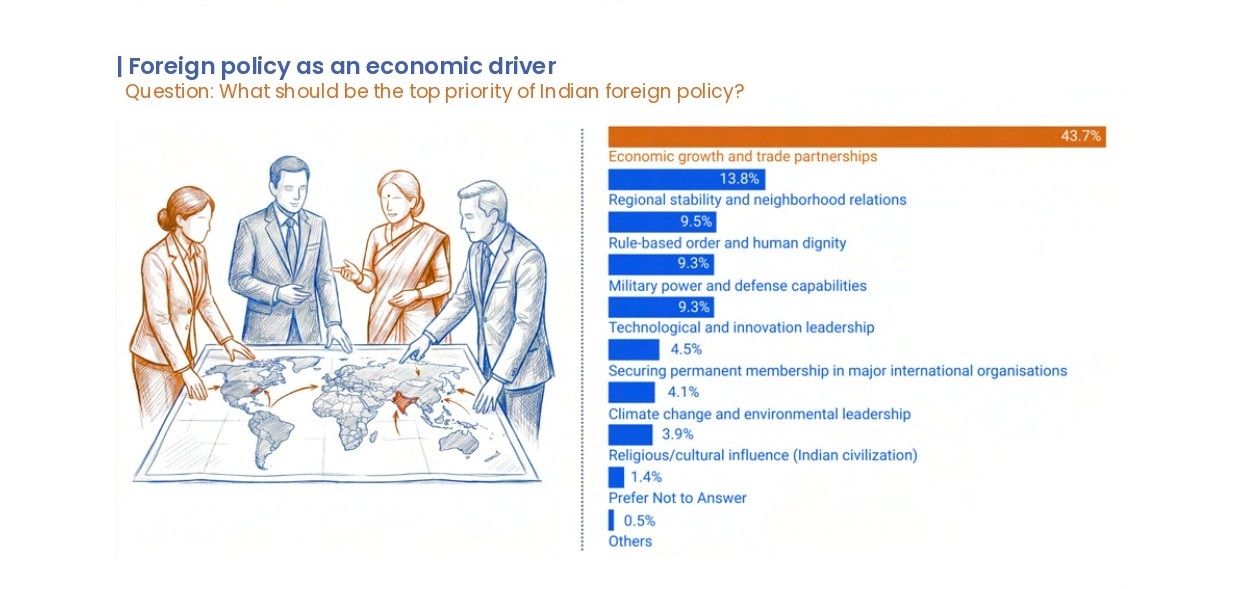
The findings offer insight into how Indians perceive global partners and what they expect from international engagement. According to the report, Indians increasingly evaluate foreign relationships through the lens of development. Respondents from business, academic and policy circles emphasized that diplomacy should primarily serve economic growth and help address domestic challenges.
Despite its strong growth in recent decades, India continues to face structural issues including unemployment, environmental degradation, education gaps and persistent poverty. These concerns shape expectations that international partnerships should contribute directly to domestic prosperity.
“Indians remain very conscious that theirs is a low-income country and the majority of respondents place development concerns at the top of their priority list. They also put economic growth as the most important purpose of foreign policy,” the report says. At the same time, it adds that “maintaining India’s policy autonomy receives almost equal billing, reflecting a deep and lasting continuity in Indian foreign policy priorities”.
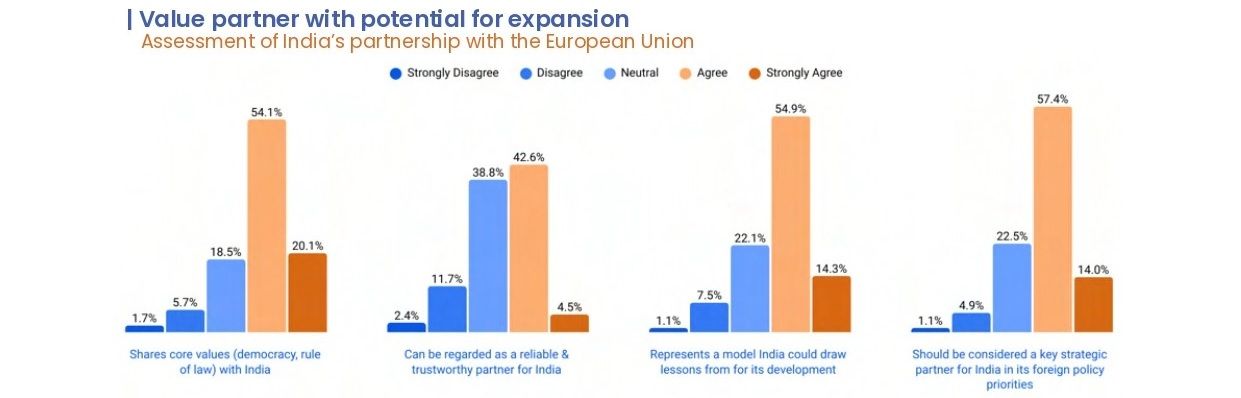
Within this context, Europe stands out as a partner that combines economic opportunity with political and institutional compatibility. Respondents frequently associated Europe with democratic governance, the rule of law and stable institutions. These characteristics enhance Europe’s credibility as a trustworthy collaborator.
In a global environment where geopolitical rivalries are intensifying and the reliability of major powers is often questioned, the perception of Europe as a values-based political community carries particular significance for Indian observers.
Most Favoured
Europe’s economic model also attracts attention. Many Indians express admiration for the concept of a social market economy that attempts to balance economic dynamism with social welfare protections.
“The social market economy strongly associated with Europe is the most favoured among Indians,” the report notes, suggesting that this model resonates with Indian aspirations to achieve rapid growth while maintaining social stability and inclusiveness.
Trade and investment represent central pillars of India’s engagement with Europe. Respondents view European economies as important destinations for Indian exports and as major sources of capital and technological expertise.
“Europe even scores higher than the United States in terms of trust,” the report says. “Indians see Europe as a partner in commerce and investment, but also technology and climate leadership”.
The findings also show a broadly positive outlook among Indians toward deeper economic integration. “The majority of Indians are supportive of trade agreements, opening up to foreign investment and even allowing highly-skilled foreign workers to come to the country,” the report states.
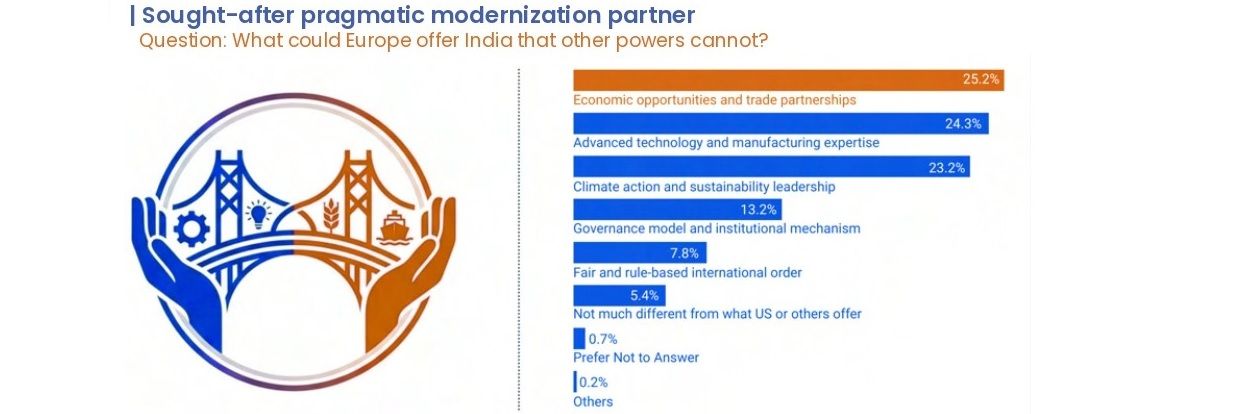
In an increasingly fragmented global trade environment, closer commercial ties with Europe are seen as strategically valuable. European companies bring advanced manufacturing capabilities and technical expertise that can help strengthen India’s industrial base.
Tech Dependence
Technological cooperation further enhances Europe’s attractiveness as a partner. India’s long-term economic ambitions depend heavily on technological modernisation and innovation.
European countries are widely respected for their engineering capabilities, research institutions and technological sophistication. Cooperation in fields such as renewable energy, climate technology, industrial automation and digital transformation is viewed as particularly promising.
Education and professional mobility form another important dimension of the India-Europe relationship. “Europe is the most favoured destination for education and employment for Indians,” the report says.
Universities and research institutions across Europe are widely recognised for academic excellence. Indian students increasingly see European education as a pathway to global exposure and professional advancement, helping create long-term networks that strengthen intellectual exchange between the two regions.
The survey’s findings become clearer when compared with Indian perceptions of other major global powers.
The United States is widely respected for its technological leadership, military capabilities and cultural influence. Many Indians also acknowledge shared democratic values between the two countries. However, respondents expressed uncertainty about the consistency of American policies, creating hesitation in viewing the US as a completely dependable partner.
China is perceived through a mixture of admiration and suspicion. Respondents recognise China’s rapid economic rise and technological progress, and many see aspects of its development trajectory as worth studying. At the same time, geopolitical tensions and differences in political values generate distrust, reinforcing the view of China as both a competitor and a security challenge.
Russia occupies a different place in Indian strategic thinking. Although respondents acknowledge that Russia offers fewer economic opportunities than other major powers, it continues to enjoy a high level of trust in security matters. Historical ties dating back to the Soviet era still influence Indian perceptions, and many believe Russia would provide reliable military support in the event of a major conflict.
Trust Factor
Against this backdrop, Europe’s role becomes distinctive. While it is not viewed primarily as a security partner, it commands respect as a collaborator in governance, commerce, technology and environmental leadership. As the report notes, “Europe emerges as the champion in terms of its democratic system and commitment to the rule of law”, reinforcing its credibility as a governance partner.
Europe’s emphasis on sustainability and climate action aligns with India’s growing awareness of environmental challenges. “Indians see Europe not only as a commercial partner but also as a leader in climate action and sustainable development,” the report says, highlighting the potential for collaboration in green technologies and environmental governance.
Understanding India’s interest in Europe also requires examining the broader evolution of Indian foreign policy. In the decades after independence, India adopted a cautious approach to global engagement, emphasising non-alignment, economic self-reliance and limited integration with global markets.
However, economic reforms in the early 1990s transformed this outlook by opening the country to international trade and investment. “Since the reforms, India’s growth has been closely linked to global trade, foreign investment and technological exchange,” the report observes, underlining how international partnerships have become central to development.
As the economy expanded to several trillion dollars, Indians increasingly recognised that global cooperation was necessary to sustain growth. According to the report: “Respondents consistently emphasize that international partnerships should contribute directly to India’s domestic prosperity and economic modernisation.”
The contemporary international environment also encourages India to build diverse relationships. Rather than aligning exclusively with a single power, many Indians support maintaining partnerships with multiple countries while preserving strategic autonomy.
“Maintaining India’s policy autonomy remains a core objective of foreign policy even as economic cooperation deepens,” the report states, reflecting the country’s long-standing approach of balancing engagement with independence.
Within this framework, Europe fits comfortably into India’s foreign policy outlook. European countries are seen as partners capable of contributing to economic modernisation, technological advancement and climate solutions without demanding exclusive political alignment.
“Europe’s combination of shared democratic values, institutional stability and economic cooperation gives it a distinctive place in India’s global outlook,” the report concludes.
As India continues to expand its international role, engagement with Europe is likely to deepen. Trade partnerships, technological cooperation, educational exchanges and climate initiatives all offer opportunities to strengthen ties. In an increasingly uncertain global environment, the India-Europe relationship represents a partnership grounded in both pragmatic interests and shared values.