


New Delhi: India will continue to outpace the global economy and the G20 bloc despite rising geopolitical and inflationary headwinds, with the Organisation for Economic Co-operation and Development (OECD) projecting growth of 7.6% in FY26 before a moderation to 6.1% in FY27 and 6.4% in FY28. This compares with global GDP growth expected to slow to 2.9% in 2026 and edge up to 3% in 2027, while inflation across the G20 is projected to remain elevated at 4% in 2026.
In its interim Economic Outlook titled ‘Testing Resilience’, the OECD said India’s recent growth performance has been stronger than anticipated, noting that “India experienced more rapid growth than anticipated in the second half of 2025, following revisions to (its) national accounts”. This momentum is expected to carry into the current fiscal, even as the external environment turns increasingly uncertain.
The report, however, flags a gradual cooling of growth as policy support wanes and external disruptions intensify. “The decline in US tariffs should support growth in India, though gas rationing will disrupt some production activities and fiscal support is expected to fade,” it said, adding that growth will ease after FY26 before stabilizing.
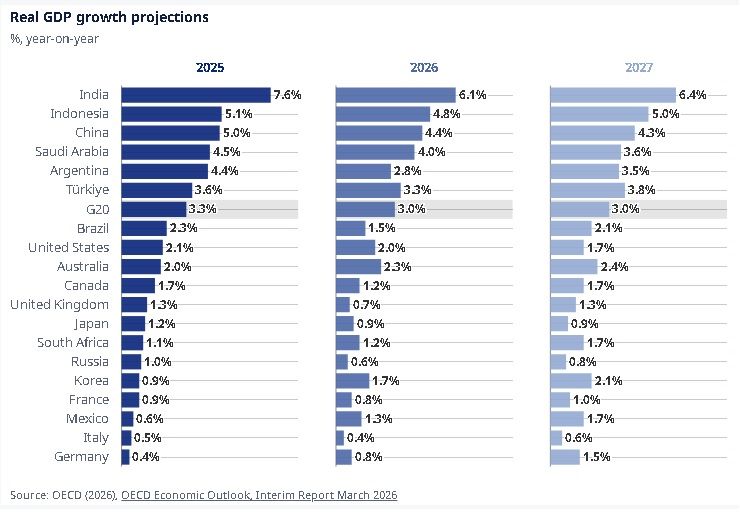
Inflation is emerging as a key concern or India. After remaining unusually low at around 2% in FY26, price pressures are expected to rise sharply. The OECD noted that “the fading deflationary impact of past food and energy price-reducing shocks will be exacerbated by the recent surge in global energy prices”, pushing inflation to 5.1% in FY27 before easing to 4.1% in FY28. In response, monetary policy is likely to tighten modestly, with the report stating that India is projected “to raise policy rates temporarily in the second quarter of 2026 to help offset stronger inflationary pressures”.
On the external front, India stands to gain from easing trade tensions. The OECD highlighted that “US bilateral tariff rates have declined following the US Supreme Court ruling against the tariffs imposed under the International Emergency Economic Powers Act”, with “particularly large reductions for several emerging-market economies, including India”. Even so, it cautioned that overall US tariff levels remain higher than pre-2025 norms.
Currency pressures persist, with the report pointing to continued weakness in the rupee amid a broader strengthening of the US dollar. At the same time, domestic conditions remain relatively supportive, with labour markets described as favourable and unemployment staying low.
World View
The global context, however, is getting increasingly fragile. The OECD warned that “the evolving conflict in the West Asia has human and economic costs for the countries directly involved, and will test the resilience of the global economy”.
Disruptions to energy flows have already had significant consequences. “A halt in shipments through the Strait of Hormuz and the closure or damage of energy infrastructure has generated a surge in energy prices and disrupted the global supply of energy and other important commodities, such as fertilisers,” the report said.
This energy shock is feeding into broader macroeconomic risks. “The breadth and duration of the conflict are very uncertain, but a prolonged period of higher energy prices will add markedly to business costs and raise consumer price inflation, with adverse consequences for growth,” the OECD noted.
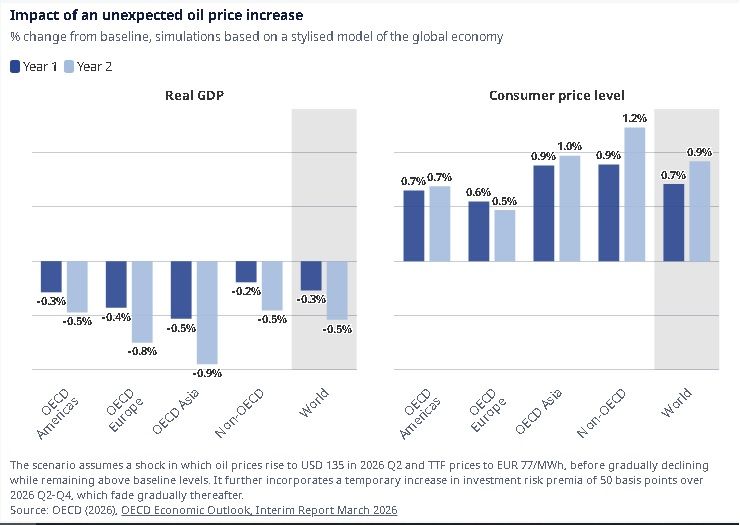
“Policies that improve domestic energy efficiency and lower reliance on imported fossil fuels over the medium-term are a priority as these can help lower exposure to future geopolitical tensions, as well as mitigate costs for households and businesses,” it said.
Financial market volatility has also picked up, particularly in parts of Asia, while financial conditions, though still mildly accommodative, have tightened. “Effective monitoring, supervision, and robust regulatory policies are needed to address financial stability risks given stretched valuations in financial markets and growing interconnections between banks and non-bank financial institutions,” said the report.
Among major economies, the United States is projected to see growth moderate from 2% in 2026 to 1.7% in 2027 as consumption slows, while the euro area is expected to expand by just 0.8% in 2026 before recovering modestly. China’s growth is projected to ease to 4.4% in 2026 and 4.3% in 2027.
The OECD added that “the energy price surge and the unpredictable nature of the evolving conflict in the West Asia will raise costs and lower demand, offsetting the tailwinds from strong technology-related investment and production”.
The global outlook remains contingent on easing energy disruptions over time. “These projections are conditional on a technical assumption that the current extent of energy market disruption moderates over time,” the report said, warning that a sharper or more prolonged shock could worsen inflation and weaken growth further.
At the same time, the OECD pointed to upside risks, noting that “a surprisingly resilient business sector, an earlier-than-assumed resolution of the conflict… or broadening investment in artificial intelligence technologies” could lift growth prospects.
For India, the report has a message of “cautious resilience”. Strong domestic demand, easing trade frictions and a stable labour market provide a buffer, but rising energy costs, inflationary pressures and external uncertainties will test policy calibration.
At the global level, the OECD has advised that central banks must remain vigilant to ensure that inflation expectations stay anchored, while governments must balance targeted support with fiscal sustainability in an increasingly volatile global environment.
Effective monitoring, supervision, and robust regulatory policies are needed to address financial stability risks, it says.
(Cover photo by Zoshua Colah on Unsplash)