

New Delhi: India’s IT sector is not witnessing the mass job destruction many fear from generative AI. Instead, early evidence suggests a quieter but deeper transformation — one defined by productivity gains, evolving skill demands and a gradual reorganization of work rather than sweeping displacement.
A major new study by the Indian Council for Research on International Economic Relations (ICRIER), supported by OpenAI, finds no evidence of large-scale job losses linked to generative AI adoption in India’s IT industry. Titled ‘AI and Jobs: This Time Is No Different’, the research draws on a survey of 651 IT firms across 10 Indian cities conducted between November 2025 and January 2026, supplemented by interviews with industry leaders. It offers one of the most detailed firm-level assessments yet of how generative AI is reshaping employment, productivity and skilling patterns in the country’s most globally integrated sector.
The research’s headline finding is clear: hiring has moderated, particularly at the entry level, but total employment in the sector continues to grow. Roles widely assumed to be most vulnerable to automation — such as software developers, application developers and database professionals — are among those seeing the strongest demand. Generative AI, at least for now, is functioning more as a complement to technical and analytical talent than as a substitute.
Open AI Chief Economist Ronnie Chatterji underscored the nature of this transition. “We are seeing a shift in how work is organized, where AI appears to be complementing human talent. This data offers a window into the transition underway in India. The focus now should be on the practical steps needed to help workers align their skills with the advancing capabilities of AI. Currently, only 4% of firms have trained more than half their workforce in AI, presenting a huge opportunity for growth.”
Productivity Gains
According to the ICRIER report, across more than 1,900 business divisions identified as being most affected by AI, productivity gains significantly outnumber declines. Divisions reporting higher output with stable or reduced team sizes outnumber those experiencing productivity drops by a ratio of 3.5 to 1, says the report, adding nearly one-third report both increased output and reduced costs, suggesting that firms are scaling more efficiently without corresponding employment cuts.
AI is raising output per worker, not eliminating the worker. This evidence pushes back against a global narrative increasingly dominated by warnings of inevitable tech unemployment. Prominent figures such as Elon Musk, Dario Amodei and IMF Managing Director Kristalina Georgieva have cautioned that AI could displace vast sections of the workforce.
In India, where the IT industry is both a pillar of national pride and a major employer, such fears resonate deeply. The country is home to the world’s largest and fastest-growing software developer community, built on a model of standardized, codifiable and repeatable tasks — the very terrain where generative AI delivers rapid productivity gains. Unsurprisingly, Indian IT stocks have reacted sharply to major AI breakthroughs.
Yet the firm-level data tells a more grounded story. While overall hiring has slowed, researchers note that this moderation aligns with broader post-pandemic trends in the global IT industry and cannot be attributed to AI adoption alone. The pattern emerging is one of recalibration rather than retrenchment.
At the entry level, hiring has softened as firms deploy AI tools to handle routine coding, documentation and testing tasks. At the mid-level, demand is rising for professionals who can supervise AI systems, integrate them into workflows and apply domain expertise to AI-generated outputs. At the senior level, employment remains broadly stable, reflecting the continued need for strategic oversight and client-facing leadership.
Hybrid Roles
Occupational data reinforces this shift. Technical and analytically intensive roles — those most exposed to AI tools — are not shrinking. On the contrary, they are expanding. Software analysts and developers, application developers, statisticians and mathematicians are among the roles experiencing increased demand. This suggests that AI is amplifying high-skill work rather than hollowing it out.
Hiring priorities are also evolving.
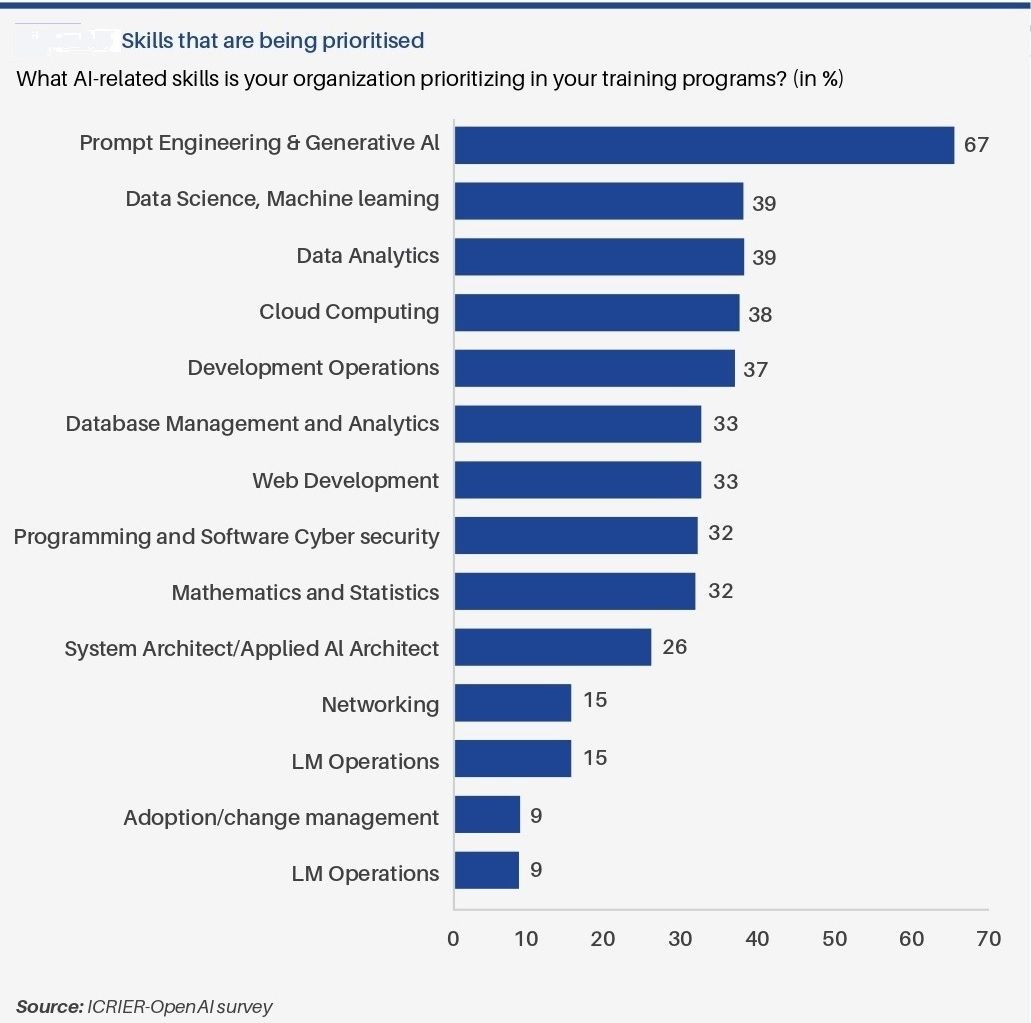
Sixty-three percent of surveyed firms report increased demand for candidates who combine domain expertise with AI or data skills. Hybrid skill sets are becoming the new baseline. Prompt engineering and generative AI capabilities are now among the most sought-after competencies, cited by 68% of firms. Data analytics follows at 36%, with data science and machine learning close behind at 35%. AI literacy is rapidly shifting from a niche advantage to a core professional expectation.
Productivity gains are broad-based. A majority of firms report higher and better-quality output following AI adoption, along with time and cost savings. While many divisions report modest declines in team size consistent with overall hiring moderation, those most directly affected by AI — particularly software-related functions — are experiencing the smallest relative job losses. In effect, AI-intensive divisions are outperforming others.
ICRIER Director and Chief Executive Shekhar Aiyar emphasized the importance of grounding the debate in evidence. “Everyone has opinions on this matter, but the ICRIER-OpenAI study brings evidence to the table. The authors have complemented survey findings with in-depth interviews with Indian IT industry leaders to better understand the true impact of generative AI. The results should reassure Indian policymakers without inducing complacency. While India’s IT sector appears to be managing AI adoption relatively well, many firms remain insufficiently prepared for what lies ahead.”
Lack of Preparedness
The report, however, reveals that preparedness remains the critical fault line. Although more than half of surveyed firms report supporting AI adoption through awareness or training initiatives, formal AI training coverage is limited. Only 4% of firms have trained more than half their workforce in AI-related skills over the past year. An additional 38% plan to roll out such initiatives, but the current reach is uneven and fragmented.
Key constraints include high training costs, shortages of qualified instructors, uncertain returns on investment, ethical and legal concerns, and broader organizational readiness challenges. Limited expansion in AI-focused R&D and cautious hiring in specialized AI roles further highlight structural bottlenecks. Regulatory uncertainty also complicates long-term planning.
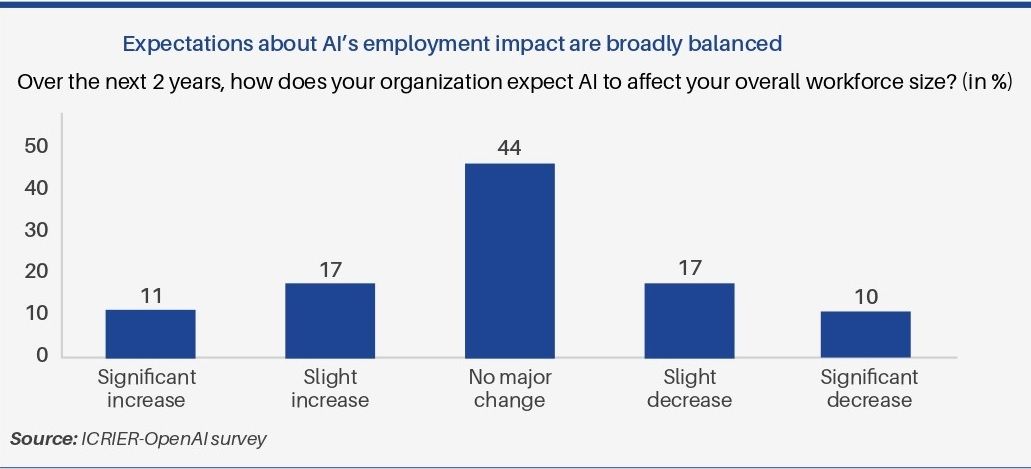
Forward expectations of firms remain measured rather than alarmist. About 44% anticipate no major change in employment in the near term; 28% expect workforce expansion; while 27% foresee some decline. These projections suggest adjustment and differentiation, not collapse.
The broader historical context is instructive. Past general-purpose technologies — from steam engines and electricity to automobiles and the internet — eliminated specific occupations but ultimately generated more employment than they destroyed. Predictions of permanent technological unemployment repeatedly failed to materialize because rising productivity lowered costs, expanded markets and created new industries. Generative AI is distinctive in targeting non-routine cognitive tasks and advancing at extraordinary speed, but it is still in an early phase of diffusion.
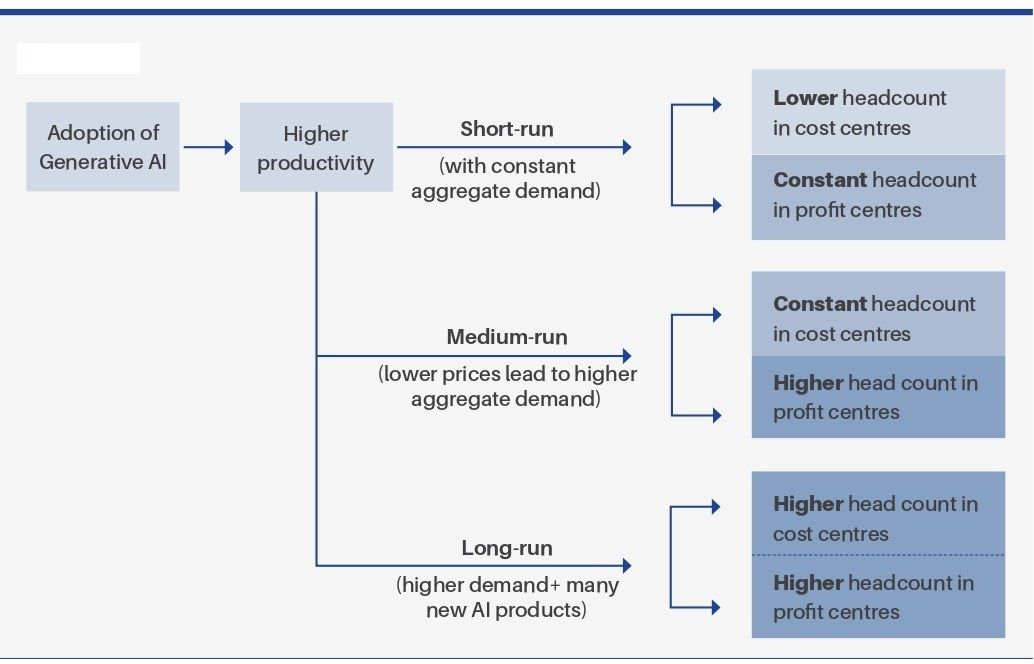
The study argues that while initial substitution effects are visible — especially in moderated entry-level hiring — income effects are likely to dominate over time. As productivity rises and global demand for AI-enabled services expands, India’s IT sector could see net job creation over the medium to long term, even as roles and required skills evolve significantly.
For policymakers, the message is twofold. Immediate fears of mass displacement appear overstated. India’s IT industry is integrating generative AI with resilience, registering productivity gains without aggregate employment contraction. Yet the window for proactive adaptation is narrow. Accelerated investment in workforce training, expansion of the trainer ecosystem, regulatory clarity and stronger R&D incentives will be essential to fully harness AI’s potential.
The transformation underway is real and structural. Generative AI is reorganizing workflows, compressing routine entry-level tasks and elevating the premium on hybrid, high-skill talent. It is rewarding firms that embed it strategically and exposing preparedness gaps in those that hesitate. What it is not doing — so far — is triggering the apocalyptic job losses many predicted.
As generative AI spreads, the central question is no longer whether India’s IT workforce will vanish. It is whether institutions can move fast enough to align skills with rapidly advancing capabilities. The data suggests a transition defined less by displacement and more by adaptation. The outcome will depend not on inevitability, but on readiness.
(Cover photo by Immo Wegmann on Unsplash)