
New Delhi: India and New Zealand on Monday (April 27, 2026) signed a “landmark” Free Trade Agreement (FTA) aimed at strengthening bilateral trade, investment flows, and people-to-people ties, in what both governments described as a historic step forward in their economic partnership.
The agreement was formally signed in New Delhi by Commerce Minister Piyush Goyal and New Zealand’s Trade and Investment Minister Todd McClay. The pact will see New Zealand eliminate tariffs on all goods imported from India, while India will remove or reduce duties on about 95% of imports from New Zealand, marking a significant liberalisation of trade between the two countries.
Prime Minister Narendra Modi described the development as a major milestone. “The signing of the FTA reflects our strengthening economic partnership and a convergence of values, trust and shared ambition between two vibrant democracies.”
New Zealand Prime Minister Christopher Luxon emphasised the broader significance of the deal amid global uncertainty. “And the India-New Zealand story is about more than trade,” he said. “New Zealand and India are building a relationship that is bigger, deeper and more exciting every year — across trade, investment, defence, sport, and innovation.”
Negotiations for the agreement began in March 2025 and were concluded by December the same year, making it one of the fastest trade deals finalised by India. The agreement is expected to come into force later this year following ratification by New Zealand’s Parliament.
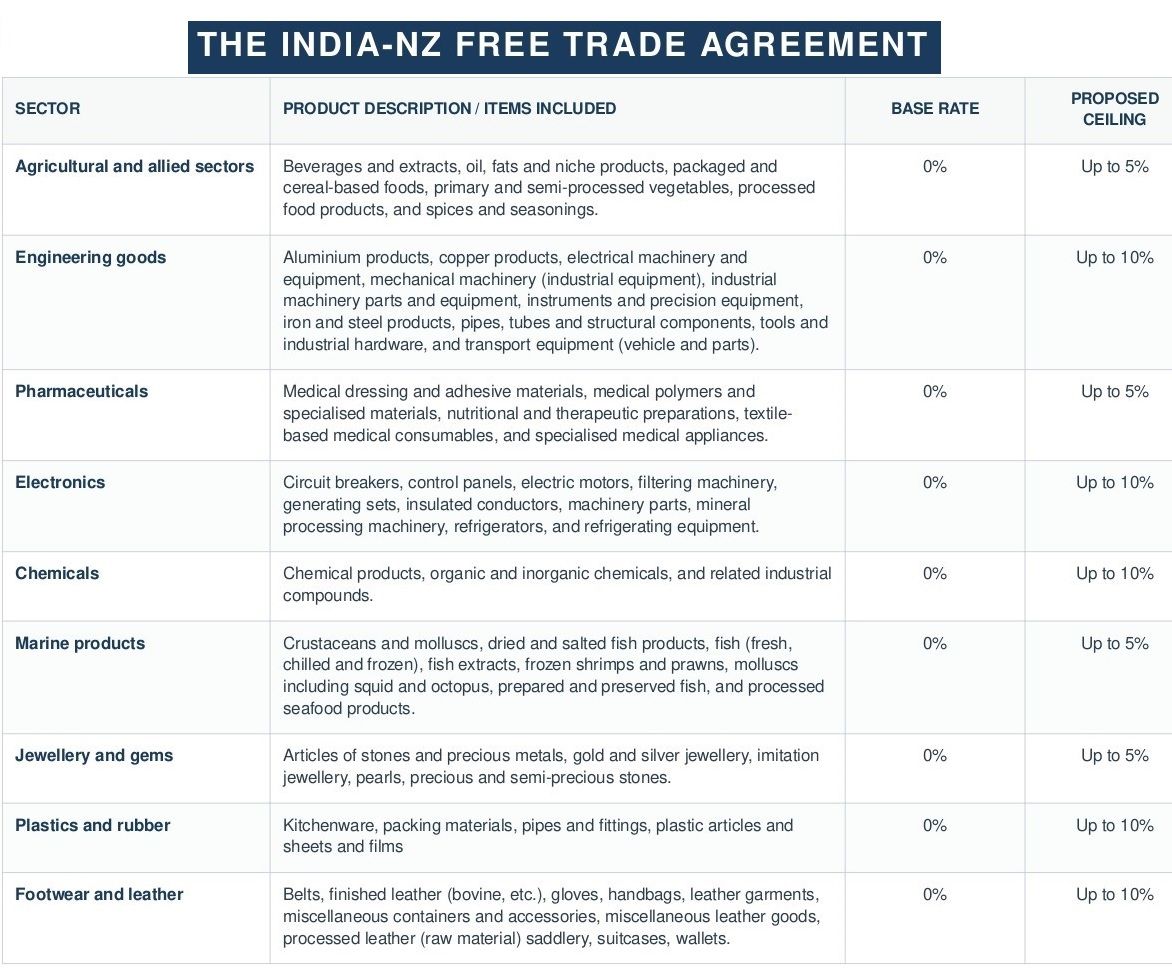
The FTA provides India with full duty-free access to the New Zealand market across all tariff lines, significantly improving competitiveness for labour-intensive sectors such as textiles, leather, engineering goods and processed foods. At the same time, India has adopted a calibrated approach, opening around 70% of tariff lines while protecting sensitive sectors such as dairy, certain agricultural products, and metals.
Beyond goods, the agreement includes wide-ranging provisions covering services, investment and mobility. New Zealand has offered market access commitments across 118 service sectors and extended Most-Favoured Nation (MFN) treatment in 139 sub-sectors, benefiting industries such as IT, education, finance, tourism, and professional services.
A key feature of the agreement is the facilitation of $20 billion in investment from New Zealand into India over the next 15 years, aimed at boosting infrastructure, manufacturing, and innovation ecosystems. “Our ‘Make in India’ flagship initiative offers synergy to New Zealand’s investment commitment of $20 billion in India and delivers a vibrant partnership that goes beyond trade,” Modi said.
The agreement also introduces new mobility pathways, including a Temporary Employment Entry visa route for Indian professionals, alongside expanded opportunities for students through extended post-study work rights. These measures are expected to deepen workforce integration and skill exchange between the two economies.
McClay highlighted the benefits for New Zealand businesses, calling the deal transformative. “This once-in-a-generation agreement delivers opportunities New Zealand exporters have never had in India,” he said. “It will deliver thousands of jobs and unleash huge potential for our world-class exporters.”
The FTA further streamlines regulatory processes, enhances customs efficiency, and promotes cooperation in areas such as agriculture, traditional medicine, and innovation. It also includes commitments on intellectual property reforms, enabling broader recognition of Indian geographical indications in New Zealand.
Manoj Mishra, Partner, Grant Thornton Bhar, said, “Backed by a $20 billion investment commitment from New Zealand the FTA is expected to drive long-term economic engagement and infrastructure development. Further, New Zealand’s robust services commitments and enhanced talent mobility pathways will create significant opportunities for Indian professionals and service providers globally. The FTA also opens new avenues for AYUSH and traditional medicine, collectively supporting export-led growth and more resilient, diversified global value chains,” said
Bilateral trade between the two countries has already shown strong momentum, with India’s exports to New Zealand rising sharply in recent years. With tariffs being eliminated and market access expanded, trade volumes are expected to grow significantly, supported by stronger institutional frameworks and reduced barriers.
Industry bodies in India have welcomed the agreement, noting that it will create new export opportunities across sectors including agriculture, pharmaceuticals, engineering goods, and services. The deal is also expected to support MSMEs, women entrepreneurs, and startups by improving access to global value chains and enhancing competitiveness.