


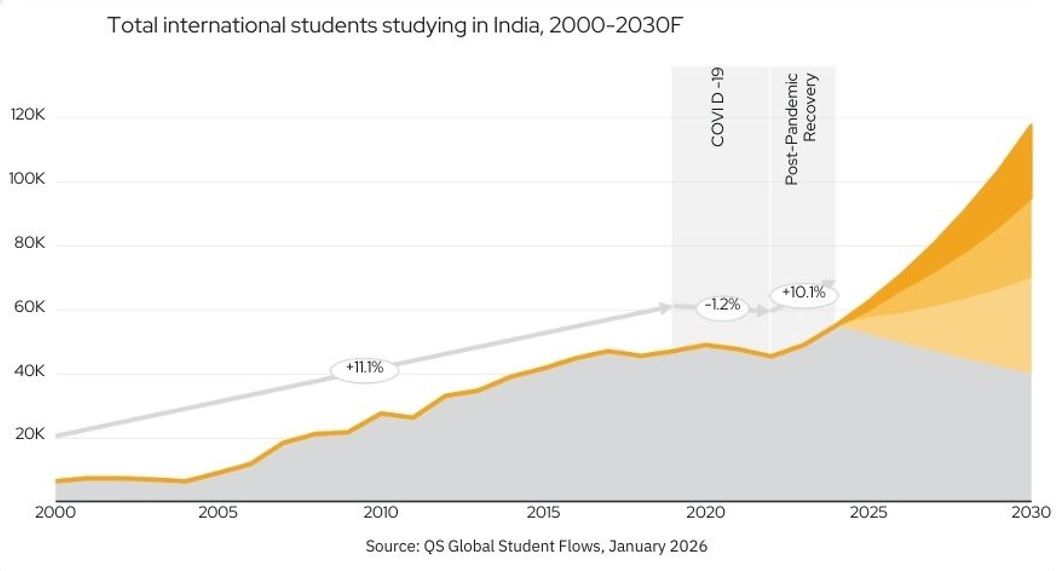
New Delhi: India’s inbound international student numbers are entering a “steady growth” phase, reflecting changing global mobility patterns and policy reforms that are gradually repositioning the country as a regional education hub. According to the Global Student Flows: India 2026 report by QS Quacquarelli Symonds, international enrolments in India are projected to grow at roughly 8% annually from a base of around 58,000 students in 2025.
If sustained through the decade, this growth trajectory could make India one of the fastest-expanding study destinations globally. The report links this shift to structural changes in the international education landscape. Traditional Anglophone destinations — including the United States, the United Kingdom, Canada and Australia — have introduced stricter visa rules and seen a rise in tuition fees and living costs in recent years. As a result, many students are increasingly exploring countries that offer comparable academic programmes at significantly lower costs.
India’s competitive positioning lies in three structural advantages: affordability, widespread English-medium education, and geographic proximity to key student-sending regions. The country’s higher-education ecosystem — one of the largest globally with thousands of universities and colleges — also offers a wide range of programmes across engineering, medicine, management and emerging technology disciplines.
Policy reforms have further strengthened this momentum. Initiatives such as ‘Study in India’ aim to simplify admissions and reduce financial barriers for foreign applicants through scholarships and streamlined application processes. In parallel, reforms linked to National Education Policy 2020 have introduced measures to internationalize India’s higher-education system.
One of the key provisions allows Indian universities to reserve up to 25% supernumerary seats specifically for international students, enabling institutions to increase foreign enrolments without reducing seats for domestic applicants. The policy framework has also opened the door for foreign universities to establish campuses in India, a move intended to deepen academic collaboration and raise global visibility.
India’s government has also articulated a long-term strategic ambition: hosting 500,000 international students by 2047. Achieving this target would significantly expand the country’s current share of global student mobility and position international education as an important pillar of its knowledge economy.
“The conditions surrounding mobility are shifting. As more institutions, particularly in markets historically seen as primarily ‘sending’ actively position themselves as global recruitment destinations, Indian institutions and policymakers must consider how best to build on existing strengths while adapting strategically to remain competitive in a rapidly changing environment,” says Ashwin Fernandes, Executive Director- AMESA, QS Quacquarelli Symonds.
However, the report notes that maintaining sustained growth will require improvements in campus infrastructure, institutional reputation and employment outcomes, areas that remain critical considerations for prospective international students.
Regional Demand Shaping Inbound Growth
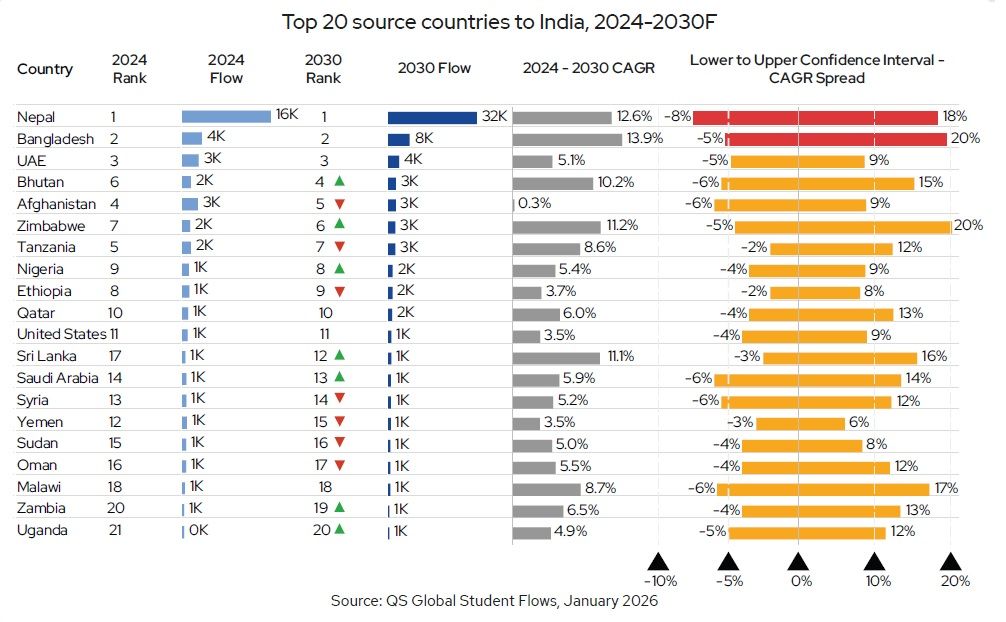
Regional mobility remains the main driver of international student inflows to India. According to the QS report, South Asia accounts for nearly half of all international students in the country, highlighting India’s role as a regional education hub.
Students from Nepal and Bangladesh together represent more than 30% of inbound enrolments, reflecting strong academic ties and cultural familiarity. Nepal is emerging as a particularly fast-growing source market, with student numbers projected to grow by around 11% annually.
India’s large number of English-medium programmes, relatively affordable tuition fees and easier travel routes compared with distant destinations help explain this trend. The country also offers specialized education — particularly in engineering, medicine and business — that may be less accessible in some neighbouring systems.
Growth patterns, however, vary across the region. Student mobility from Afghanistan is expected to remain limited, with annual growth forecast at below 1%, largely due to visa challenges and geopolitical uncertainty.
Beyond South Asia, Sub-Saharan Africa is becoming an increasingly important source of students. The QS analysis forecasts annual growth of around 5-6%, driven by demographic expansion and limited higher-education capacity in several African countries.
Among African markets, Zimbabwe stands out as one of the fastest-growing, with student numbers projected to increase by 11-13% annually. If this trend continues, Zimbabwe could rise from India’s seventh-largest African source market to the fourth by 2030.
The Middle East and North Africa (MENA) also contributes significantly. Students from the United Arab Emirates are expected to account for around 5% of India’s international student population by 2030, supported by diaspora links and growing awareness of Indian universities.
The report suggests India’s inbound growth will remain largely regional, with neighbouring and developing economies driving expansion.
With international migration and student mobility under increasing political pressure worldwide, India’s higher education sector is shifting its focus toward exporting education through trans-national education as a pathway for global engagement. “Top Indian higher education institutions (HEIs) are expanding overseas through branch campuses, joint degrees, and academic partnerships guided by the National Education Policy (NEP) 2020, which envisions India as a global knowledge hub,” says the report.
Outbound Mobility Diversifying
India also remains one of the world’s largest sources of international students. More than 800,000 Indian students were studying overseas in 2024, making the country the second-largest outbound market globally. Outbound student mobility from India grew at an average rate of 11% from 2022 to 2025, says the report.
Traditionally, many have chosen the ‘Big Four’ destinations — the United States, the United Kingdom, Canada and Australia. However, the report projects that combined enrolments in these countries will decline slightly by about 0.5% annually through 2030.
Rising tuition costs, higher living expenses and tighter visa rules are prompting students to explore alternative destinations offering lower costs and clearer immigration pathways.
Germany, France and the United Arab Emirates are benefiting from this shift. Germany’s low-cost public universities, France’s scholarship initiatives and the UAE’s international branch campuses and proximity to India are strengthening their appeal.
Reputation & Employability Challenges
Despite favourable growth projections, several structural challenges remain. Institutional reputation continues to influence student decisions, particularly among applicants from the Middle East and developed economies.
Employability is another concern. A 2025 study by Mercer-Mettl found that only 42.6% of Indian graduates are considered employable, highlighting a persistent gap between education and labour-market needs.
Infrastructure capacity will also require attention as international enrolments expand. Universities will need to strengthen housing, facilities and student support services to sustain growth.
Reforms under the National Education Policy 2020 aim to address these issues through multi-disciplinary learning, vocational education and stronger university-industry collaboration.