
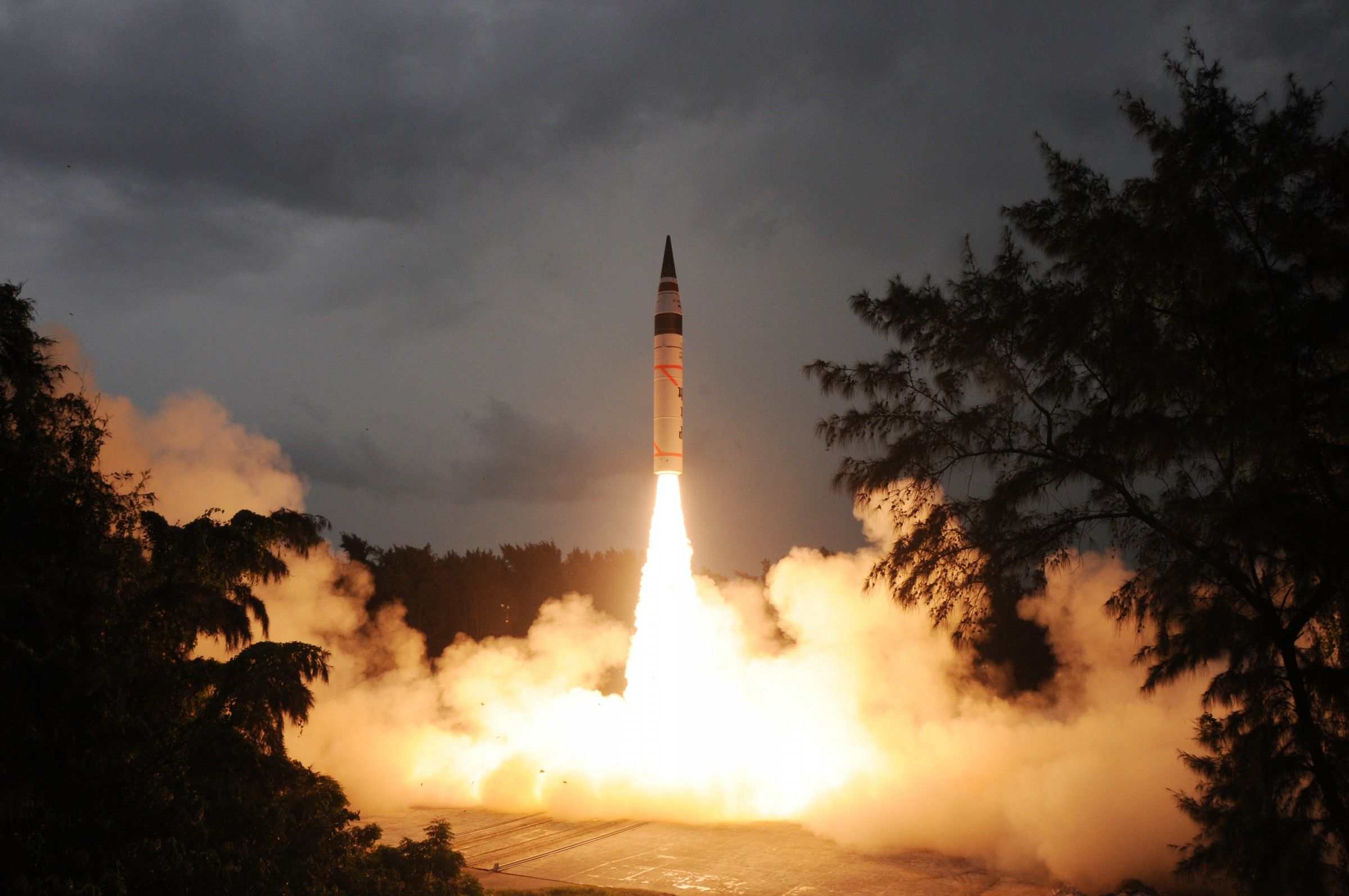

New Delhi: India may be slowly moving away from its long-assumed policy of storing nuclear warheads separately from delivery platforms during peacetime. According to the Stockholm International Peace Research Institute (SIPRI) Yearbook 2026, India operationally deployed 12 nuclear warheads in 2025, while modestly expanding its overall arsenal to around 190 weapons. If the assessment of the global arms watchdog is correct, it would mark one of the most important developments in India’s nuclear posture since it declared itself a nuclear weapons state.
Although New Delhi has not announced any change in its official nuclear doctrine, the SIPRI report points to a gradual shift towards higher operational readiness in response to an increasingly complex security environment shaped by China, Pakistan and evolving military technologies.
“It has long been assumed that India stores its nuclear warheads separate from its deployed launchers during peacetime. However, the country’s recent moves towards placing missiles in canisters and conducting sea-based deterrence patrols suggest that India could be shifting in the direction of mating some of its warheads with their launchers in peacetime,” the report states.
If true, the development would represent an important evolution in India’s nuclear posture rather than a departure from its declared doctrine. New Delhi continues to adhere to its ‘No First Use’ policy, under which nuclear weapons are meant solely for retaliation against a nuclear strike. The principle of maintaining a credible minimum deterrent also remains central to India’s strategic thinking.
The report does not indicate when the deployment may have taken place or identify the exact systems involved. However, it points to increasing operational readiness as India modernises its nuclear forces across land, air and sea.
A Changing Neighbourhood
India’s nuclear modernisation cannot be viewed in isolation. The country’s strategic planners are navigating a security environment shaped by an assertive China and a nuclear-armed Pakistan, both of which continue to upgrade their military capabilities.
“India is believed to have once again slightly expanded its nuclear arsenal in 2025,” SIPRI says, adding that the country “continued development of new types of nuclear delivery systems”.
According to the report, India’s long-range missile programme is increasingly focused on strengthening deterrence against China while preserving its ability to respond to challenges from Pakistan.
The Agni-V missile occupies a central place in that strategy. SIPRI observes, “With the potential to further develop the Agni as an intercontinental-range ballistic missile, India will acquire the ability to hold at risk the entirety of China’s territory, giving it deterrence parity but not numerical or overall strategic parity with China, as well as significantly complicating the China-India-Pakistan nuclear balance.”
The report also places India’s evolving posture in the context of the brief military confrontation with Pakistan in May 2025. The crisis demonstrated both the risks and restraints that accompany rivalry between two nuclear-armed neighbours.
“The brief armed conflict between India and Pakistan in May 2025 saw India attacking Pakistani air and missile bases that are likely to have nuclear-related roles, but both sides took steps to avoid escalation,” SIPRI notes.
At the global level, the think tank warns that nuclear deterrence is assuming greater importance in international politics. “Of the total global inventory of an estimated 12,187 warheads in January 2026, about 9,745 were in military stockpiles for potential use,” the report says.
It further adds, “Nearly all of these warheads belonged to Russia or the USA, and, to a lesser extent, France and the UK, but China and India may now occasionally deploy a small number of warheads mounted on missiles during peacetime.”
Strategic Stakes Rise
The nuclear assessment forms part of a broader picture of India’s expanding military capabilities and its efforts to adapt to a rapidly changing geopolitical environment.
SIPRI estimates that India’s military expenditure reached $92.1 billion in 2025, making it the world’s fifth-largest defence spender. Spending rose by 8.9% over the previous year, while the country accounted for 8.2% of global arms imports between 2021 and 2025, making it the second-largest importer worldwide.
The report also highlights the growing significance of submarine-based deterrence. India’s nuclear triad, comprising aircraft, land-based missiles and ballistic missile submarines, is steadily maturing, with sea-based assets offering a more secure second-strike capability.
At the same time, strategic competition across Asia continues to intensify. SIPRI points to military build-ups, technological advances and unresolved disputes as factors increasing the possibility of future crises.
“World events — not least the outbreak of conflict between nuclear-armed India and Pakistan — are challenging nuclear deterrence logic,” the report says, cautioning that the risks associated with nuclear weapons are becoming more pronounced.
For India, the reported deployment of 12 warheads is less about altering its declared doctrine than strengthening the credibility of its deterrent in a region marked by shifting power equations. Whether this represents a limited operational adjustment or the beginning of a long-term strategic shift, the SIPRI findings suggest that India’s nuclear posture is entering a more mature and complex phase, reflecting the realities of an increasingly contested Asian security order.