


New Delhi: India has stood out as one of the most resilient large emerging economies since 2020, according to a new report by Moody’s Ratings released on May 5. The country’s strong foreign exchange reserves have played a key role in limiting currency fluctuations and maintaining investor confidence during periods of global uncertainty, it noted.
Moody’s also highlighted that India is well prepared to handle future economic shocks. This is due to its transparent and consistent monetary policy framework, stable inflation expectations, and a flexible exchange rate system that can adjust as required.
Large emerging economies such as India have navigated an extraordinary cycle of global disruptions over the past five years without losing market access, underscoring the growing credibility of their policy frameworks and financial buffers.
In an in-depth assessment of sovereign resilience across emerging markets, the ratings agency said countries that undertook early structural reforms and built macroeconomic buffers were better equipped to withstand repeated episodes of global volatility since 2020. These shocks ranged from the Covid-19 pandemic to aggressive monetary tightening, banking stress in the US, and renewed tariff tensions.
“Relatively accommodative external market conditions in the wake of recent shocks helped emerging markets absorb successive external shocks since 2020. Market pressures over this period have been transmitted primarily through yield adjustment rather than through rising sovereign risk premia,” Moody’s said.
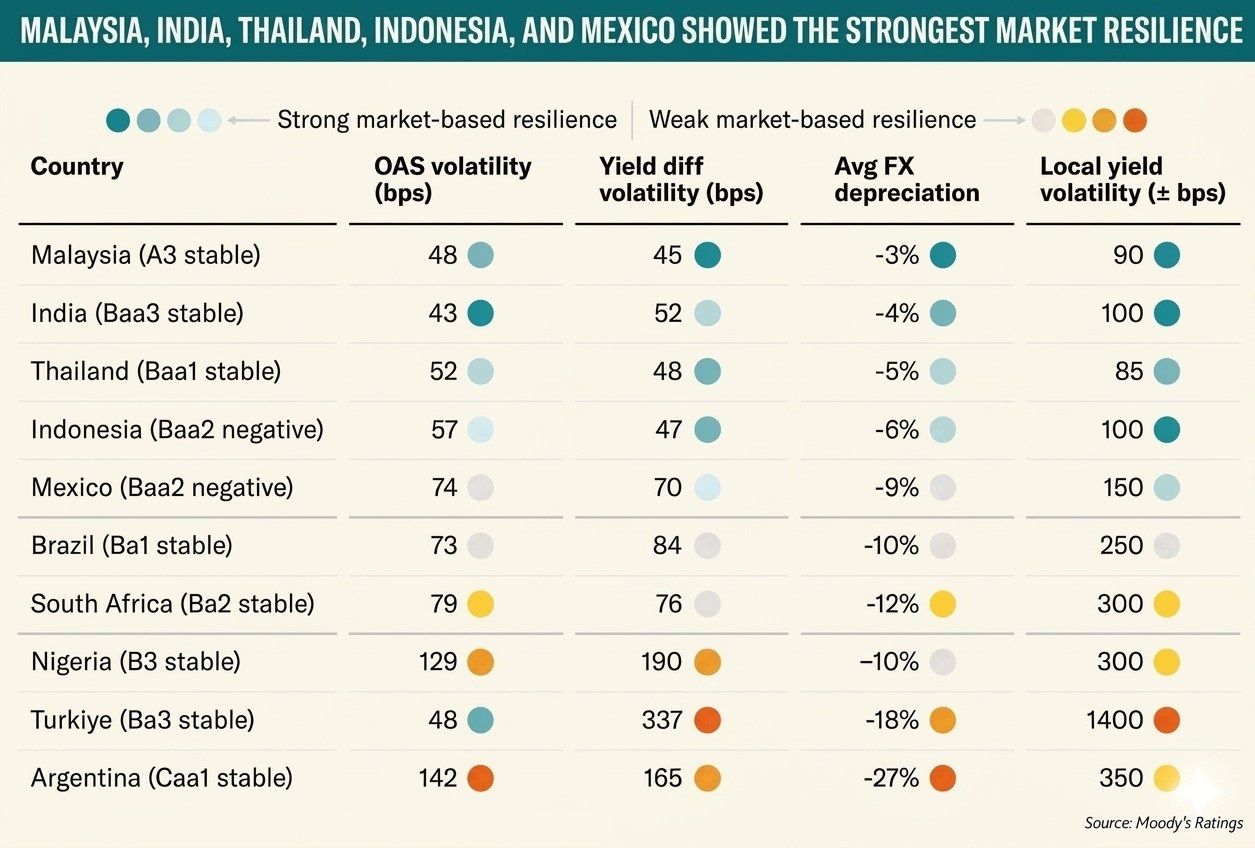
The report highlights that while resilience has been broad-based, outcomes have varied significantly across countries. “However, outcomes vary across countries, with some like India (Baa3 stable) showing the most resilience across a range of market indicators, and others like Türkiye (Ba3 stable) recording the most volatility, reflecting policy, balance sheet and credibility constraints,” it added.
The Moody’s analysis, based on indicators such as sovereign bond spreads, local currency yield volatility and exchange-rate movements, finds that India consistently ranks among the strongest performers. Alongside Malaysia, Thailand, Indonesia and Mexico, India demonstrated the ability to absorb shocks primarily through orderly price adjustments rather than through financing stress or disruptions in market access.
“Widening in hard currency credit spreads was limited and short-lived, emerging market-US yield differentials’ peak moves were moderate and exchange rate depreciation was contained,” the report noted. It added that local currency yield volatility, while elevated during stress episodes, remained well below that of more fragile peers, indicating stable and predictable market functioning.
A key differentiator has been the strength and credibility of India’s macroeconomic policy framework. The adoption of inflation targeting well before the recent cycle of shocks has anchored inflation expectations and reduced the risk of destabilising policy responses.
Moody’s emphasised that clear and predictable monetary policy, combined with exchange-rate flexibility, has allowed India to absorb external shocks without triggering sustained financial stress.
“India and Thailand (Baa1 stable) are well placed to manage future shocks because monetary policy frameworks are clear and predictable, inflation expectations are well anchored, and exchange rates can adjust when needed,” the report said.
The role of buffers has been equally critical. India entered recent crises with sizeable foreign-exchange reserves, which helped stabilise the currency and sustain investor confidence during periods of global risk aversion. The country’s deep domestic financial markets and balanced reliance on local funding have further insulated it from volatile external financing conditions.
Moody’s noted that improvements in structural policy, ranging from stronger debt management to greater reliance on local currency financing, have enhanced resilience across several emerging markets. Countries that acted early, rather than reacting during crises, have shown more durable stability across successive shocks.
The nature of recent global disruptions has also played to the advantage of emerging markets. Fiscal pressures, energy-led inflation and banking stress were largely concentrated in advanced economies, making large emerging markets relatively more attractive to global investors.
Despite these strengths, Moody’s flagged constraints that could limit India’s policy flexibility in future crises. High public debt and a relatively weak fiscal balance remain structural challenges that could restrict the government’s ability to respond aggressively during periods of stress. It noted that longer debt maturities have helped reduce rollover risks.
In contrast, more fragile economies such as Türkiye, Argentina and Nigeria continue to face persistent market stress, marked by sharp currency depreciation, volatile yields and recurring spikes in credit spreads. These vulnerabilities stem from delayed or inconsistent policy responses, weaker inflation anchoring and limited buffers.
The report evaluates resilience across four major stress episodes
- Onset of the Covid-19 pandemic in early 2020
- Global inflation surge and US Federal Reserve tightening cycle in 2022
- US regional banking stress in early 2023
- Renewed tariff tensions in 2025.
Moody’s concludes that resilience among large emerging markets is increasingly structural rather than cyclical. Countries like India that have built credible policy frameworks and substantial buffers are better positioned to absorb future shocks, even as global financial conditions become more challenging.
“Early policy adoption and substantial buffers are key to lasting resilience,” the agency said, reinforcing the view that proactive reform, rather than reactive adjustment, is the defining feature separating the strongest emerging markets from the rest.
(Cover photo by Vishal Kumar on Unsplash)