


New Delhi: Indian households sharply accelerated their shift towards financial assets in FY25, channeling a record ₹6.91 lakh crore into the securities market, with mutual funds accounting for nearly four-fifths of the total inflows. The dramatic rise, driven by retail participation, systematic investment plans and post-pandemic financialisation, has also forced a major rethink in how India measures household savings.
The findings emerge from the report, Household Savings through Indian Securities Market, authored by officials of the Securities and Exchange Board of India (SEBI). The report shows that household savings routed through the securities market surged from ₹3.58 lakh crore in FY24 to ₹6.91 lakh crore in FY25, reflecting the deepening penetration of capital market products among retail investors.
Mutual funds alone accounted for ₹5.44 lakh crore of the total household securities market savings during FY25, including primary and secondary market flows, underscoring the growing preference for professionally managed investment products amid rising market participation.
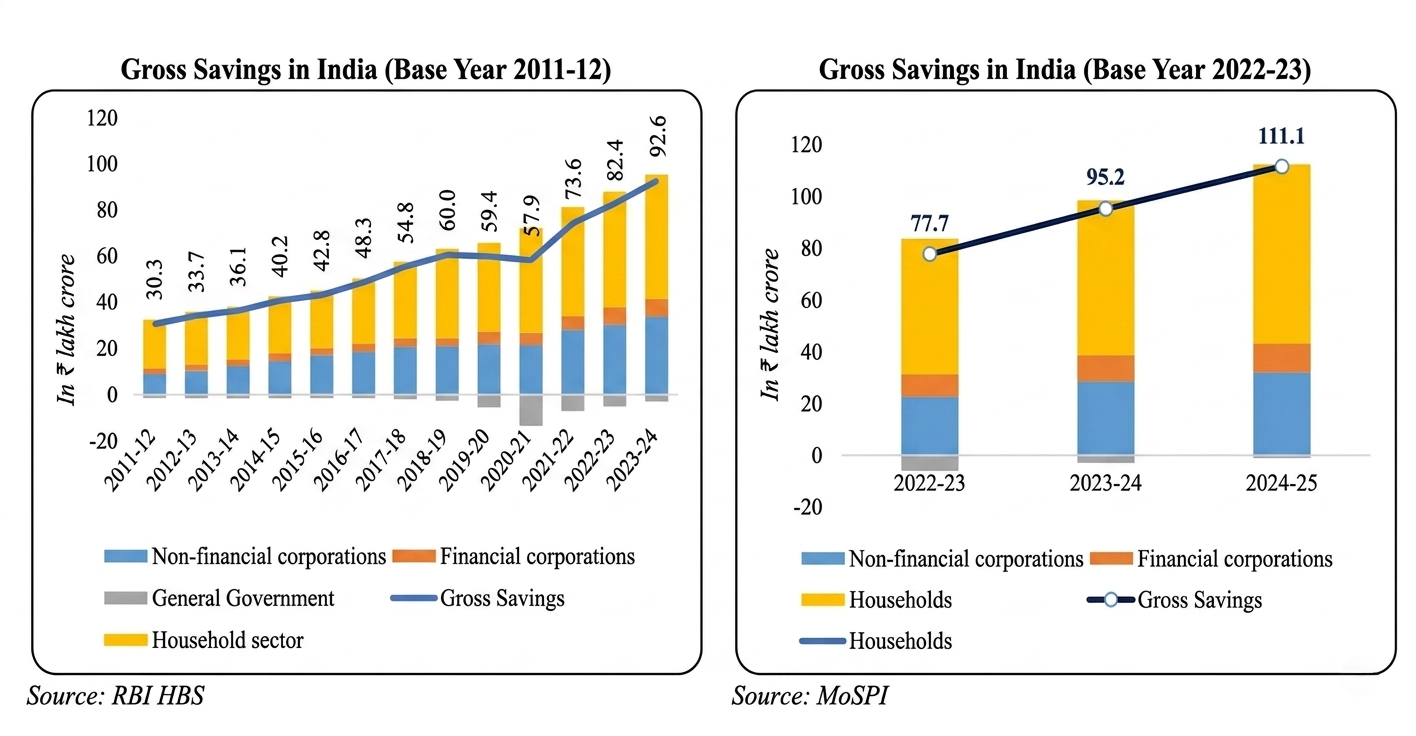
“The actual household savings through securities market is significantly higher than the earlier reported data on account of the comprehensive coverage considered in the computation. For FY 2024-25, the rate of gross savings to GDP has increased to 34.94%, which would have been 34.47% if the old methodology for computation of securities market investments continued. So, with the change in methodology, the under reporting of savings has been taken care of,” says the report.
Sebi Revises Methodology to Capture Real Retail Flows
The report marks a significant methodological shift in India’s national savings computation. Earlier estimates relied largely on approximations and covered only limited primary market investments. The revised framework now captures granular transaction-level data across equities, debt instruments, REITs, InvITs, exchange traded funds (ETFs) and secondary market investments.
The report notes that the previous methodology “focused solely on primary market issuances, sans certain channels of primary issuances like private placements”. It adds that “the secondary market transactions, and investments in REITs and InvITs were not part of the computation. Consequently, the reported figures did not fully reflect the total household savings flowing into the securities market.”
Under the revised methodology, household savings through securities markets rose to 2.17% of GDP in FY25, compared with 1.71% under the earlier estimation model. The recalibration also lifted the gross savings-to-GDP ratio by 47 basis points to 34.94%.
“Usage of actual granular data from primary sources provides a realistic and accurate picture of how Indian households channel savings into the economy and ensure better data quality for public policy and economic planning,” the report states:
Financial Assets Gain Ground Over Gold, Real Estate
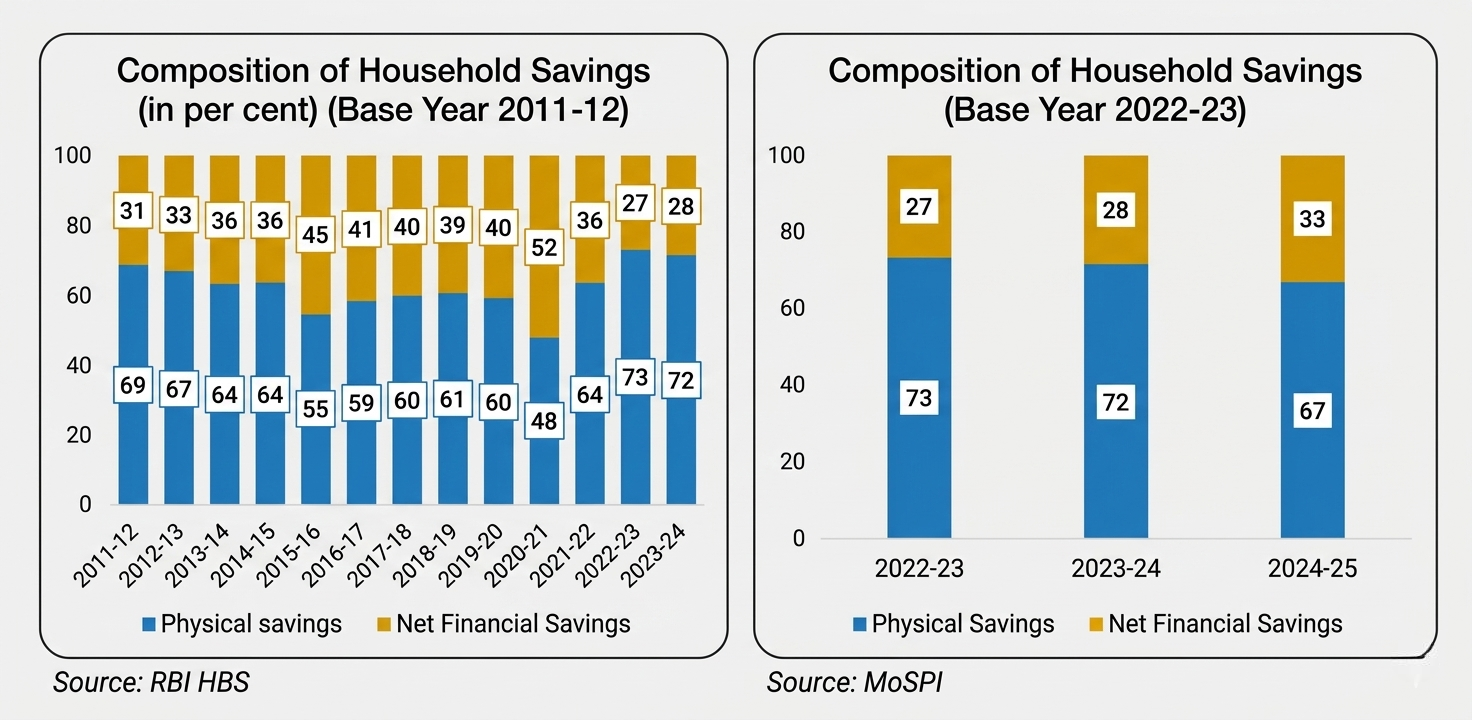
The data reflects a structural transformation in Indian household behaviour, with financial instruments increasingly competing with traditional savings avenues such as gold and real estate. Although physical assets still dominate household savings, the share of financial savings has steadily improved over the past three years.
According to the report, “Financial assets are gaining popularity due to their potential for higher returns and liquidity… Government initiatives such as tax benefits on investments, financial inclusion programs, and digital banking have also nudged Indian households towards financial assets.”
The securities market boom has been powered by a surge in retail demat accounts, rapid SIP expansion and wider participation in equity markets after Covid-19. Equity savings through the primary market almost doubled to ₹95,139 crore in FY25, while debt market investments remained resilient despite volatile interest rate cycles.
Importantly, the revised methodology now includes investments routed through private placements, municipal bonds, securitised debt instruments and newer asset classes such as REITs and InvITs, offering a broader picture of household participation in capital markets.
Retail Wealth in Securities Market Crosses ₹141L Crore
Beyond annual savings flows, the report also highlights the growing stock of household wealth accumulated in market-linked instruments. Household assets held in the Indian securities market climbed to ₹141.34 lakh crore at the end of FY25 under the revised methodology.
Equity holdings accounted for the largest share at ₹88.92 lakh crore, followed by mutual fund assets worth ₹44.39 lakh crore. The report also captured substantial holdings in debt securities, alternative investment funds, REITs and InvITs, categories that were previously under-represented in official datasets.
“In the absence of actual data, estimates do their best to compensate for a constituent in a computation. However, actual data provides superior value and factual picture. Thus, the computation using the actual granular data from primary sources gives a realistic picture about the household savings channelized through the securities market,” says the report.
The revised estimates are likely to strengthen the case that India’s retail investing culture is entering a new phase, with households increasingly viewing capital markets not merely as speculative avenues, but as core long-term savings vehicles.