
New Delhi: Indian consumers are not retreating from spending. They are becoming far more deliberate about where, why and how they spend, reflecting a new phase of calibrated consumption shaped by inflation concerns, economic uncertainty and evolving lifestyle priorities.
The latest edition of the Consumer Signals-India Chapter report by Deloitte points to a decisive behavioural shift in urban India, where consumers are trading volume for value and experiences while preserving financial resilience. Rising anxiety linked to geopolitical and economic developments is weighing on sentiment and near-term decisions, even as households continue to demonstrate confidence in their underlying financial stability.
“Sentiments towards financial well-being and purchasing power remain stable, but consumers are focusing on ‘where to spend’ rather than ‘how much to spend’,” says the report.
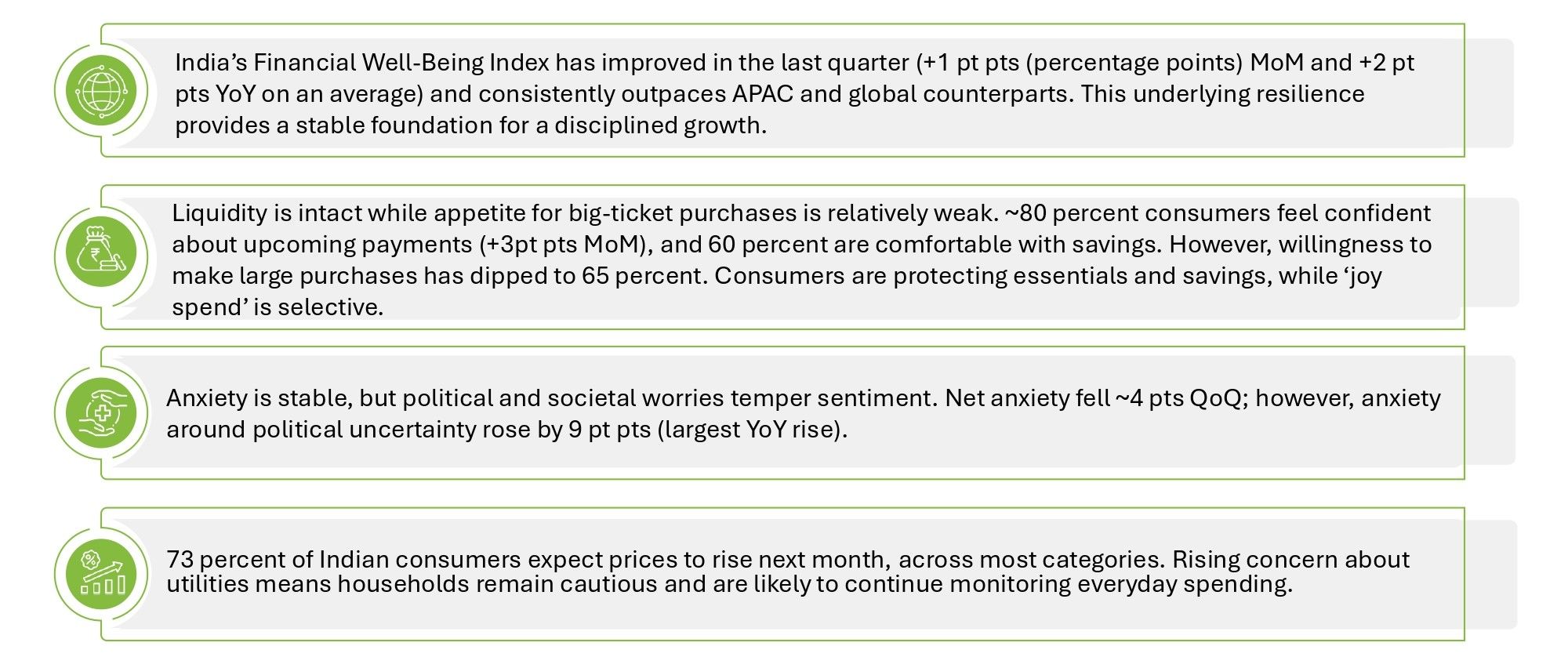
India’s Financial Wellbeing Index (FWBI) rose to 111.1 in March 2026 from 109.1 a year earlier, significantly outperforming both the Asia-Pacific region and global averages. Yet beneath that resilience lies growing caution. While 79% of consumers remain confident about meeting upcoming payments, willingness to make large discretionary purchases slipped to 65%.
The report indicates a clear shift in where Indian consumers are choosing to spend. “Rising anxiety linked to geopolitical and economic developments is weighing on sentiment and near-term decisions,” it notes.
Inflation worries continue to dominate household thinking. Nearly 73% of Indian consumers expect prices to rise across categories next month, particularly in utilities, fuel and food. Anxiety around political uncertainty and societal unrest has also risen sharply over the past year, tempering otherwise stable financial sentiment.
Against that backdrop, consumers are becoming increasingly selective rather than uniformly frugal.
‘Premiumisation’ Gains Pace
The sharpest evidence of this selective spending is emerging in travel and hospitality, where consumers are increasingly willing to pay more for comfort, reliability and curated experiences even as overall travel intent softens.
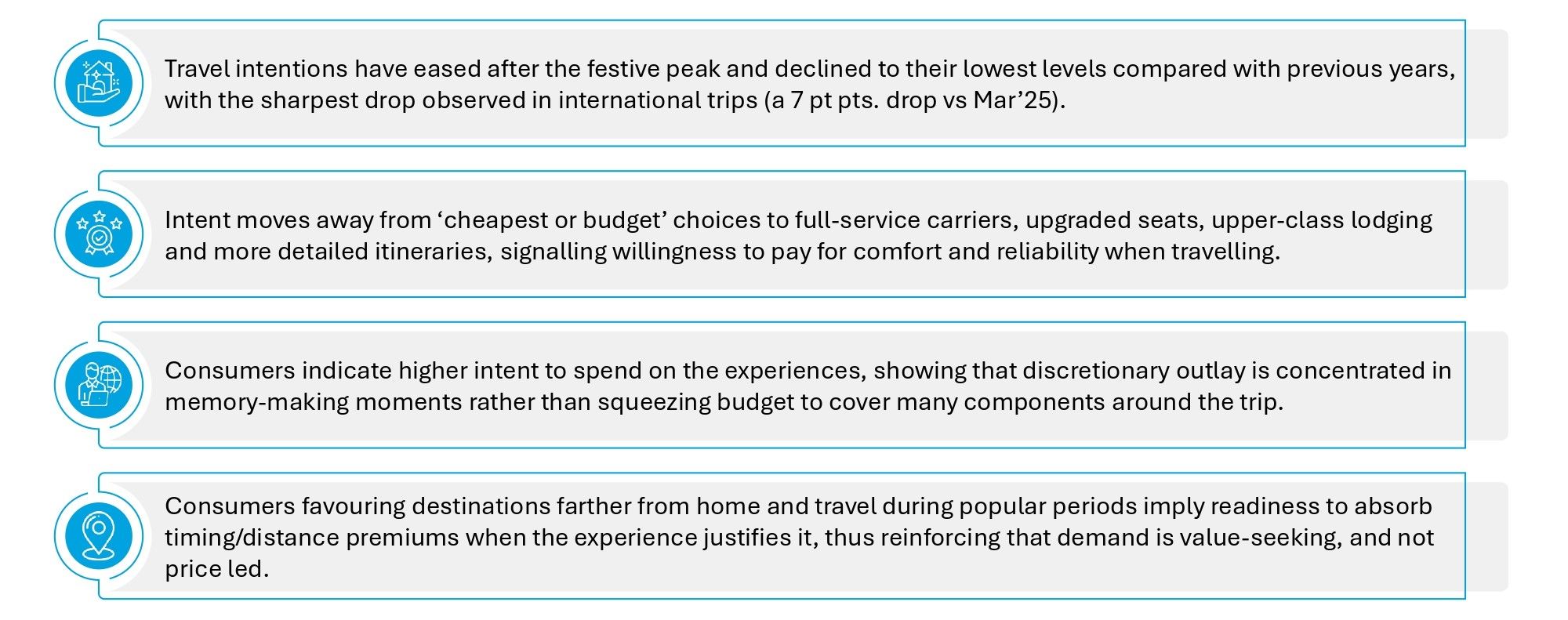
“Travel intentions have eased after the festive peak and declined to their lowest levels compared with previous years, with the sharpest drop observed in international trips,” says the report. Yet consumers are simultaneously moving away from low-cost choices towards premium travel formats.
“Intent moves away from ‘cheapest or budget’ choices to full-service carriers, upgraded seats, upper-class lodging and more detailed itineraries, signalling willingness to pay for comfort and reliability when travelling.”
Consumers are also spending more consciously on experiences that deliver emotional value rather than broad discretionary indulgence.
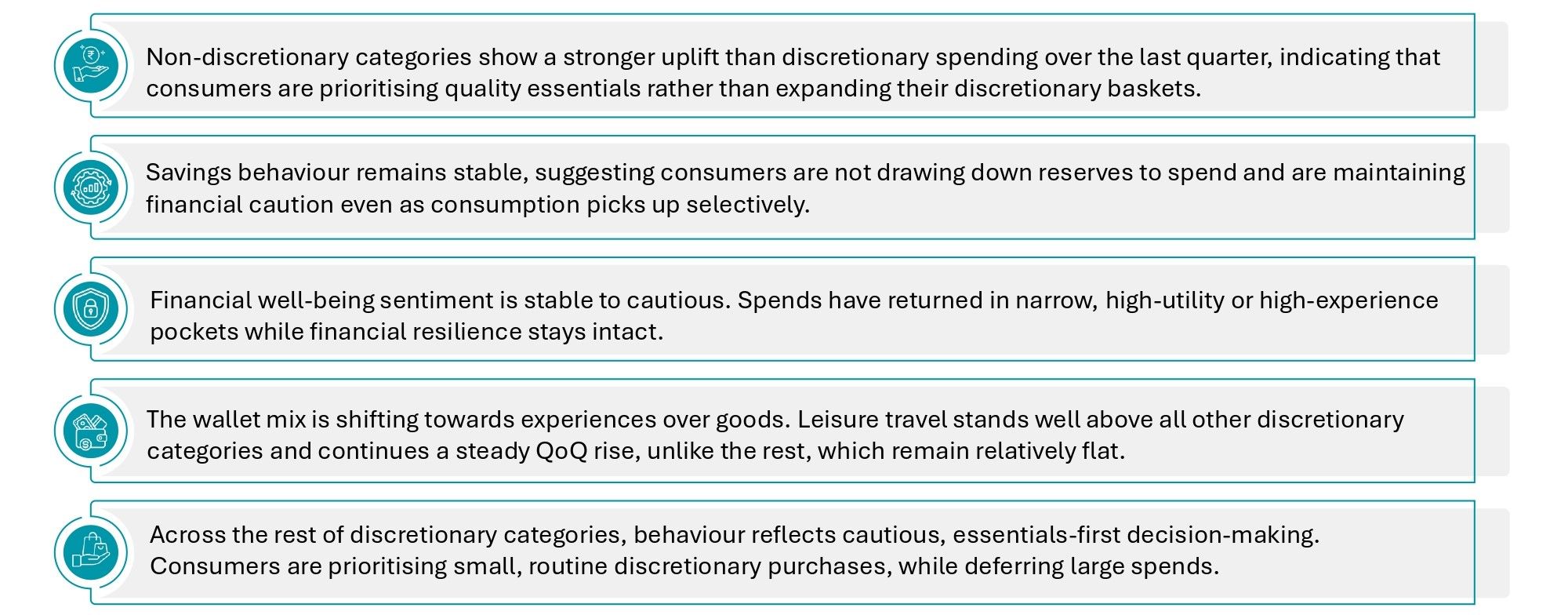
“The wallet mix is shifting towards experiences over goods. Leisure travel stands well above all other discretionary categories and continues a steady QoQ rise,” says the report.
That behavioural transition extends well beyond travel. Deloitte says Indian households are prioritising optimisation over sacrifice, particularly in food consumption, where quality remains largely protected despite rising prices.
“With 31% reducing home food waste, consumers are stretching budgets through planning and portion control, signalling a preference for smarter usage over cutting items out of their meal plans,” reveals the report.
Only 11% of consumers reported buying less food than desired, while around 12% traded down to lower-cost options, suggesting that meaningful compromise remains limited to a smaller segment of households. The broader pattern reflects intelligent spending rather than distress-led consumption cuts.
Aspirational Yet Cautious
The Deloitte report finds Indian consumers are entering a structurally different consumption cycle — one defined by sharper prioritisation, measured aspiration and long-term financial prudence.
“Indian consumers are entering a phase of calibrated consumption. They are becoming more mature and resilient, balancing aspiration with financial discipline and intentional decision-making. Households are not stepping back from consumption; they are becoming sharper about where value lies, prioritising essentials, upgrading experiences and deferring large commitments. Improved food frugality and stable savings behaviour reinforce this shift. At the same time, continued interest in EVs points to a growing focus on future readiness,” said Anand Ramanathan, Partner and Consumer Industry Leader, Deloitte South Asia.
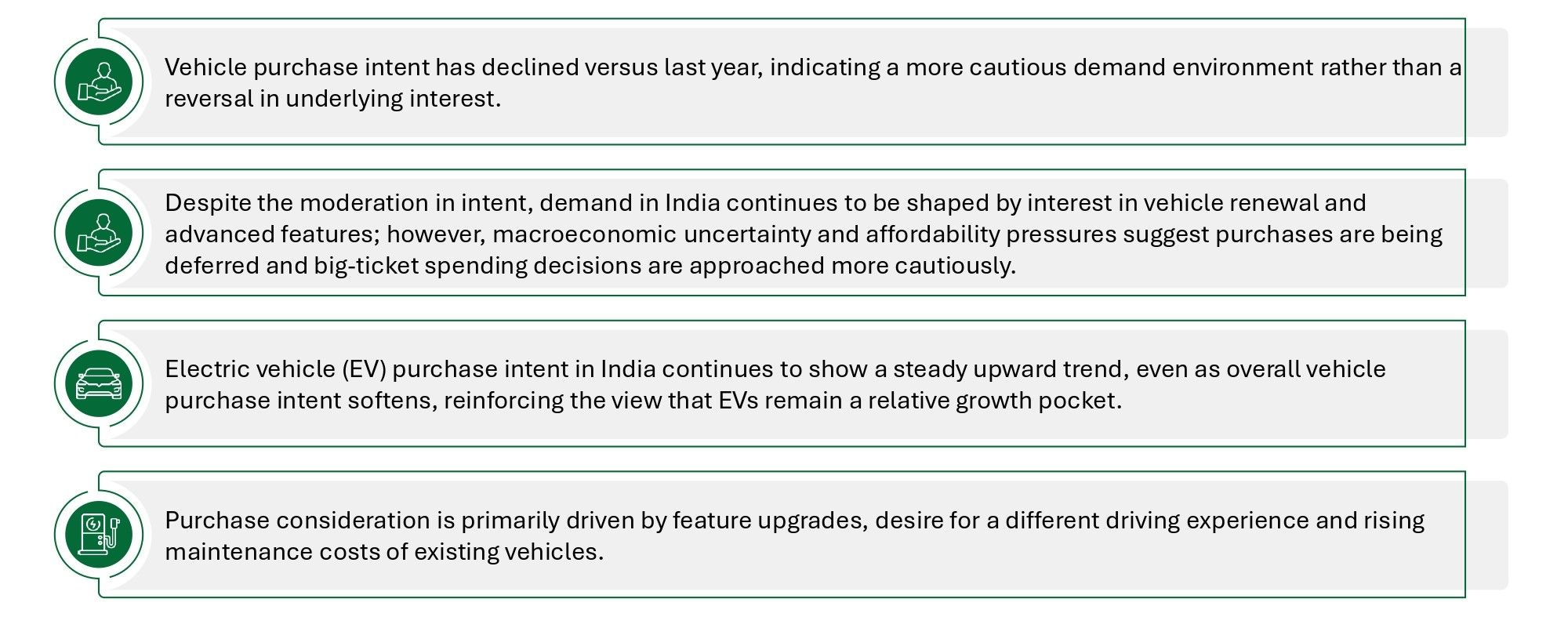
The same pattern is visible in automobile purchases. Vehicle Purchase Intent (VPI) moderated to 85.2 in March 2026 as consumers delayed large commitments amid economic uncertainty. Around 43% of respondents said their existing vehicles still met their needs, while 12% were reluctant to undertake major expenses in the current environment.
At the same time, electric vehicles continue to buck the broader slowdown. EV purchase intent has held steady at 60%, supported by demand for advanced technology, lower maintenance costs and sustainable mobility alternatives.
“Electric vehicle (EV) purchase intent in India continues to show a steady upward trend, even as overall vehicle purchase intent softens, reinforcing the view that EVs remain a relative growth pocket,” says the report.
For India Inc, the message is becoming increasingly clear. Consumers remain resilient and aspirational, but they are rewarding businesses that deliver differentiated value, reliability and meaningful experiences rather than pure affordability. The era of indiscriminate consumption is fading, replaced by a more mature consumer mindset that values intentional spending over excess.