

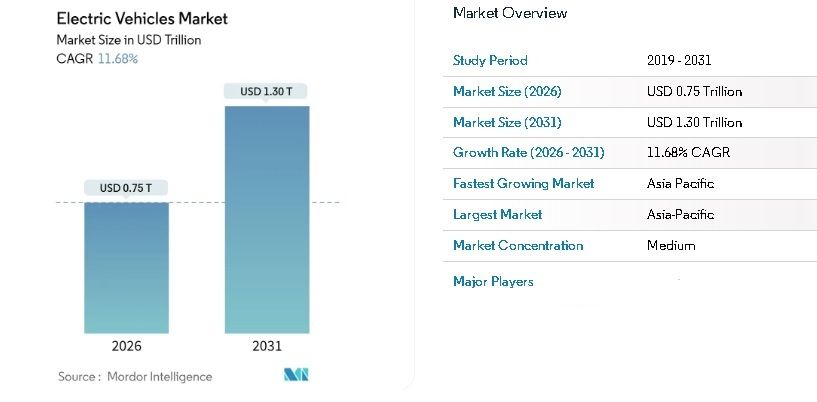
New Delhi: The global electric vehicles market is entering a high-growth phase, with its value expected to rise from $0.67 trillion in 2025 to $0.75 trillion in 2026, and further expand to $1.30 trillion by 2031, reflecting a compound annual growth rate of 11.68%, according to Mordor Intelligence’s latest report.
The research firm attributes the accelerating momentum to the convergence of several structural and technological factors. Declining battery pack costs, rapid deployment of 350 kW and higher-capacity fast-charging corridors, and tightening fleet-average CO₂ regulations across China, the European Union and the United States are collectively reshaping the competitive landscape.
Battery electric vehicles already account for more than 70% of total unit sales, while Asia-Pacific contributes over half of global demand, supported largely by China’s large-scale lithium-iron-phosphate production.
Automakers are increasingly transitioning to 400-800V vehicle architectures, enabling sub-20-minute charging times and improving overall consumer convenience, says the report. At the same time, commercial fleet operators are accelerating electrification as total cost of ownership for electric vehicles falls below that of diesel alternatives in multiple use cases. Despite intensifying competition, the market remains moderately concentrated, with BYD, Tesla and SAIC together controlling roughly one-third of global share, even as established automakers are ramping up production capacity to meet emission targets.
Stricter Standards
Regulatory momentum is playing a central role in shaping the industry’s trajectory. China has strengthened its dual-credit requirements, the European Union has tightened emission standards, and California’s Advanced Clean Cars II framework is approaching implementation.
According to the Mordor Intelligence report, these policy shifts are directing capital flows toward zero-emission vehicle programs at an unprecedented pace. In Europe, the threat of steep non-compliance penalties has prompted automakers such as Volkswagen, Stellantis and General Motors to realign research and development priorities, it says. Many legacy manufacturers are accelerating dedicated electric vehicle platforms while scaling back new internal combustion engine programs, underscoring how regulation is redefining long-term strategy, it adds.
Technological innovation is further reinforcing market growth. The Mercedes-Benz Vision EQXX concept highlighted the potential of advanced silicon-carbon anodes to significantly extend driving range without increasing battery size. Material advancements from companies such as Sila Nanotechnologies are bringing silicon-based battery technologies closer to large-scale commercialization, with expectations of continued improvements in energy density.
The report highlights that earlier durability concerns are gradually easing as nano-engineered silicon materials and improved binders enhance battery stability. As these innovations mature, longer driving ranges are becoming more common in mainstream crossover models, helping reduce range anxiety and encourage consumer adoption.
China’s Dominance
Regionally, Asia-Pacific remains the epicentre of global electric vehicle demand. China continues to dominate sales, driven by rapid scale-up of LFP blade batteries, while India’s production-linked incentive schemes are strengthening domestic manufacturing, says the report. South Korean automakers Hyundai and Kia are expanding export volumes, Japan is increasing subsidies to stimulate adoption, and emerging Southeast Asian hubs such as Thailand and Indonesia are attracting investment through tax incentives and access to raw materials. Mordor Intelligence notes that this broad-based industrial expansion reinforces the region’s leadership in electric mobility.
In North America, supportive federal and state-level policies are encouraging domestic assembly and localized supply chains. Tesla maintains a strong position in the US battery electric vehicle segment, while General Motors, Ford and Stellantis are expanding production capacity in an effort to narrow the competitive gap.
Canada’s zero-emission vehicle mandate closely aligns with California’s roadmap, and Mexico is leveraging trade advantages to attract new battery investments. Although challenges persist around rural charging access and grid readiness, infrastructure rollout continues to accelerate under policy support.
“Electric vehicle adoption continues to reflect regulatory direction, investment flows, and evolving consumer demand across regions. Mordor Intelligence's structured research approach, grounded in cross-verified industry data and consistent market tracking, provides decision-makers with dependable view compared with fragmented or single-source analyses,” said Phani Kumar, Senior Research Manager at Mordor Intelligence.