


New Delhi: The automotive industry is entering a structural transition that is less visible than electrification and less celebrated than autonomy, yet potentially more disruptive than either.
By end-2026, cybersecurity exposures linked to opaque and untraceable software are predicted to rival — and in some cases overtake — defective physical components as the leading trigger for vehicle recalls. What was once the domain of IT security teams is becoming a core product risk, with direct implications for brand equity, market access, and financial performance.
Modern vehicles are no longer primarily mechanical systems augmented by electronics. They are increasingly software-defined platforms running millions of lines of code across distributed control units and centralized computing architectures. Over-the-air updates can modify vehicle behaviour long after production. Advanced driver assistance systems, battery management, thermal optimization, infotainment, charging, and fleet connectivity are all software-governed.
In this environment, a software vulnerability is not simply a technical flaw. It can represent a safety defect, a compliance failure, or a regulatory breach. If exposure enables remote exploitation or compromises safety-critical functionality, it can escalate into a recall event. The distinction between cybersecurity incident and product defect is dissolving.
The technical root of the problem is traceability. Many automotive organizations still struggle to determine which software components are installed in which vehicle variants, sourced from which suppliers, and with what dependencies. A single electronic module can integrate proprietary code, open-source libraries, semiconductor firmware, and third-party middleware — often delivered to OEMs as black-box systems. When a vulnerability is disclosed, identifying exposure requires a precise software bill of materials mapped to production batches. Without this visibility, response time stretches from hours to weeks, increasing regulatory and financial risk.
Auditable Cybersecurity
Frameworks such as UNECE WP.29 now require auditable cybersecurity management systems. Compliance demands demonstrable control over software supply chains and lifecycle monitoring. In effect, cybersecurity governance is becoming a prerequisite for type approval in major markets.
At the same time, electrification and connectivity are expanding supplier networks and software complexity. The average vehicle contains thousands of semiconductors and dozens of networked units. Data about component provenance, software versions, carbon intensity, and certifications is no longer optional metadata; it is essential to product launch and cross-border trade.
Proof requirements are tightening. The EU’s Digital Battery Passport mandates lifecycle transparency for EV batteries. Due diligence obligations on environmental and human rights standards are expanding. In many cases, compliance depends on producing structured, verifiable supply chain evidence.
Yet much automotive information still flows through spreadsheets, PDFs and bespoke integrations. These systems function in stable conditions but fail under disruption. When cyber-incidents or audits occur, retrieving harmonized data can take weeks, delaying launches and eroding trust.
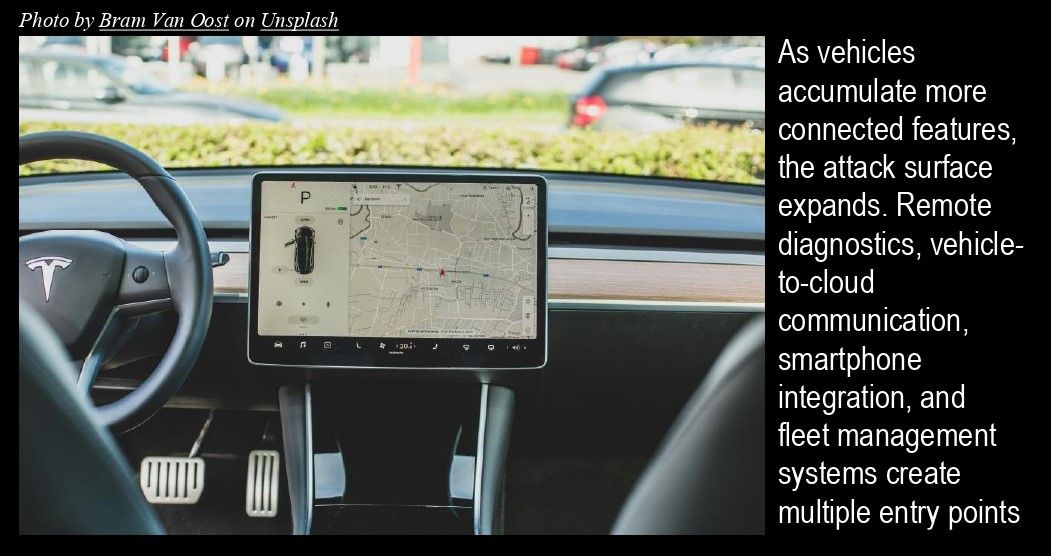
The digital supply chain — the flow of software dependencies and compliance documentation — remains less mature than physical logistics. As vehicles accumulate connected features, the attack surface expands. Even rare cybersecurity incidents can damage consumer trust and brand positioning.
Managing software as a living, evolving component requires continuous oversight. Organizations need automated monitoring tools that correlate vulnerability disclosures with internal inventories. Manual processes cannot scale to millions of vehicles and thousands of components.
The transition to software-defined vehicles therefore demands a corresponding shift in governance architecture. Comprehensive software bills of materials, standardized data exchange, and lifecycle traceability must become foundational. Companies that master data interoperability can reduce recall exposure, accelerate compliance, and respond faster to market shifts.
Beyond compliance, competitive differentiation will increasingly depend on resilience. Investors are beginning to evaluate cybersecurity maturity alongside quality metrics and ESG disclosures. Insurers are reassessing product liability exposure in light of software risk. Suppliers that cannot provide transparent, machine-readable documentation may find themselves excluded from global platforms. Conversely, those that embed security-by-design principles and maintain real-time component visibility can shorten validation cycles and reduce warranty volatility.
By 2026, the industry’s risk landscape will be defined as much by information architecture as by hardware reliability. Cybersecurity exposure will not simply be a technical issue but a strategic variable shaping capital allocation and competitiveness. Organizations that invest in transparent and secure data ecosystems will be better positioned in a market where evidence — not assumption — underpins trust.
(Cover photo by Dextar Vision on Unsplash)