


New Delhi: India’s continued progress in improving newborn and child health outcomes provides a measure of optimism at a time when global gains in child survival are slowing, according to a new report estimating that 4.9 million children died before their fifth birthday in 2024, a vast majority from preventable causes.
The report titled ‘Levels & Trends in Child Mortality’, released by the United Nations Inter-agency Group for Child Mortality Estimation, paints a complex picture of sustained long-term improvement tempered by recent stagnation. While under-five deaths worldwide have dropped by more than 50% since 2000, the pace of reduction has slowed by over 60% since 2015, raising alarm among policymakers and health experts.
India’s trajectory stands out within this global context. With its vast demographic and socio-cultural diversity, the country has made consistent gains through a strong, centrally guided yet state-driven public health system. A continuum-of-care approach — spanning antenatal services, skilled care at birth, and postnatal support — has been central to these improvements. Flagship programmes such as Janani Suraksha Yojana and Janani Shishu Suraksha Karyakram have helped expand institutional deliveries and reduce financial barriers, while investments in infrastructure, including special newborn care units and mother newborn care units, have strengthened last-mile service delivery.
Digital innovations such as Tele-SNCU and a focus on quality improvement through evidence-based guidelines have further enhanced care, particularly for vulnerable populations in remote regions. India has also taken a lead in stillbirth surveillance, signalling a shift towards more comprehensive maternal and child health monitoring.
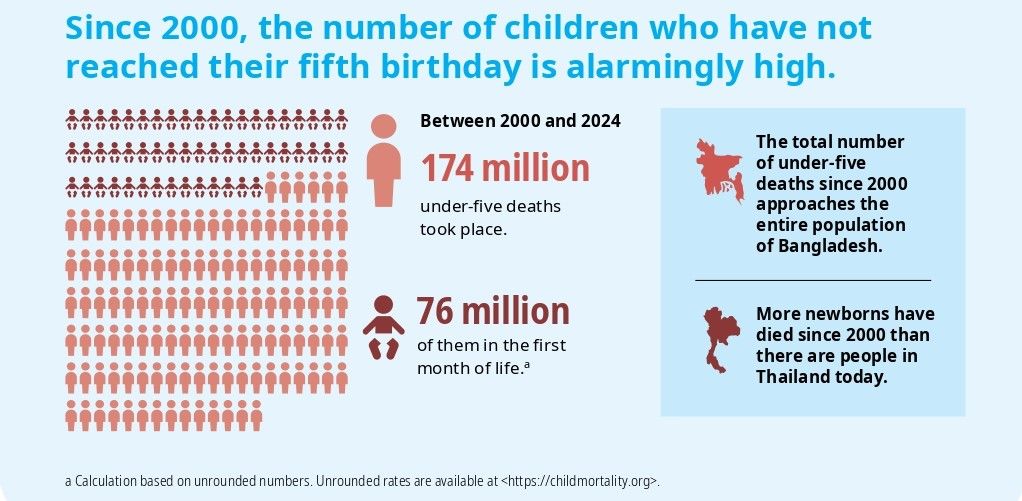
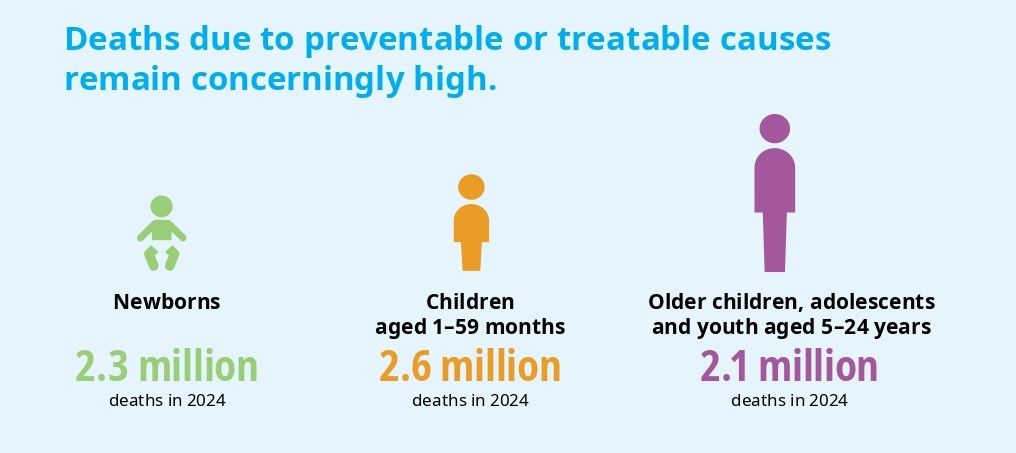
Globally, however, the report underscores persistent and, in some cases, widening inequalities. Newborn deaths accounted for nearly half of all under-five mortality in 2024, reflecting slower progress in addressing risks around childbirth. Complications from pre-term birth were responsible for 36% of newborn deaths, while complications during labour and delivery accounted for 21%. Infections, including neonatal sepsis, and congenital anomalies also contributed significantly.
“No child should die from diseases that we know how to prevent,” said Catherine Russell, Executive Director of UNICEF. She warned that “we see worrying signs that progress in child survival is slowing – and at a time where we’re seeing further global budget cuts,” underscoring the risk that hard-won gains could be reversed without sustained investment.
Beyond the first month of life, infectious diseases remain the dominant threat. Malaria continues to be the single largest killer among children aged 1-59 months, accounting for 17% of deaths, followed by pneumonia and diarrhoeal diseases. These deaths are heavily concentrated in sub-Saharan Africa, where health systems face challenges ranging from conflict and climate shocks to drug resistance and limited access to preventive tools.
Tedros Adhanom Ghebreyesus, Director-General of the World Health Organization, said the findings highlight both progress and urgency. “The world has made remarkable progress in saving children’s lives, but many still die from preventable causes,” he said, adding that children in conflict settings are nearly three times more likely to die before their fifth birthday. “We must protect essential health and nutrition services and reach the most vulnerable families so every child has the chance not only to survive, but to thrive.”
The report also, for the first time, provides estimates of deaths directly attributable to severe acute malnutrition (SAM), identifying more than 100,000 such deaths among children aged 1-59 months — about 5% of mortality in this age group. However, the authors caution that this figure likely underestimates the true burden, as malnutrition often acts as an underlying condition that increases susceptibility to other diseases and is frequently underreported.
Geographic disparities remain stark. Sub-Saharan Africa accounted for 58% of all under-five deaths in 2024, with infectious diseases responsible for more than half of these fatalities. Southern Asia, including India, contributed 25% of global under-five deaths, with mortality largely driven by preventable complications in the neonatal period. By contrast, the share of deaths linked to infectious diseases drops sharply to 9% in Europe and Northern America and 6% in Australia and New Zealand.
“These findings are a collective call to speed up implementation of the proven, scalable solutions we know are within reach,” said Monique Vledder of the World Bank Group, pointing to the importance of expanding access to quality primary healthcare services.
Fragile and conflict-affected settings continue to bear a disproportionate share of the burden, with children born in these environments facing significantly higher mortality risks. The report further estimates that 2.1 million children, adolescents, and youth aged 5-24 died in 2024. While infectious diseases and injuries dominate among younger children, causes shift in adolescence — with self-harm emerging as the leading cause of death among girls aged 15-19 and road traffic injuries among boys.
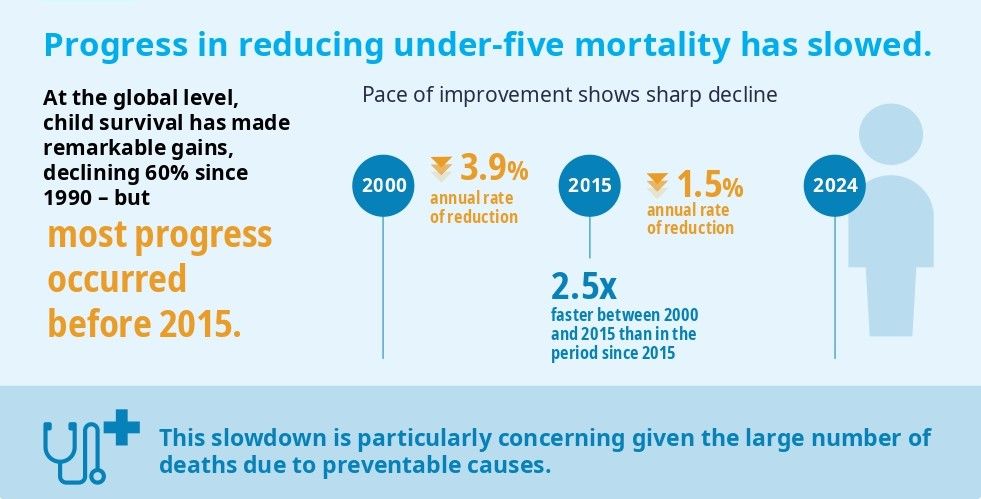
Li Junhua, speaking on behalf of the United Nations, warned that many countries are falling behind global targets. He described the findings as “a stark reminder that progress on child survival is slowing and too many countries are off track to meet the Sustainable Development Goals,” calling for renewed political commitment, sustained investment in primary healthcare, and stronger data systems.
Experts emphasise that solutions are well established and highly cost-effective. Expanding immunisation, improving nutrition, ensuring skilled attendance at birth, and strengthening community-based healthcare systems could prevent millions of deaths. According to the report, every dollar invested in child survival can generate up to twenty dollars in broader social and economic benefits.
India’s experience illustrates what sustained political commitment and strategic investment can achieve at scale. Yet the global slowdown highlighted in the report signals that without renewed urgency — particularly in the most vulnerable regions — preventable child deaths will remain a persistent and unacceptable reality.
(Cover photo by Isaac Quesada on Unsplash)