

New Delhi: The oil price spiral triggered by the West Asia war and mounting fears over supply disruptions through the Strait of Hormuz have pushed India to accelerate the next phase of its ethanol-blending strategy, with the government now formally laying the technical groundwork for blending petrol with up to 30% ethanol.
In a notification issued on Tuesday (May 18), the Bureau of Indian Standards (BIS) notified specifications for E22, E25, E27 and E30 fuel blends, creating the regulatory architecture for higher ethanol-mixed petrol beyond the current nationwide E20 rollout. The move comes at a time when geopolitical tensions have renewed concerns over India’s dependence on imported crude oil, especially as nearly 20% of the world’s oil supply passes through the Strait of Hormuz.
The BIS notification covers technical standards for “admixture of anhydrous ethanol and motor gasoline for usage in the positive ignition engine-powered vehicles”, including specifications related to octane ratings, sulphur content, water limits, vapour pressure, corrosion resistance and fuel stability. The standards came into force from May 15, 2026.
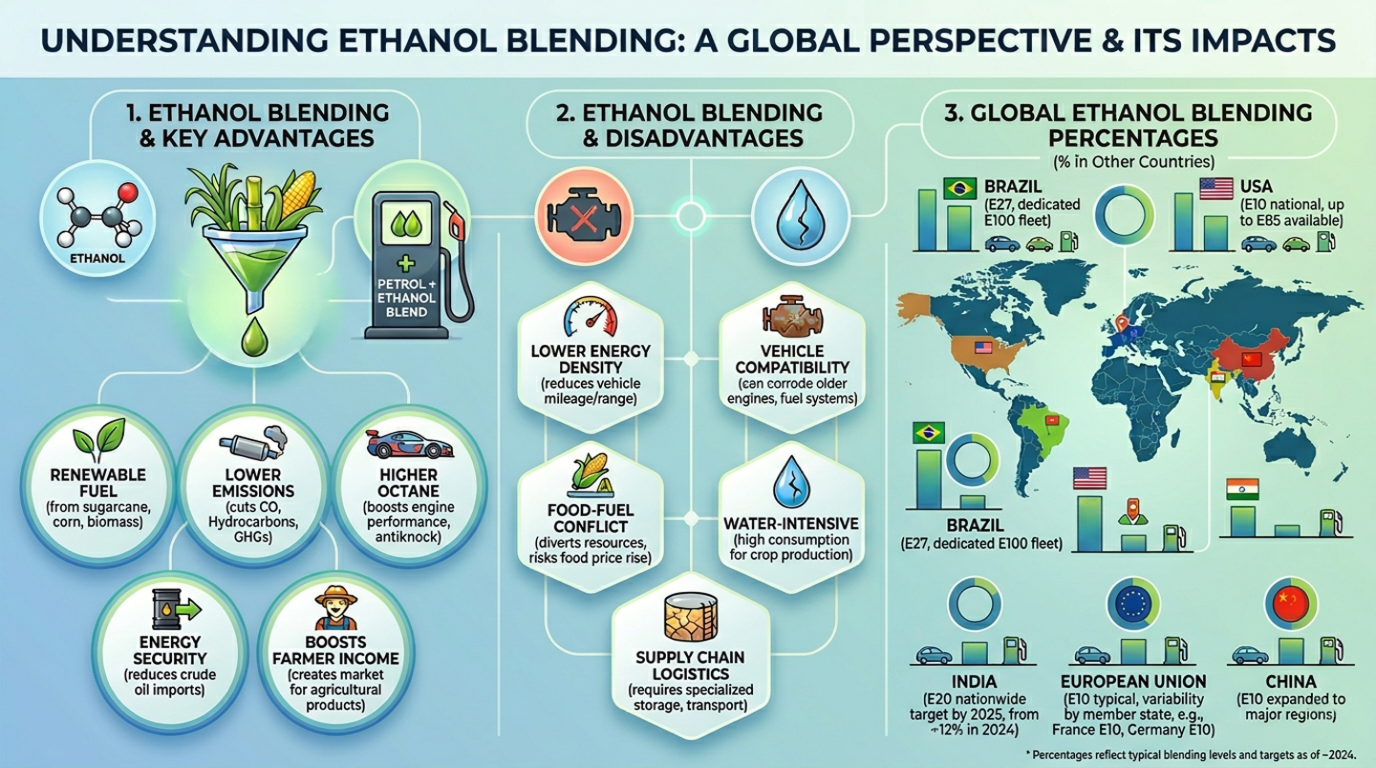
While the notification does not mandate immediate nationwide retailing of E30 fuel, it signals the Centre’s intent to move beyond E20 as India prepares for the next stage of its biofuel transition. The government had earlier advanced the E20 blending target from 2030 to 2025-26, making India one of the fastest large economies to scale ethanol use in transport fuel.
The timing is significant. Crude oil volatility linked to the conflict in West Asia has once again exposed India’s vulnerability to imported energy shocks. Industry executives say the latest push towards higher ethanol blends is now being viewed not merely as an environmental programme but increasingly as a strategic energy-security intervention.
Ethanol Lobby Pressure
The move also follows sustained lobbying by ethanol producers, sugar mills and distillery associations that have repeatedly demanded higher blending targets amid rising domestic ethanol capacity and concerns over surplus production.
The All India Distillers’ Association (AIDA), one of the strongest advocates of higher ethanol blending, has in recent months urged the government to move gradually from E20 to E30 while simultaneously fast-tracking flex-fuel vehicle deployment.
In a statement issued after the BIS notification, AIDA president Vijendra Singh said, “It’s a progressive and forward-looking step that reinforces the government’s long-term commitment towards higher ethanol adoption, reduced crude oil dependence, and a cleaner mobility ecosystem.”
Singh further added: “The introduction of E25 fuel standards will provide interim relief to the industry by helping absorb the current surplus sugar and ethanol production capacities.”
Earlier this year, AIDA had directly linked higher ethanol blending to crude oil disruptions arising from the West Asia conflict. In a letter to Union Road Transport Minister Nitin Gadkari, AIDA deputy director general Bharati Balaji wrote, “Now with the Middle East entangled in a war and oil prices having started increasing, we as an ethanol industry are ready to offer ethanol more than 20% which will reduce proportionally the import of crude.”
The ethanol industry has simultaneously pushed for commercialisation of flex-fuel vehicles capable of operating on significantly higher ethanol concentrations, including E85 and E100, similar to Brazil’s fuel ecosystem.
At AIDA’s annual conclave earlier this year, Vijendra Singh said, “We have the technology and the infrastructure in place. There is no reason why ethanol blending cannot be gradually increased to 30%.”
Industry bodies argue that India’s ethanol production capacity has already outpaced current procurement levels. According to Indian Sugar & Bio-Energy Manufacturers Association (Isma) data, India’s installed ethanol production capacity has reached nearly two billion litres, while procurement by oil marketing companies remains around one billion litres. The sector currently operates more than 380 distilleries, with another 33 facilities planned.
Executives from sugar-producing companies and grain-based distilleries have repeatedly argued that higher blending ratios are necessary to improve capacity utilisation, support farmer incomes and prevent oversupply pressures in the ethanol market.
Auto Industry Readiness
The shift towards E30, however, places fresh pressure on automobile manufacturers, fuel retailers and component suppliers to prepare for higher ethanol-compatible infrastructure.
The new BIS standards are aimed at ensuring fuel compatibility with engines, fuel injection systems and vehicle components as India gradually expands flex-fuel mobility. Automobile manufacturers have already begun testing and showcasing flex-fuel models, though industry executives acknowledge that a full-scale transition would require substantial investments in vehicle engineering, fuel systems and retail infrastructure.
Auto industry executives said manufacturers are “technically prepared” to comply with any new government-mandated norms and have the capability to meet such requirements if implemented across the sector. Scaling up beyond E20 will require oil marketing companies to invest in dedicated storage tanks, modified dispensing systems and changes to fuel logistics infrastructure, they added. Flex-fuel deployment would also need alignment between automakers, fuel availability and regional climatic conditions.
Automobile companies have privately expressed concerns over transition timelines, particularly given ongoing adaptation to E20-compatible engines. Several industry experts caution that moving aggressively towards E30 without adequate infrastructure and compatibility standards may create operational challenges across India’s highly diverse vehicle ecosystem.
At the same time, auto manufacturers are increasingly aware that flex-fuel capability may become strategically necessary as the government deepens its focus on import substitution and biofuel adoption.
Import Reduction Push
The Centre continues to frame higher ethanol blending as a critical instrument for reducing India’s crude oil dependence, strengthening domestic agriculture and lowering transport-sector emissions.
India imports nearly 85% of its crude oil requirement, making the economy highly vulnerable to global price shocks. Policymakers believe higher ethanol blending can reduce foreign exchange outflows while simultaneously creating stable demand for sugarcane, maize and grain-based feedstock.
AIDA has also argued that ethanol blending should extend beyond petrol. At an industry roundtable earlier this year, the association proposed ethanol-diesel blending as the next major biofuel opportunity, particularly because diesel accounts for nearly 40% of India’s fuel consumption.
The government is also evaluating the long-term feasibility of even higher blends such as E85 as part of a broader flex-fuel roadmap. Industry executives say the current BIS notification effectively establishes the technical base for that future transition.