
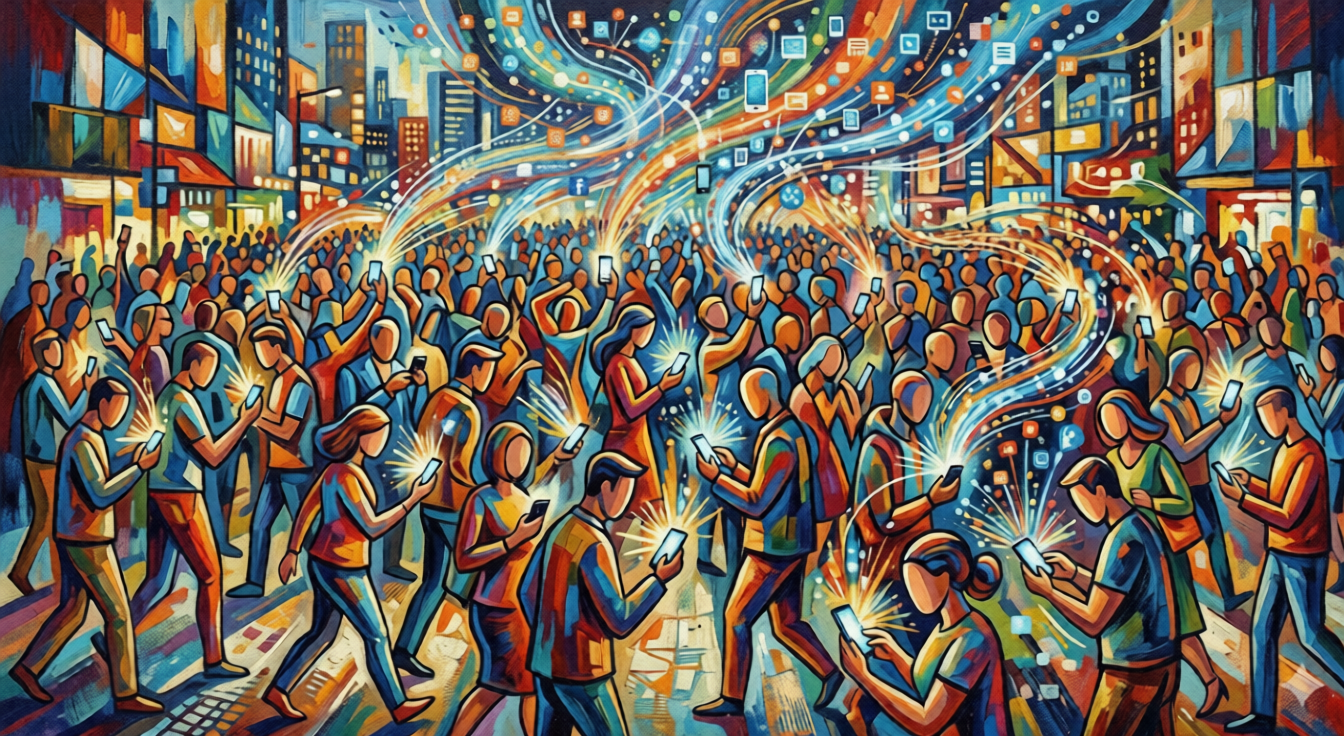
New Delhi: The Supreme Court of India’s observation on Friday that “every person with a mobile phone has become media” may sound like a case-specific remark, but it lands at a moment when journalism is facing a deep and visible crisis. The explosion of unverified content, coupled with the rise of untrained and unaccountable content creators, is reshaping the information landscape in ways that blur the line between reporting and rumour, evidence and opinion. In that context, the court’s remark captures a profound structural shift in India’s information ecosystem. One that is as empowering as it is deeply unsettling.
Hearing a public interest litigation on the conduct of police and the media, a bench led by Chief Justice Surya Kant, along with Justices Joymalya Bagchi and Vipul M Pancholi, voiced concern over what it described as an “infectious trend” of individuals recording and instantly uploading videos on social media. The court warned that such behaviour poses “a grave threat to fair trial of the accused”, especially when public perception is shaped long before evidence goes through the mandatory grilling in court.
The bench agreed with senior advocate Gopal Sankaranarayanan’s stark formulation that “every person with a mobile phone has become media”, noting how even in moments of crisis, “whenever there is an accident, people take out their mobile phones to create content even when a person is bleeding on the road”.
Justice Bagchi pushed the concern further, asking, “The police can be restrained through the SOP. But what about the media, especially social media, and the public? Can they be restrained?” He added, “The problem is the atomized social media.”
Inevitable Consequence
Chief Justice Kant sharpened the critique by likening the phenomenon to “a different facet of digital arrest”, where public shaming precedes legal adjudication. The anxiety within the judiciary is clear: in a hyper-connected society, the line between reporting and prejudicing a case is collapsing.
Yet what the court is grappling with is not merely a legal problem. It is the inevitable consequence of a technological and economic transformation that has turned India into one of the world’s most intense “mobile-first” societies.
By late 2025, India had crossed 1.06 billion cellular connections and over 1 billion internet users, according to industry estimates from telecom and digital research bodies. Data compiled by the Internet and Mobile Association of India (IAMAI) and global analytics firms show that smartphones now account for roughly 78% of total digital advertising expenditure, decisively overtaking television as the primary medium for both content consumption and commerce.
This scale has fundamentally altered who gets to produce information. What was once the domain of trained journalists, editors and institutional gatekeepers is now open to anyone with a smartphone and a data connection. Scholars studying mobile journalism, often referred to as MoJo, note that nearly 57.5% of journalists themselves now rely on smartphones for reporting and live streaming, citing immediacy and accessibility. At the same time, research on rural internet usage indicates that 92.7% of young users in non-urban areas actively create and share media, effectively bypassing traditional news pipelines altogether.
This decentralization has undeniable democratic potential. Initiatives such as CGNet Swara, frequently cited in academic studies on community media, have shown how mobile platforms can amplify hyper-local voices, especially in regions historically ignored by mainstream media. In Tier-2 and Tier-3 towns, vernacular creators often command more trust and engagement than national television anchors.
Creator Economy
But the same forces that democratize information also destabilize it.
The rise of what industry reports call the “creator economy” has formalized content production as a livelihood, with digital media contributing around 32% of India’s media and entertainment revenue by 2024, overtaking television. In this ecosystem, speed and virality often outweigh verification. Social media platforms increasingly function as “search engines for life”, where users turn to influencers and peers for advice, news and opinion, frequently without the filters of editorial scrutiny.
The consequences are visible in both social behaviour and political discourse. Studies tracking digital engagement in 2025-2026 estimate that the average Indian user spends about 5.3 hours per day on mobile screens, while social media platforms now reach roughly 44% of the adult electorate. This has reshaped how narratives are built, amplified and contested, often in real time and without accountability.
It is this collapse of mediation that worries the judiciary. Traditional media, for all its flaws, operates within identifiable legal and professional frameworks. “Comparatively, TV channels are much more restrained, even though one might disagree with their views,” Justice Bagchi observed. Social media, by contrast, is diffuse, anonymous and algorithmically driven, what the court called “atomized”.
The Solicitor General’s description of certain online actors as “blackmailers” hints at another layer of concern: the emergence of quasi-media identities without institutional checks. Chief Justice Kant pointed to a growing trend in smaller towns where individuals “flaunt their credentials as media persons and boldly display it on their vehicles for ulterior designs”, blurring the line between journalism and opportunism.
The court’s suggestion that the petition be refiled with a broader scope reflects the scale of the challenge. Regulating police briefings through standard operating procedures is one thing; addressing a society where every citizen is a broadcaster is quite another.
At its core, the “mobile-as-media” phenomenon represents a paradox. It has empowered millions to document injustice, share stories and participate in public discourse. At the same time, it has created an environment where information is immediate but not necessarily accurate, widespread but not necessarily responsible.
The Supreme Court’s concern, therefore, is not a rejection of technological progress but a warning about its unintended consequences. When everyone is media, the question is no longer who speaks, but who verifies, who is accountable, and who bears the cost when the rush to publish overrides the duty to be fair.
In that tension lies the defining media challenge of contemporary India.