
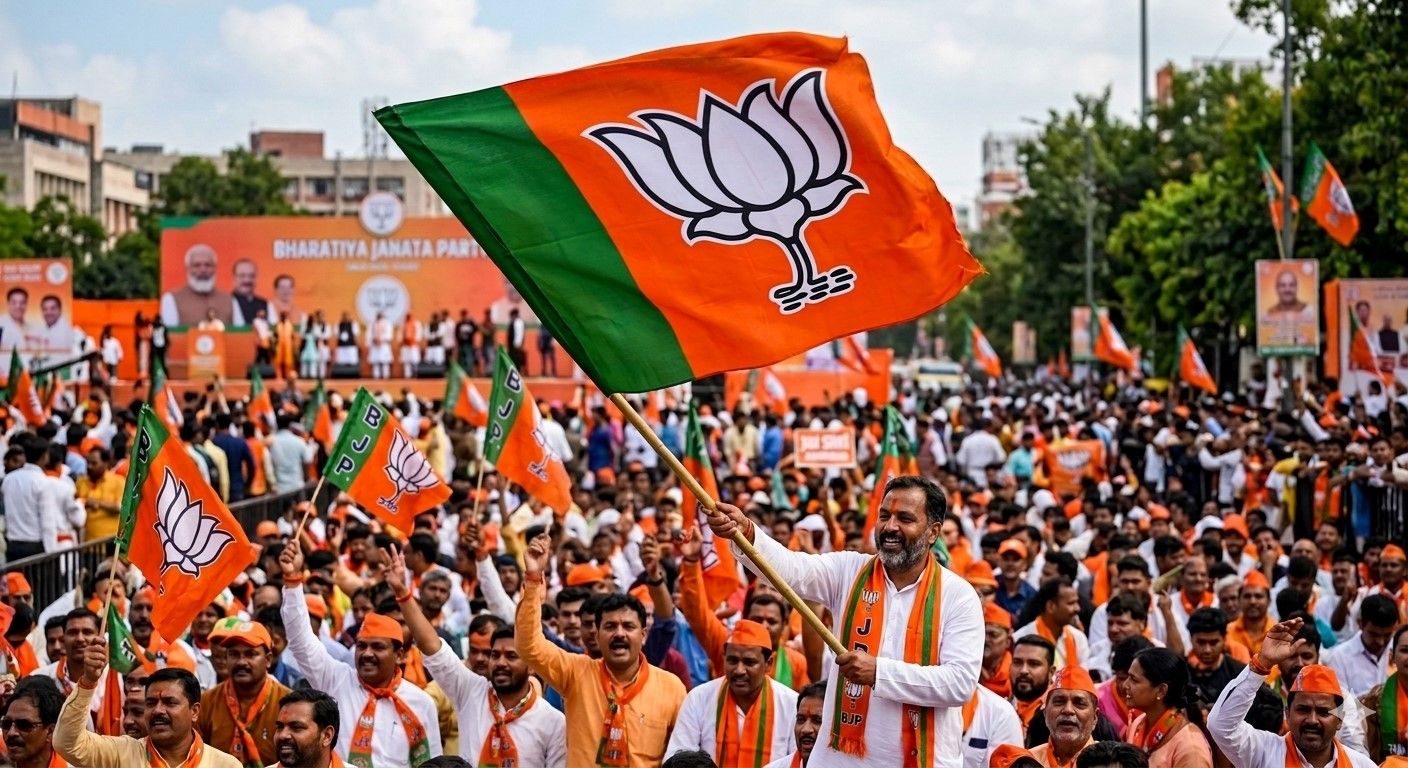

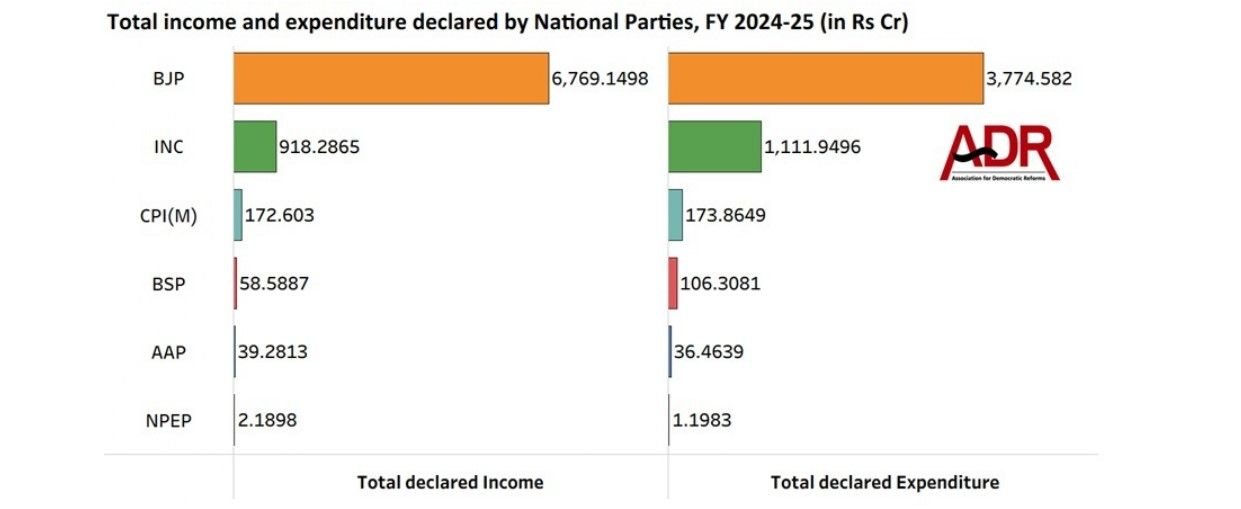
New Delhi: India’s six recognized national political parties together declared a total income of Rs 7,960.09 crore during the financial year (FY) 2024-25, says a report released on Thursday by the Association for Democratic Reforms.
According to the audit statements submitted to the Election Commission of India by the parties -- BJP, Congress, CPI(M), BSP, AAP and NPEP -- BJP declared the highest income at Rs 6,769.14 crore. This amount accounts for about 85.03% of the total income reported by all these parties during the year.
Congress reported the second highest income of Rs 918.28 crore, representing about 11.53% of the combined income of national parties. CPI(M) reported an income of Rs 172.60 crore, while BSP declared Rs 58.58 crore. AAP reported an income of Rs 39.28 crore and NPEP declared Rs 2.18 crore.
The audit reports for FY 2024-25 were required to be submitted to the Election Commission of India by October 31, 2025. According to the ADR report, NPEP, AAP and BSP submitted their statements within the deadline. Congress filed its report with a delay of 18 days, while CPI(M) and BJP submitted their statements after a delay of 56 days.
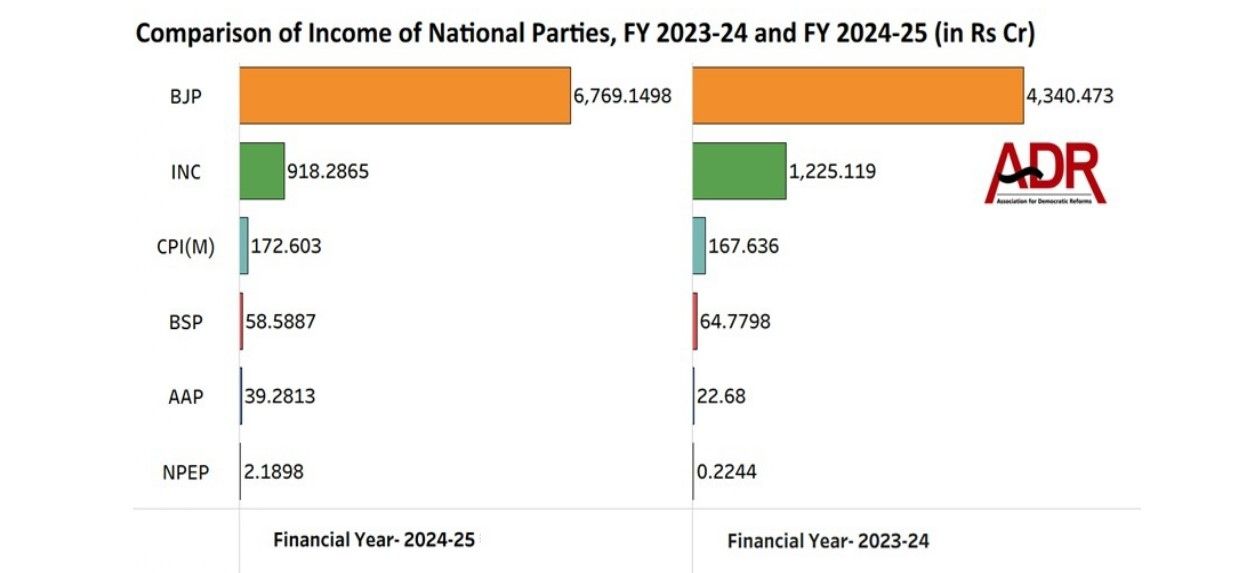
BJP’s income increased by 55.95% between FY 2023-24 and FY 2024-25, rising by about Rs 2,428.68 crore. CPI(M) recorded a modest increase of 2.96%, amounting to about Rs 4.96 crore.
In contrast, Congress saw its income decline by 25.05%, or about Rs 306.83 crore, while BSP’s income fell by 9.56%, or about Rs 6.19 crore. AAP recorded a significant increase of 73.20%, equivalent to about Rs 16.60 crore.
Expenditure patterns also varied among the parties. BJP reported total spending of Rs 3,774.58 crore during FY 2024-25, which is about 55.76% of its income. Congress reported total expenditure of Rs 1,111.94 crore, which is about 21.09% higher than its income for the year.
CPI(M) spent Rs 173.86 crore, exceeding its income by Rs 1.26 crore, or about 0.73%. BSP reported expenditure of Rs 106.30 crore, which was about 81.45% higher than its income. AAP spent Rs 36.46 crore, or about 92.83% of its income, while NPEP reported expenditure of Rs 1.19 crore, representing about 54.72% of its income.
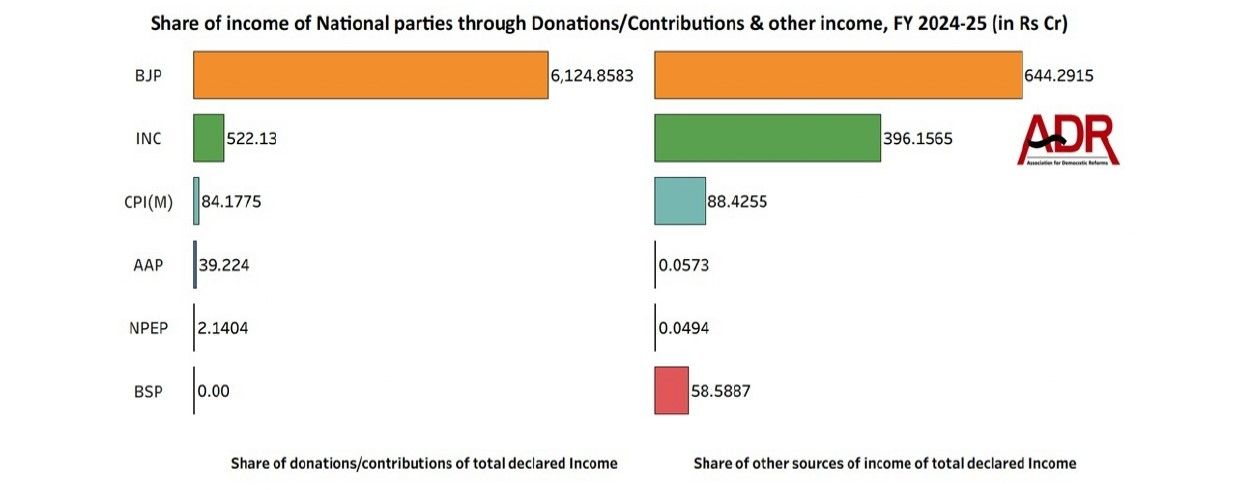
The ADR report also analyzed the sources of income declared by the parties. Overall, the national parties reported that 85.08% of their total income, amounting to Rs 6,772.53 crore, came from donations and contributions, while the remaining 14.92%, or Rs 1,187.56 crore, came from other sources.
BJP reported that 90.48% of its income, or Rs 6,124.85 crore, came from donations. AAP reported 99.85% of its income from contributions, while NPEP reported 97.74% from this source.
Congress reported that 56.86% of its income, or Rs 522.13 crore, came from donations, while the remaining 43.14%, or Rs 396.15 crore, came from other sources. CPI(M) reported 48.77% of its income from donations and 51.23% from other sources.
BSP reported its entire income of Rs 58.58 crore under other sources and did not report any donations.
Congress also reported Rs 350.12 crore as income collected through the sale of coupons, which accounts for 38.12% of its total income during the year. CPI(M) reported Rs 10.41 crore from the sale of coupons.
In terms of expenditure categories, BJP’s largest spending was on election and general propaganda, amounting to Rs 3,335.36 crore, followed by administrative costs of Rs 323.05 crore. Congress reported its highest expenditure on election-related activities at Rs 896.22 crore, followed by administrative and general expenses of Rs 159.68 crore. CPI(M)’s largest expenditure was administrative and general expenses amounting to Rs 78.11 crore, followed by employee costs of Rs 51.03 crore.
The ADR recommended that, “full details of all donors should be made available for public scrutiny under the RTI. Some countries where this is done include Bhutan, Nepal, Germany, France, Italy, Brazil, Bulgaria, the US and Japan. In none of these countries is it possible for 70% of the source of funds to be unknown”.
It also suggested that “any party which does not submit its IT returns on or before the due date, their income should not be tax-exempted and defaulting parties should be derecognized. Those parties not following the ICAI guidelines for auditing of reports should be scrutinized by the IT department”.