

New Delhi: Human mobility is undergoing its most profound transformation since the advent of the internal combustion engine. This shift extends far beyond engineering innovation; it sits at the intersection of climate urgency, rising urban density, and the deeply ingrained emotional bonds people share with how they move.
These insights form the core of recently-released Ipsos Mobility Report: A 31-Country Global Advisor Survey, which provides an exhaustive look at how mobility choices are shaping modern societies, from access and inclusion to safety and environmental impact.
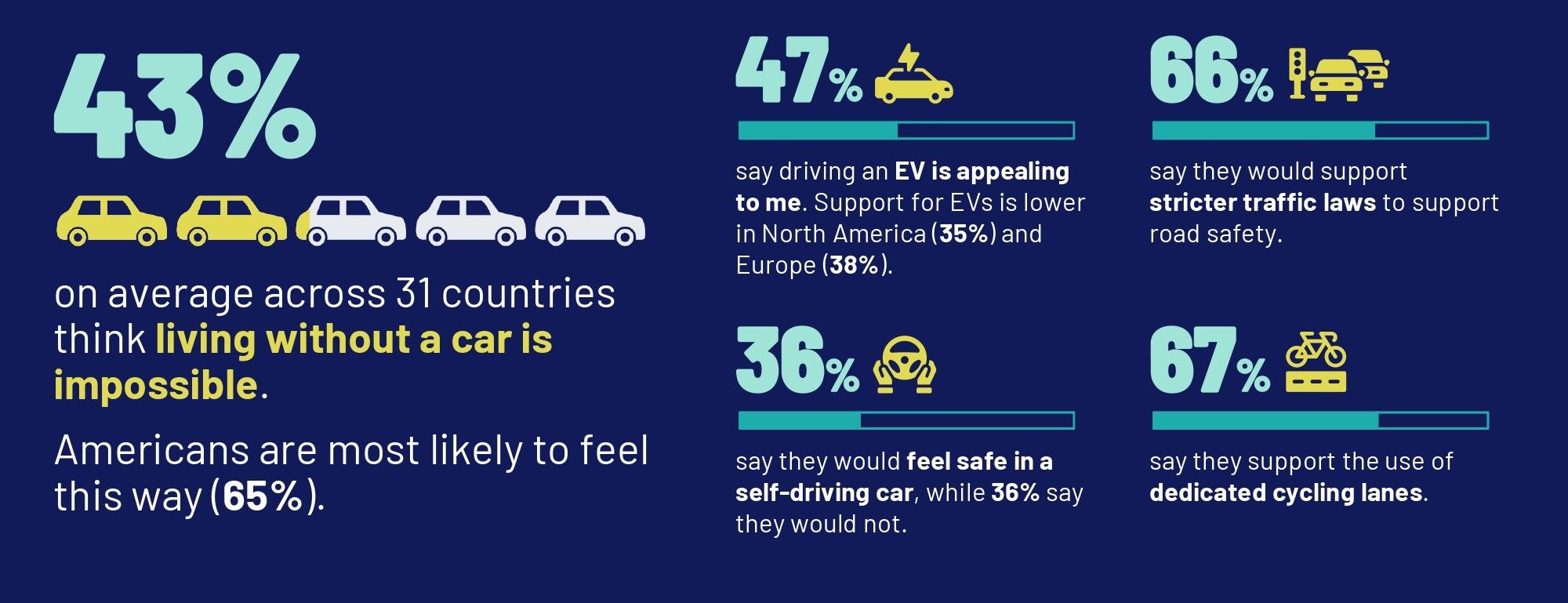
Around the world, the personal vehicle remains a formidable force. Across 31 countries, an average of 43% of respondents said living without a car would be “impossible”, a sentiment that peaks in North America, with 65% of Americans holding this view. Yet, the data reveals a striking dichotomy: while the West remains tethered to the steering wheel, emerging economies in Asia, specifically India, are charting a different course characterized by a greater openness to public transit and sustainable alternatives.
The India story is one of the most compelling narratives within the report. While global car reliance is high, Indian citizens are among the most likely in the world to embrace public transport. In fact, India ranks alongside Colombia and Singapore as one of the few nations where people are most likely to say they actually enjoy using public transport as their favourite mode of getting around. This is further supported by a strong environmental consciousness; 62% of Indians would choose public transport over a personal car specifically for environmental reasons, a figure significantly higher than the 46% global average and vastly outpacing sentiment in nations like the United States and Canada.
Urban-rural divide
Public transport accessibility is a cornerstone of this shift. Globally, 62% of people view public transport as accessible, and a matching 62% consider it safe. However, these averages mask a significant urban-rural divide. While 68% of urban residents find transit accessible, that number plummets to just 44% for those in rural areas. In India, where rural-to-urban migration and the development of tier-2 and tier-3 cities are central to the national growth story, the report suggests that “limitations in transport options make it hard to access places that are essential” for nearly half of rural dwellers globally.
The report also highlights a growing appetite for ‘active travel’. Globally, 67% of people support the implementation of dedicated cycling lanes, and 61% would prefer to walk or cycle to stay healthy. This health-conscious mindset is particularly prevalent in urban centres where “congestion pricing”— supported by 46% globally — is increasingly viewed as a viable tool to promote sustainable habits.
In India, 58% of respondents support the introduction of congestion pricing, placing it well above the global average and signalling a public mandate for urban planning that prioritizes efficiency over unbridled car usage.
Safety, however, remains a persistent anxiety. On average, 55% of global citizens are concerned about road safety in their local area, with worry being most acute in urban environments. There is overwhelming public backing for stricter traffic laws, with 66% of respondents in favour of more rigorous enforcement to protect pedestrians and cyclists.
Interestingly, while 70% support lower speed limits in residential streets, this support dips to 56% when applied to freeways or motorways, reflecting a tension between the desire for safety and the need for speed.
EV Transition
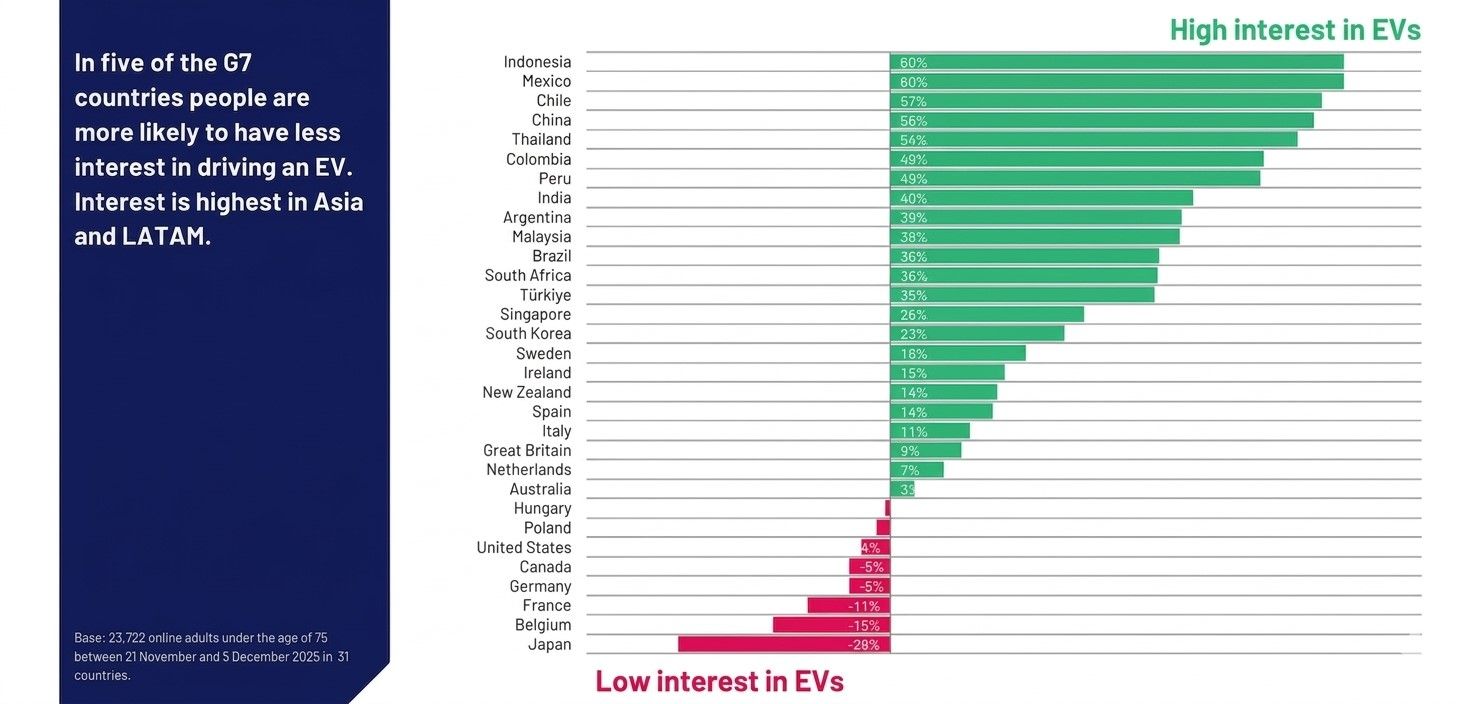
The transition to Electric Vehicles (EVs) presents another area of geographic divergence. Globally, 47% find driving an EV appealing, but enthusiasm is starkly divided. Mature markets like France, Germany, and the US show signs of “EV apathy”, where more people reject the idea of driving an electric car than embrace it. In contrast, Asia is the engine of the EV revolution. India sits in the high-interest bracket, with a strong majority finding EVs appealing, trailing only behind leaders like China and Indonesia.
This regional enthusiasm is vital for automakers to understand. “Brands need to recognise that their most mature markets may require longer ICE and hybrid transition periods, while emerging markets in Asia and LATAM could leapfrog to EV adoption more quickly,” the report says.
Furthermore, the report identifies a rising trend of “brand origin vulnerability”. In an era of heightened geopolitics, 48% of consumers say they would avoid purchasing a car from a specific country due to its nationality. This is particularly evident in Japan and South Korea, where two-thirds of respondents would boycott brands from certain nations. Globally, Chinese (41%), Indian (38%), and American (24%) vehicles are currently the most likely to face such avoidance. This poses a unique challenge for Indian manufacturers looking to expand globally, suggesting “where your brand is from is no longer just a marketing asset, it’s a potential liability”.
Trust also remains a significant barrier for autonomous technology. Opinion is perfectly split on self-driving cars: 36% of people would feel safe in one, while 36% would not. Concerns over data privacy are paramount, especially in North America and Europe, where trust in automakers to protect personal data is significantly lower than in Asia. In fact, only 31% in North America trust automakers with their data, compared to 50% in Asia Pacific.
Emotional Value
The report delves deeper into the psyche of the modern driver, revealing that the car is often an “emotional sanctuary”. Across 22 of the 31 countries, driving remains the “favourite” mode of transport. This emotional bond is strongest in rural areas, where 60% of people feel their car is an absolute necessity. However, even in urban areas where alternatives exist, 48% of car owners admit they “could live without their vehicle but prefer to have it”. This underscores a fundamental challenge for policy makers: transitioning to greener cities requires not just better infrastructure, but a shift in the cultural and emotional value placed on personal vehicle ownership.
For India, the report underscores a unique position. While the nation shows a high level of interest in EVs (56%) and a strong preference for public transport (62% for environmental reasons), it also faces the global trend of brand scepticism. As Indian automotive brands gain prominence, they must navigate a world where 38% of global consumers might avoid a car simply because of its Indian origin. Success on the global stage will therefore require a dual focus on technological excellence and the building of a “trust-based” brand identity that transcends national borders.
The report suggests that while the “death of car ownership” may be premature, the nature of ownership is changing. For many, the car is no longer just a tool for utility but an emotional choice. “Cars remain emotionally and practically essential. The data shows that 43% of car owners say living without their vehicle would be ‘impossible’... This goes beyond utility… People genuinely enjoy driving.”
For a country like India, the challenge and opportunity lie in balancing this emotional attachment to personal mobility with the high public demand for sustainable, safe, and accessible mass transit. With 67% of the global population supporting dedicated cycling lanes and 66% calling for stricter traffic laws, the mandate for a safer, greener, and more inclusive mobility future is clear.
The road ahead is not just about the vehicles we build, but about the societies we choose to move within. The findings of the report serve as a critical roadmap for governments and automakers alike, highlighting that the future of mobility will be defined by those who can bridge the gap between technological innovation and public trust.