


New Delhi: On a hot humid Tuesday morning in Bengaluru, 32-year-old software engineer Rohan Mehta logged-in expecting another sprint review. Instead, he found himself reviewing AI-generated codes, validating outputs rather than writing them. His role had not disappeared… it had morphed. What once required hours of manual coding was now compressed into minutes of oversight, refinement, and decision-making.
Rohan’s story is rapidly becoming the norm across India’s technology workforce. AI is no longer a distant disruptor; it’s an embedded force reshaping the nature of work itself. According to the report, Future of Jobs in the Age of AI: Emerging Roles, New Opportunities, published by the Center of Policy Research and Governance and DeepTech4Bharat Foundation, the shift is both sweeping and nuanced.
A ServiceNow estimate cited in the report suggests that AI will redefine roles for over 13.5 million individuals in India. Simultaneously, Bain & Company projects the creation of approximately 2.3 million new AI-related jobs by 2027. This duality —disruption alongside creation — defines the current phase of India’s labour market transformation.
“Today, the world is experiencing a new technological revolution that is changing more than just the nature of work; it is redefining how individuals interpret, experience, and perform at the workplace itself. Just as the steam engine or the telephone once overhauled the economy, AI is now pushing the boundaries of what human skills can achieve,” says the report. “By doing so, it is fundamentally altering the job market across sectors. This transformation is no longer speculative,” it adds.
The report argues that the prevailing narrative of job loss misses a larger truth: AI is as much an engine of job creation as it is of displacement.
Expanding AI Job Ecosystem
The most striking shift is not merely the automation of tasks but the expansion of an entirely new job architecture. From data centres to algorithmic governance, AI is spawning roles across the value chain.
“Much of the current discourse about AI has focused on the fear of job loss. Disruptions are expected across a wide range of sectors… However, …technological change has historically had a commensurate effect on both job displacement and job creation,” says the report. “Shifting the narrative from AI-driven displacement to the emergence of new, specialized roles” is central to understanding the transformation, it adds.
At the foundational level, AI data centres are emerging as critical employment hubs. These facilities, housing high-performance computing infrastructure, are driving demand for engineers, network specialists, and cloud operators. India’s data centre market is projected to attract over $100 billion in investments by 2027, creating a cascade of direct and indirect employment.
The report notes: “These massive facilities house the servers, storage systems, and processing capabilities needed for AI development and deployment… without robust and efficient data centres operating in the background, the speed and reach of AI innovation would come to a standstill.
“Beyond the core technical roles… the growth in AI data centres also generates second- and third-order employment effects… creating jobs in energy, construction, manufacturing, and facility management.”
Equally significant is the rise of the pre-model data ecosystem. Data annotators, quality analysts, and synthetic data engineers are becoming indispensable to AI development. What was once considered low-value work is evolving into a strategic function.
Data is frequently described as the “new oil” for AI algorithms. Model development is preceded by a rigorous process of collection, cleaning, annotation and validation. Actual AI deployment still lags behind its theoretical potential, indicating that human involvement continues to be indispensable in functions such as data preparation, annotation, validation, and quality control, highlights the report.
This ecosystem reflects a broader trend. AI is not eliminating human roles but redistributing them across new layers of value creation.
Rise of Hybrid Intelligence
At the heart of the AI-led jab market transformation lies the emergence of hybrid roles that blend technical expertise with domain knowledge. AI/ML engineers, generative AI designers, and system integrators are redefining how technology is built and deployed.
“AI model development represents the stage at which data is transformed into functional intelligence… this phase involves designing model architectures, training algorithms, testing performance, and refining systems for deployment,” says the report.
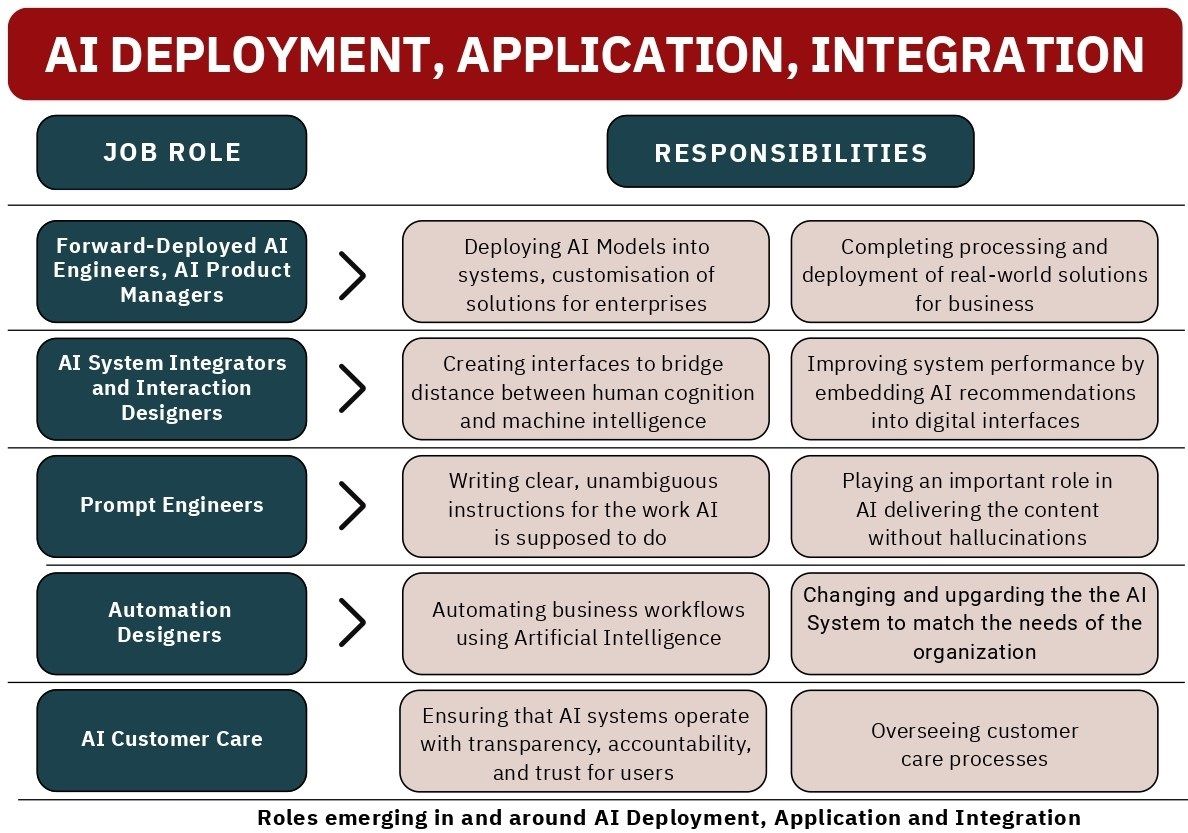
But the shift is not confined to core engineering. The deployment layer, where AI meets business, has become a major job generator. Roles such as prompt engineers, automation designers, and AI product managers are gaining prominence.
Roles in this layer focus on embedding AI tools into existing workflows and aligning technical capabilities with business objectives, the report notes.
“Prompt engineering… involves the creation of structured instructions… While effective prompting ensures the accuracy and utility of response… poorly constructed prompts can lead to… hallucinations.”
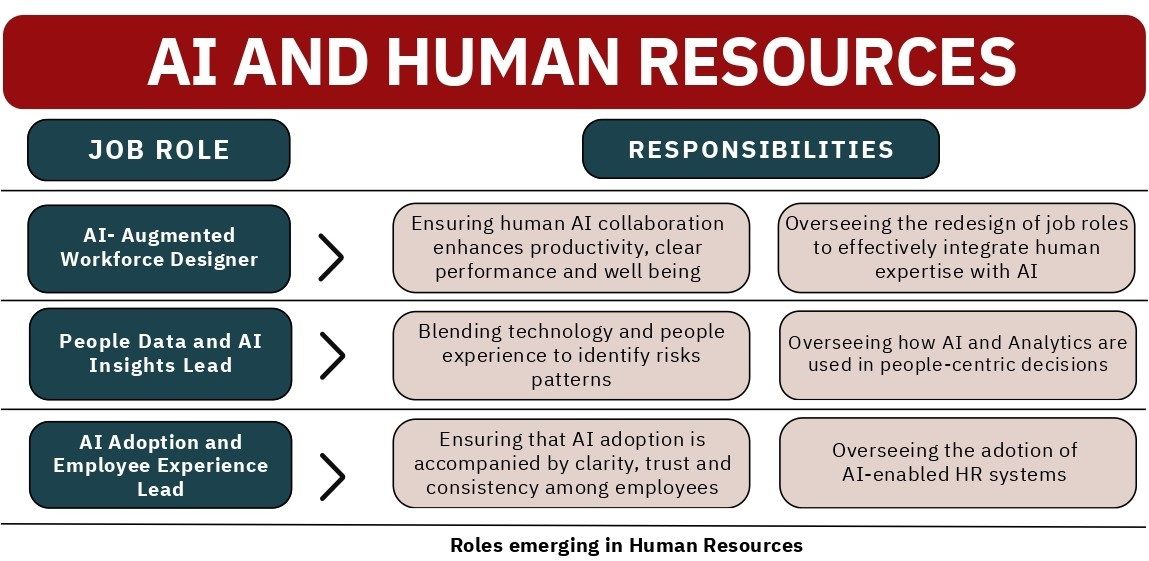
This evolution is also reshaping traditional functions such as human resources. AI is automating routine HR processes while elevating the strategic importance of workforce design and analytics. It is also being used to analyse candidate data… allowing HR professionals to shift into more strategic and governance-oriented roles.
Research suggests that the integration of AI requires substantial job redesign, rather than simple substitution of labour.
Experts cited in the report emphasise that the future workforce will require continuous reskilling. One industry leader notes that the demand is shifting “from routine execution to problem-solving, interpretation, and system oversight”, underscoring the need for adaptive skills.
Another expert highlights that “AI adoption is not just a technological shift but an organisational transformation”, requiring workers to understand both tools and context.
The real value lies in combining domain expertise with algorithmic understanding, signalling the rise of multidisciplinary careers.
Future of Work
As AI penetrates high-stakes domains, from finance to healthcare, the question of trust becomes central. This has given rise to an entire governance layer within the AI ecosystem.
As AI shifts from being a peripheral experiment into a ‘normal’, foundational technology, organisations must now confront not only questions of performance and efficiency, but also those of legitimacy, accountability, and broader social impact.
Roles such as AI ethicists, governance architects, and algorithmic auditors are emerging to ensure responsible deployment. “AI ethicists… are responsible for guiding ethical practices throughout the AI lifecycle… helping keep AI systems responsible,” the report notes. “Algorithmic auditing… involves examining whether the outcomes of algorithmic systems can be justified under legal, ethical, and public accountability standards,” it adds.
This governance layer is critical as AI increasingly influences decision-making. A Deloitte survey cited in the report found that 60% of executives now rely on AI for decisions, underscoring the need for oversight mechanisms.
At the same time, a significant skills gap threatens to slow adoption. Only about 30% of employees feel adequately trained to use AI tools effectively. This has created demand for AI literacy trainers and workforce enablement specialists.
Building both AI literacy and applied skills across the workforce is emerging as a critical priority for organisations. AI ‘literacy trainers’ must function as intermediaries responsible for translating complex technological processes into forms that are intelligible for users.
Reshaped Labour Market
The transformation underway is neither linear nor uniform. AI is not simply replacing jobs, it’s redefining them. The Indian workforce stands at a pivotal moment where 1.35 crore roles face restructuring even as 23 lakh new opportunities emerge.
The report concludes that the future of work will depend not just on technology but on how it is deployed, governed, and integrated into society. For professionals like Rohan Mehta, the challenge is immediate: adapt or risk obsolescence. For policymakers and businesses, the mandate is broader: build an ecosystem that enables transition, not displacement.
If managed strategically, AI could usher in a more dynamic, inclusive, and resilient labour market. If not, the disruption could outpace the opportunity. Either way, the reshaping of India’s job market has already begun, and there is no turning back.
(Cover photo by Immo Wegmann on Unsplash)