

New Delhi: India’s listed private sector regained momentum in FY2025-26, delivering its strongest sales growth in three years and signalling a broad-based recovery across major segments of the economy.
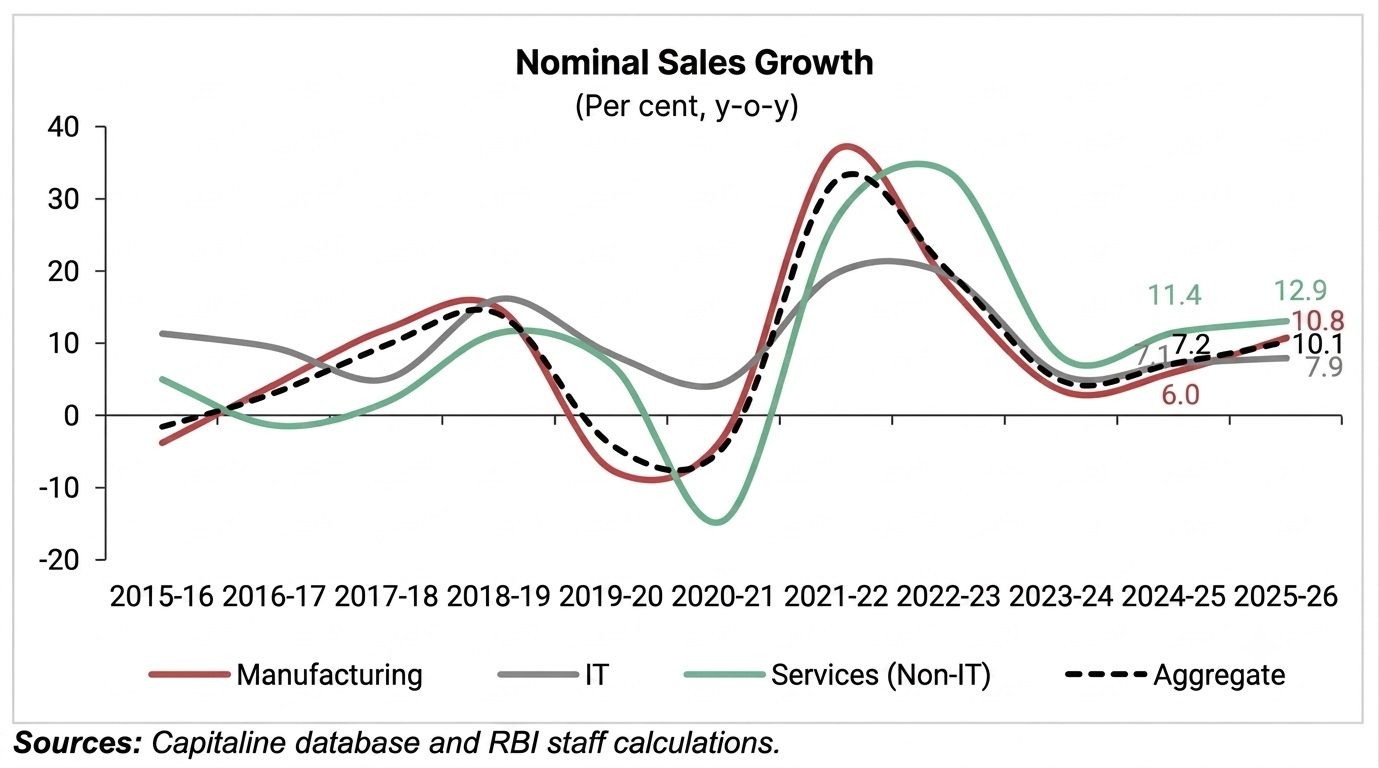
Fresh data released by the Reserve Bank of India show that 4,278 listed non-government, non-financial companies recorded aggregate sales growth of 10.1% during 2025-26, marking a return to double-digit expansion after two years of slower growth.
The acceleration was driven largely by manufacturing, where sales growth climbed to 10.8% from 6% a year earlier. The turnaround was led by automobile makers, electrical machinery producers, food and beverage companies and chemical manufacturers, highlighting strengthening domestic demand and improving industrial activity. The petroleum sector remained a notable exception, continuing to report a contraction in sales amid sector-specific challenges.
The services economy also remained resilient. Information technology companies reported sales growth of 7.9%, up from 7.1% in the previous year, while non-IT services firms maintained double-digit revenue growth, supported by strong performance in wholesale and retail trade. Together, the figures suggest that India's corporate sector is benefiting from a combination of consumer demand, investment activity and expanding services consumption.
The RBI report, titled ‘Performance of Private Corporate Business Sector during 2025-26, indicates that the recovery is no longer concentrated in a handful of industries but is becoming increasingly widespread across sectors.
Costs Begin Rising
The stronger revenue performance, however, came alongside mounting cost pressures that could test corporate profitability in the coming quarters.
According to the RBI report, manufacturing companies experienced a 12% increase in raw material expenses during 2025-26. As a result, the ratio of raw material costs to sales rose to 57.6% from 55.7% a year earlier, pointing to renewed pressure on input costs. The trend reflects a combination of commodity price fluctuations, supply-chain adjustments and higher production activity.
Labour costs also increased across sectors, says the report. Staff expenses rose by 10.7% in manufacturing, 6.1% in IT services and 9% in non-IT services companies. Despite the increase, staff costs as a proportion of sales remained broadly stable for manufacturers and declined for services companies, indicating that revenue growth was sufficient to absorb rising wage bills.
For investors and policymakers, the key question is whether companies can continue to maintain margins if raw material prices remain elevated. Cost inflation remains one of the biggest risks to the corporate earnings outlook, particularly for sectors with limited pricing flexibility.
Profitability Stays Strong
Despite higher input costs, India Inc. demonstrated notable pricing power and operational resilience.
As per the RBI report, operating profit growth for manufacturing companies accelerated to 10.3% from 6% in the previous year, suggesting that many firms successfully passed on higher costs or improved efficiency. IT companies also posted stronger operating profit growth of 10.7%, while non-IT services firms saw profit growth moderate to 7.1%.
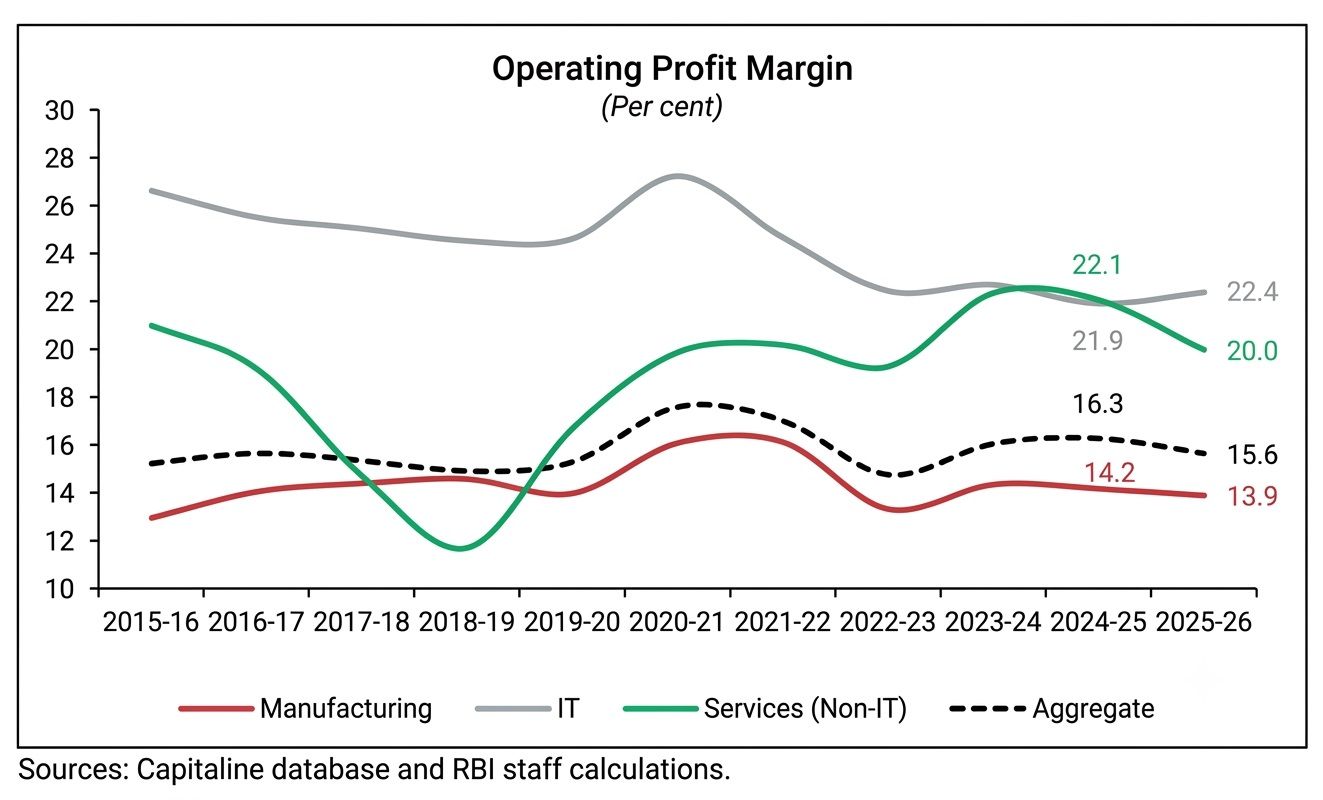
Margins, according to the RBI report, presented a mixed picture. Manufacturing operating profit margins slipped by 30 basis points to 13.9%, while non-IT services margins fell by a sharper 210 basis points to 20%. In contrast, IT companies improved margins by 50 basis points to 22.4%, underlining the sector’s continued profitability despite a challenging global technology environment.
Perhaps the most encouraging signal came from corporate balance sheets. Manufacturing companies improved their interest coverage ratio to 9.1 from 7.9, aided by stronger profits and lower interest expenses. The metric, a key indicator of debt-servicing capacity, suggests that the sector’s financial health strengthened during the year. Non-IT services firms maintained an interest coverage ratio of 2.2, while IT companies continued to report exceptionally strong debt-servicing capacity.
The RBI data paint a picture of a corporate sector entering FY26 from a position of relative strength. While rising costs remain a challenge, stronger sales growth, improving profitability and healthier balance sheets suggest India’s listed private companies are better placed to navigate economic uncertainties than they were a year ago.
As growth broadens across manufacturing and services, the latest numbers offer another indication that the corporate engine of the Indian economy is gathering speed.
(Cover photo by Francesco Giacomini on Unsplash)