

New Delhi: Researchers in Brazil have unveiled a ground-breaking technique that uses high-frequency ultrasound waves to destroy viruses by causing them to rupture from within, a process scientists have compared to popcorn exploding under heat. The discovery, made by researchers at the University of São Paulo, could open a new frontier in anti-viral treatment by targeting the physical structure of viruses rather than their genetic makeup.
The study, published in the journal Scientific Reports, demonstrated that ultrasound waves similar to those used in medical imaging can inactivate enveloped viruses such as SARS-CoV-2 and the H1N1 influenza virus without harming surrounding human cells or tissues.
“It’s kind of like fighting the virus with a shout,” said Odemir Martinez Bruno, a professor at the São Carlos Institute of Physics at USP who coordinated the research. “The energy of sound waves causes morphological changes in viral particles until they explode, a phenomenon comparable to what happens with popcorn. By degrading the structure of the pathogen, the protective membrane of the virus [called the envelope] bursts and deforms, preventing the virus from invading human cells.”
The process is based on a phenomenon known as ‘acoustic resonance’. When ultrasound waves strike spherical viral particles, the viruses absorb the sound energy and begin vibrating internally. As the energy accumulates, the viral envelope eventually ruptures and collapses, rendering the virus inactive.
According to the researchers, the effectiveness of the technique is directly tied to the geometry of the viruses. Spherical enveloped viruses are especially capable of absorbing ultrasound energy, which creates internal mechanical stress strong enough to destroy them.
“The phenomenon is entirely geometric. Spherical particles, such as many enveloped viruses, absorb ultrasound wave energy more effectively. It’s that accumulation of energy inside the particle that causes changes in the structure of the viral envelope until it ruptures. Therefore, if viruses were triangular or square, they wouldn’t undergo the same ‘popcorn effect’ of acoustic resonance,” explained Odemir Martinez Bruno, professor at São Carlos Institute of Physics at USP who coordinated the study, to Agência FAPESP. The study was funded through several projects by the São Paolo Research Foundation (FAPESP).
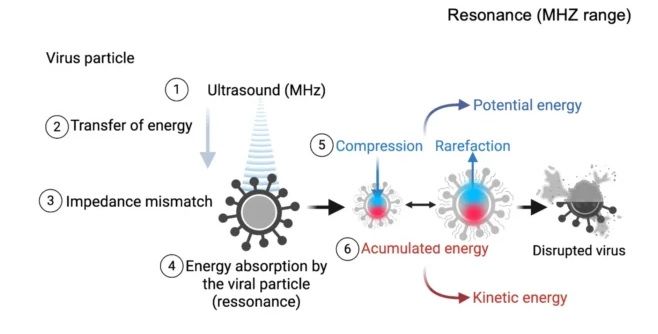
Illustration of acoustic resonance, which operates in the MHz range. (Veras et al., Sci. Rep., 2026)
The findings surprised scientists because they appear to challenge conventional physics theories. Ultrasound wavelengths are significantly larger than the viruses themselves, which, according to classical models, should make interaction between the two extremely limited. Yet the researchers observed that the viruses still absorbed the sound energy efficiently enough to trigger structural failure.
Unlike traditional ultrasound sterilization methods used for cleaning surgical or dental equipment, the new technique does not rely on cavitation, a process in which collapsing gas bubbles destroy surrounding biological material indiscriminately. Instead, the Brazilian team uses much higher frequencies to create resonance specifically within the viral particles.
“The technique isn’t intended for decontamination. That already exists. Ultrasound is already used to sterilize dental and surgical equipment, but it works through a different physical phenomenon called cavitation, which destroys biological material,” Bruno said.
He further clarified the distinction between the two approaches: “While cavitation occurs at low frequencies and destroys both viruses and tissues through the collapse of gas bubbles, acoustic resonance operates at high frequencies [3–20 MHz].”
Regarding the resonance mechanism itself, Bruno added that the sound energy couples directly with the viral structure, exciting internal vibrations that mechanically rupture the viral envelope without changing the temperature or pH of the surrounding environment. “The result is a selective and safe mechanism since only the virus absorbs the energy and is destabilized, posing no risk to human cells,” he said.
One of the most promising aspects of the discovery is that the method targets the physical structure of viruses rather than their mutations, meaning variants such as Delta and Omicron are unlikely to evade the treatment. Because the process depends solely on the shape of the viral particle, researchers believe the strategy could work broadly against many enveloped viruses.
The team is already conducting in vitro experiments against dengue, Chikungunya, and Zika viruses, illnesses that continue to affect millions in tropical and sub-tropical regions.
Flávio Protásio Veras, a professor at the Federal University of Alfenas and a FAPESP postdoctoral fellow involved in the project, believes the technique could become an important alternative to conventional antivirals.
“Although it’s still far from clinical use, this is a promising strategy against enveloped viruses in general, since developing chemical antivirals is complex and yields difficult results. Furthermore, it’s a ‘green’ solution, as it generates no waste, causes no environmental impact, and doesn’t promote viral resistance,” he said.
Scientists say the discovery may eventually pave the way for safer, environmentally friendly anti-viral therapies capable of combating a wide range of viral diseases without contributing to drug resistance.
(Cover photo by Fusion Medical Animation on Unsplash)