
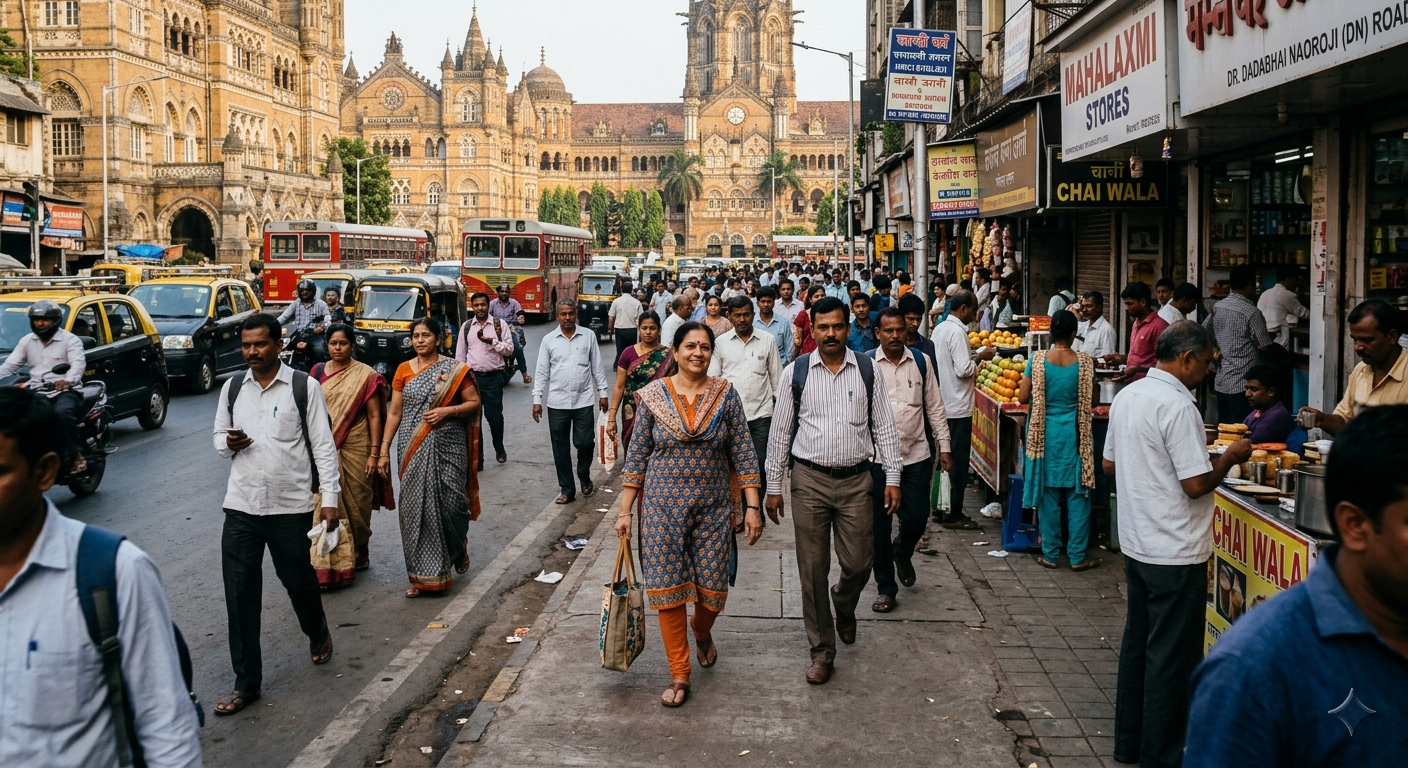

New Delhi: The Supreme Court’s declaration that the freedom to walk on safe, demarcated footpaths is a fundamental right is, at one level, a legal milestone. At another, it is an indictment of the way India’s cities have been built over the past few decades. In prioritising the pedestrian, the court has challenged an urban planning model that treats walkers as obstacles rather than citizens.
“The fundamental right to walk on demarcated footpaths shall override the privilege of a motorised vehicle,” Justice P S Narasimha, authoring the judgment, held on Friday. The observation came in a tragic case involving the death of a five-year-old boy, crushed by a truck while walking to school with his father.
The judgment cuts to the heart of an uncomfortable reality. India remains a country where walking is the most common form of commuting, yet urban investment overwhelmingly favours vehicles. Millions walk because they cannot afford private transport, because public transport begins and ends with a walk, or simply because short distances make it the most practical option. Yet the average Indian city often offers broken pavements, encroachments, open drains and speeding traffic instead of safe pathways.
Justice Narasimha’s words carry unusual force because they elevate a daily activity into a constitutional guarantee. Walking, he observed, is the “simplest of the simple human activity, inextricably connected to life”. He went further, arguing that modern India had systematically displaced pedestrians. “This should stop from now on as we declare the fundamental right to walk on demarcated footpaths alongside motorised roads,” he said.
The criticism is difficult to ignore. Urban India has spent decades measuring development by the width of highways and the number of flyovers. Footpaths, where they exist, have often been “an afterthought”. The consequence is visible every day: pedestrians forced onto roads, children walking to school inches away from traffic and senior citizens negotiating parked vehicles and dug-up pavements.
Lost Productivity
The Supreme Court’s intervention arrives at a moment when Indian cities are confronting a mobility crisis. Traffic congestion costs billions of rupees in lost productivity every year, while road crashes remain a major public health challenge. Better footpaths may appear a modest solution, but global evidence suggests they can transform urban economies.
The reason is simple. Every journey begins and ends with a walk. A commuter boarding a metro, a worker catching a bus or a shopper visiting a market depends on safe pedestrian access. Poor footpaths discourage the use of public transport and push those who can afford it towards private vehicles, adding to congestion and pollution.
Indian cities have long operated on a flawed assumption that wider roads automatically improve mobility. The opposite often happens. Additional road capacity attracts more vehicles, eventually recreating the congestion it sought to solve. Safe walking infrastructure, by contrast, encourages shorter trips to be completed on foot and makes public transport more attractive.
Cities that have invested in pedestrian-friendly design have found economic benefits beyond traffic management. Walkable commercial districts attract higher footfall for businesses, improve property values and create more vibrant public spaces. Streets designed for people rather than vehicles tend to support local commerce better than roads engineered primarily for high-speed traffic.
The social dividend is equally significant. Better footpaths improve access to schools, hospitals and workplaces. They make cities more inclusive for women, children, senior citizens and persons with disabilities. They reduce dependence on expensive motorised transport for low-income households, effectively increasing disposable incomes.
The Supreme Court recognised this broader role of walking. Justice Narasimha noted that it has “deep cultural, social, religious, political, and reformative roots in the Indian imagination”. He observed that “walking is a struggle for the not-so-fortunate, meditation in motion for many, resistance for others, discovery for the inquisitive, a cohesive strategy for sharp socio-political minds”.
That perspective broadens the debate from infrastructure to citizenship. Footpaths are not merely concrete strips along roads. They are public spaces where economic and social life unfolds.
Beyond The Verdict
The challenge now lies in implementation. India’s urban governance structure has rarely treated pedestrian infrastructure as a core public service. Municipal bodies often construct roads and pavements through different agencies with little coordination. Encroachments, poor maintenance and utility works routinely destroy footpaths that were expensive to build.
The Supreme Court appears aware of this institutional weakness. Justice Narasimha questioned the prevailing development model, asking, “In reality, how much does it take to create a well-demarcated footpath wherever a road exists? All that the fundamental right to walk demands is a comfortable space for an easy and carefree walk. Should this not be the minimum of the minimum duty that a municipal authority owes to the citizens?”
Perhaps the most striking aspect of the judgment is its criticism of existing law. “The Motor Vehicles Act has been an impediment and, in many ways, undermined the precious rights of walkers?” Justice Narasimha wrote, arguing that the legislation has traditionally placed vehicles at the centre while treating human interests as incidental.
The court’s call for a dedicated statutory framework and a specialised regulator could prove as consequential as the declaration of rights itself. A legal right without clear accountability risks becoming another constitutional aspiration. A regulator with planning and enforcement powers could force governments to incorporate pedestrian infrastructure into road design rather than treating it as optional.
The economic case for doing so is compelling. Safer footpaths can reduce accidents, ease traffic congestion, strengthen public transport networks and improve workforce productivity by making daily commutes faster and more reliable. The public health gains from increased physical activity and reduced pollution would add further benefits.
Yet the judgment also carries a political message. India’s cities have largely been designed for the convenience of vehicles despite the fact that a substantial share of urban trips involve walking. The Supreme Court has effectively argued that development cannot be measured solely by the speed of traffic but by the safety and dignity of the citizen.
Common spaces, the court observed, “must not be the monopoly of motorised vehicles”. In a country where a five-year-old child lost his life simply walking to school, that constitutional correction may turn out to be one of the most significant urban policy interventions in recent years. The test now is whether governments see the judgment as a legal obligation or as an opportunity to build cities where walking is not an act of courage.