
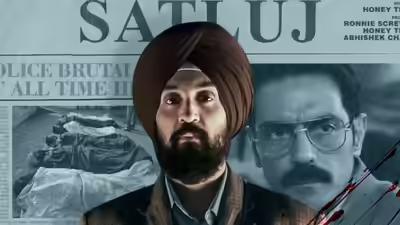

A Film Delayed by Controversy
Originally completed in 2022 under the title Punjab 95, the film spent years in certification limbo before finally arriving on ZEE5 as Satluj on July 3, 2026. Just two days later, it was removed from the platform in India, turning its release into yet another chapter in a long and controversial journey. Long before audiences could judge the film on its cinematic merits, it had already become a subject of public debate, speculation over certification, cuts, and release delays.
Its journey raises a larger question: why do certain chapters of our history remain so uncomfortable that even attempting to tell their story becomes an uphill battle?
The Historical Context
Set against the backdrop of Punjab’s insurgency years, Satluj revisits one of the most complex and emotional periods in post-Independence India. There is little disagreement that every sovereign nation has both the right and the responsibility to protect its citizens from terrorism. Security forces operating under extraordinary circumstances are often required to make extraordinarily difficult decisions, and history should acknowledge the immense burden such responsibilities carry.
The controversy surrounding Satluj stems largely from the story it chooses to tell. Inspired by the life and work of a human rights activist Jaswant Singh Kalra, the film focuses on allegations that, during Punjab's insurgency years, some individuals were unlawfully detained, subjected to enforced disappearances, killed in alleged fake encounters, and cremated without proper identification under the guise of counter-insurgency operations. While many security personnel were engaged in combating terrorism during an exceptionally violent period, the film argues that the abuse of state power by some officials also deserves public scrutiny. It is this portrayal, rather than the broader fight against terrorism itself, that has remained at the heart of the debate.
Yet history also reminds us that the legitimacy of a democracy rests not only on its ability to defeat violence, but also on its commitment to the rule of law.
More Than Just a Film
This is precisely where Satluj becomes more than a film. It is not merely reopening old wounds, it is reopening difficult conversations. Whether one agrees with every interpretation presented in the film or not, the questions it raises cannot simply be dismissed because they are uncomfortable.
Perhaps that explains why the controversy surrounding Satluj extended far beyond the censor board. Reports say the film faced repeated certification objections and extensive cut demands over years before eventually arriving on OTT under a new title. Its brief appearance on streaming platforms, followed by a quick removal, only amplified public curiosity. Even after being removed from Indian streaming platforms, Satluj has remained one of India's most talked-about films. Reports have also emerged of community screenings being organised across parts of Punjab.
Cinema, Democracy, and Difficult Conversations
In an age where information reaches us within seconds, perspective often arrives much later, if at all. We consume headlines instantly, but genuine engagement with history requires patience, empathy, and the willingness to confront complexity rather than simplify it. Cinema, at its best, encourages audiences to ask questions that official narratives alone may not fully answer.
The Lasting Question
Whether the film ultimately succeeds as cinema will remain a matter of personal taste. Whether one agrees with its interpretation of history will continue to divide opinion. But its greatest contribution may lie elsewhere. It has reminded us that some stories continue to shape public memory long after the events themselves have passed, and that attempts to suppress difficult conversations often make them impossible to ignore.
History cannot be changed by refusing to tell it. It can only be better understood when a society is willing to confront it, question it, and learn from it.