
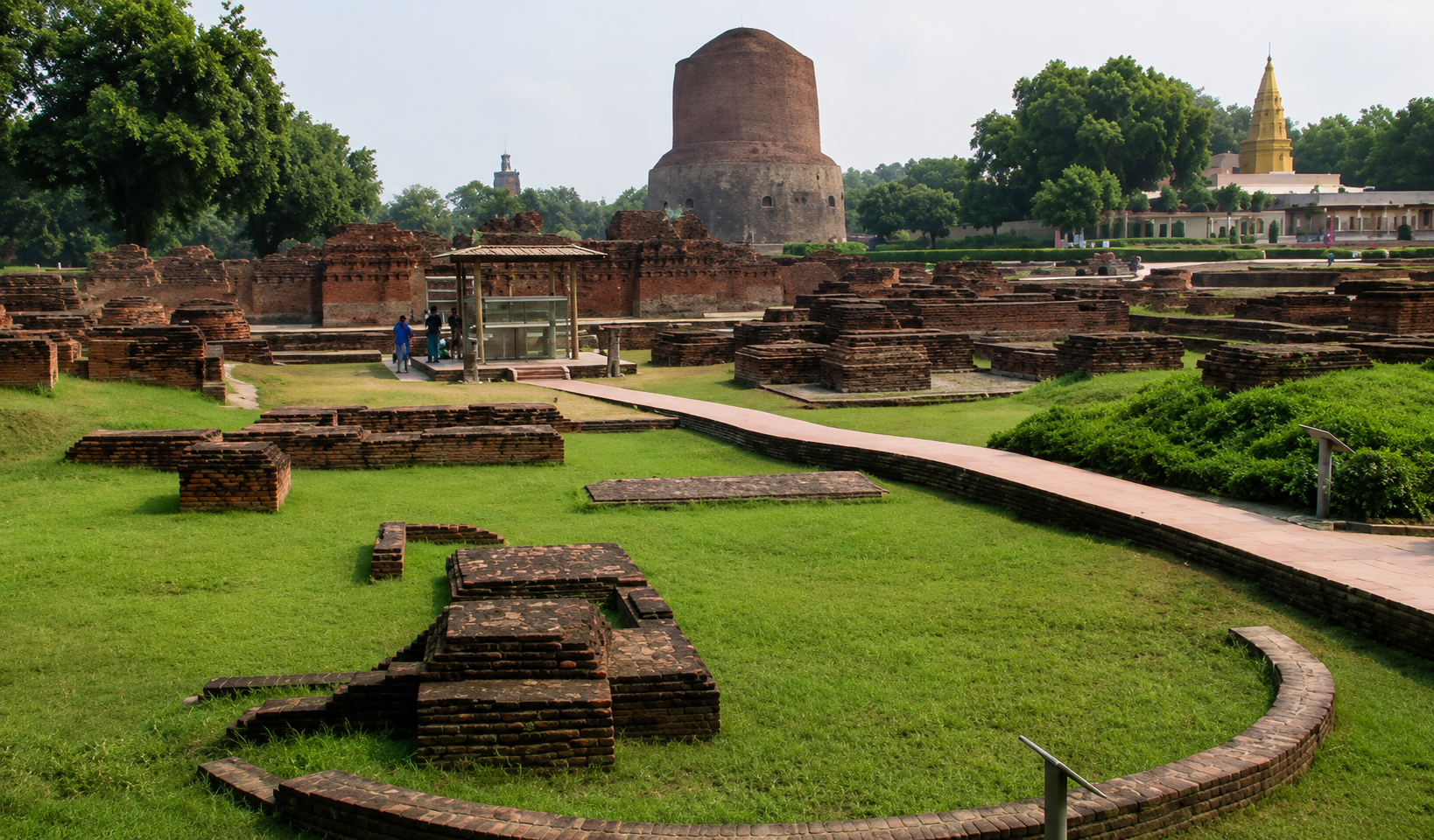

Just a few kilometres from the bustling ghats of Varanasi lies Sarnath, a place where one of history’s most influential ideas first began to spread. More than 2,500 years ago, Gautama Buddha delivered his first sermon here after attaining enlightenment, setting in motion a philosophy that would travel across Asia. On July 25, 2026, that legacy received global recognition as the Ancient Buddhist Site of Sarnath was inscribed on the UNESCO World Heritage List, becoming India’s 45th UNESCO World Heritage Site.
The inscription is more than an addition to a prestigious list. It places Sarnath among the world's most significant cultural landmarks while reinforcing India's position as the birthplace of Buddhism and a key destination for heritage tourism.
More Than the Site of Buddha's First Sermon
For many visitors, Sarnath is synonymous with Buddha's first sermon, known as Dhammachakra Pravartana or the "Turning of the Wheel of Dharma." Yet the site represents far more than a single historical event. Over centuries, it evolved into an important centre of Buddhist learning where monks, scholars and travellers from across Asia exchanged knowledge, philosophy and artistic traditions.
Its archaeological remains, including the iconic Dhamek Stupa, ancient monasteries and intricately carved sculptures, offer evidence of a thriving intellectual and spiritual landscape that once connected India with countries such as Sri Lanka, Thailand, Japan, Myanmar and South Korea.
Sarnath also occupies a unique place in India's national identity through its association with Emperor Ashoka. The Lion Capital of Ashoka, discovered at the site, was adopted as the National Emblem of India, making Sarnath one of the few places where ancient heritage continues to shape the symbols of the modern republic.
UNESCO Recognition Brings Global Attention
The UNESCO designation is expected to strengthen conservation efforts while placing Sarnath more prominently on the global tourism map. It also reinforces India's Buddhist tourism circuit alongside destinations such as Bodh Gaya and Kushinagar, creating greater opportunities for cultural exchange and international pilgrimage.
External Affairs Minister Subrahmanyam Jaishankar described the inscription as "a matter of pride" for the country, reflecting the growing role of India's cultural heritage in strengthening international engagement.
However, global recognition also brings new responsibilities. As visitor numbers are expected to increase, preserving Sarnath's fragile archaeological remains while ensuring sustainable tourism will become equally important. Conservation, research and community participation will determine whether future generations experience the site as more than just a monument.
Sarnath's greatest legacy has never been confined to its ruins. It is the place where ideas of compassion, wisdom and dialogue began a journey that reshaped civilizations across continents. UNESCO's recognition acknowledges not only the site's archaeological value but also the enduring influence of a message that continues to resonate more than two millennia later.