


New Delhi: India's latest push to attract foreign capital could buy the rupee valuable breathing space, but it is unlikely to resolve the deeper structural weaknesses weighing on the economy.
A coordinated policy effort by the government and the Reserve Bank of India (RBI) is expected to draw substantial overseas funds, easing liquidity pressures and stabilising financial markets. Yet, the strategy remains heavily dependent on factors beyond New Delhi’s control, including crude oil prices, global interest rates and geopolitical tensions.
The optimism comes at a time when the Indian economy is grappling with a widening trade deficit, persistent pressure on the external account and a banking system where credit growth continues to outpace deposit mobilisation. While policymakers have moved swiftly to shore up foreign exchange reserves and improve funding conditions, the sustainability of the gains will ultimately be determined by the quality and durability of capital inflows rather than their sheer volume.
According to the India Ratings and Research report, FCNR(B) and ECB Measures: Implications for Rupee, Liquidity and Bond Markets, the latest policy package could attract $60 billion-$70 billion through foreign currency non-resident bank deposits and external commercial borrowings. The report says these inflows could stabilise the rupee below 95 against the dollar in the near term, with an average of 93 during FY27, while keeping the benchmark 10-year government bond yield within a 6.75%-7.10% band.
“Well coordinated (government and RBI) measures provide a buffer, but the backdrop of a tightening global environment and weak exports keeps risks alive. While this may provide relief in the interim, strong capital flows in the medium to long term may provide sustained relief. Oil volatility could unsettle currencies, while fear of higher rates could strain growth,” says Soumyajit Niyogi, Director, Credit Markets, India Ratings and Research.
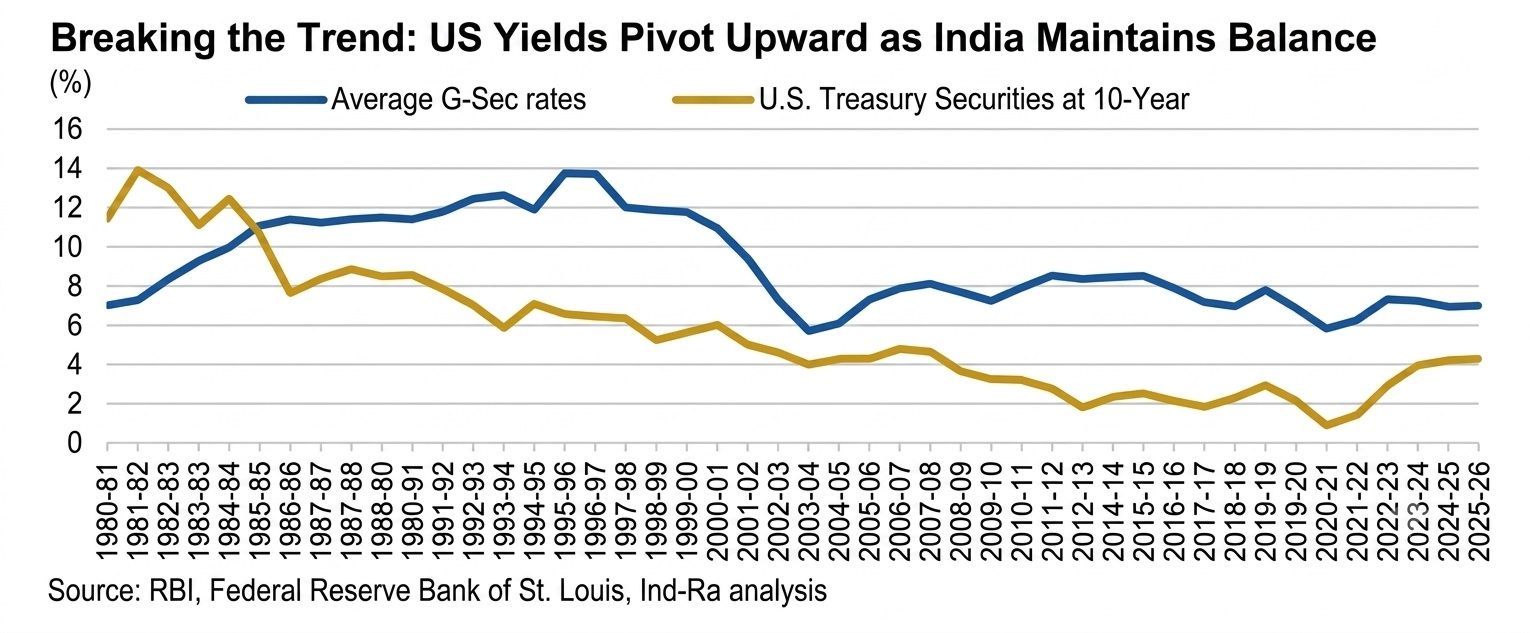
The report argues that policymakers are trying to achieve more than currency stability. By encouraging FCNR(B) deposits and ECB borrowings, they are attempting to improve India’s external financing position, rebuild forex buffers after two consecutive years of balance of payments deficits and deepen integration with global financial markets. However, the narrower India-US yield differential could make these flows more opportunistic than sticky, increasing vulnerability to shifts in global risk appetite.
Liquidity Meets Reality
A major consequence of stronger forex inflows would be a shift in the RBI's liquidity management strategy. The report says higher foreign exchange receipts could reduce the need for large-scale open market operations, keeping the impact on the government securities market broadly neutral while supporting liquidity creation through net foreign assets.
“Ind-Ra expects the arrangement to generate sizeable inflows, potentially in the range of $60 billion-$70 billion, providing a meaningful buffer to the rupee while easing broader funding pressures within the financial system. Against this backdrop of robust inflows, the currency is likely to recover to sub INR95/USD, before appreciating close to INR90/USD, and eventually average around 93.10 in FY27,” says the report.
The banking system, however, continues to face structural challenges that temporary forex inflows alone may not fix. Loan demand remains robust while deposit mobilisation has lagged. System-wide loan-to-deposit ratios remain stretched, with incremental ratios crossing 100%, indicating that banks are lending faster than they are raising deposits.
Within this context, FCNR(B) deposits assume greater significance. With the RBI absorbing hedging costs, banks can offer more attractive returns to overseas Indians while securing cheaper foreign currency funding. Private sector banks, backed by stronger and more diversified deposit franchises, are expected to benefit more than public sector lenders, which remain vulnerable to higher funding costs and tighter liquidity conditions.
The report cautions that funding conditions are likely to improve only at the margin. Elevated credit demand, coupled with the rollout of the government’s ECLGS 5.0 programme, could sustain pressure on bank liabilities even as foreign inflows provide temporary relief.
Risks Remain Elevated
The bond market may emerge as a relative beneficiary of the RBI’s strategy, although the gains are expected to be measured rather than dramatic. According to the report, strong forex inflows could improve liquidity and reduce pressure on government bond yields, but high bond supply and the possibility of tighter global monetary conditions will continue to cap investor enthusiasm.
“Liquidity may remain volatile in the next three to four months, driven by factors such as the RBI’s dividend transfer, government spending, and FCNR(B) inflows. However, this excess liquidity is likely to be absorbed over time.”
The report points to the RBI’s sizeable forward book and the country’s elevated current account deficit as important mechanisms for absorbing surplus liquidity. Any excess cash in the banking system is expected to be actively managed through variable rate reverse repo operations, ensuring that money market conditions remain aligned with policy objectives.
Higher-rated corporate borrowers are likely to gain from these developments. As public sector undertakings increasingly tap overseas borrowing through ECBs, domestic demand-supply dynamics in the corporate bond market could improve, benefiting AAA and AA-rated issuers through narrower spreads. The report expects spreads for other corporate and banking borrowers to ease as well, although to a lesser extent.
The bigger challenge lies outside the RBI’s direct influence. A spike in crude oil prices could widen the trade deficit and weaken the rupee. Higher global interest rates could trigger capital outflows and tighten financial conditions. Weak exports and a persistent credit-deposit imbalance could dilute the benefits of policy intervention.
India’s latest forex strategy can deliver near-term stability, but not permanent insulation from global shocks. Strong capital inflows may steady the rupee and improve liquidity, but unless external vulnerabilities ease and structural imbalances in the financial system narrow, policymakers could find themselves returning to the same playbook when the next bout of global volatility arrives.