
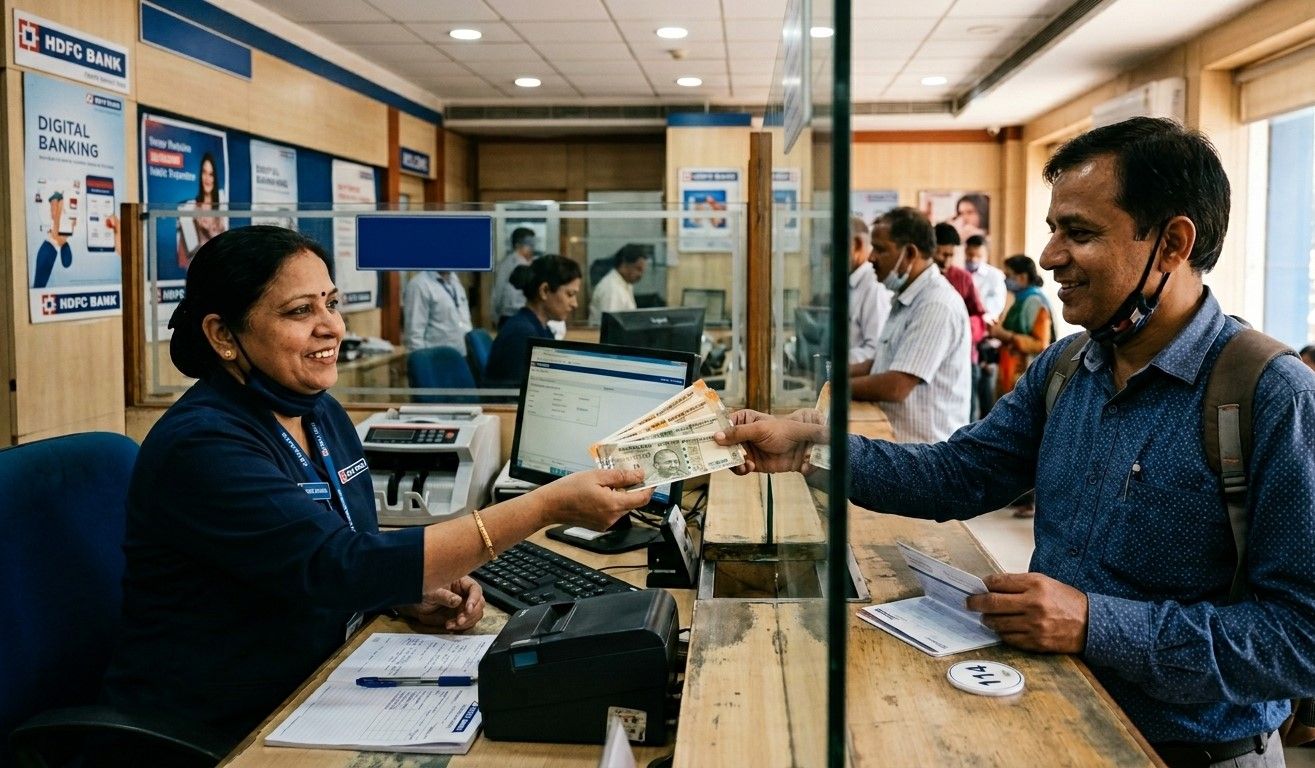

New Delhi: India’s banking sector reported steady earnings in the latest quarterly results, with large lenders posting 8%-12% profit growth and loan expansion in the 12%-16% range. Results from HDFC Bank, ICICI Bank, Axis Bank, IDFC First Bank and State Bank of India indicate that while credit demand remains robust, slowing deposit growth and rising funding costs are beginning to compress margins across the system.
The Q4 2026 numbers, reflecting early FY27 trends, suggest that the sector is moving out of a phase of margin expansion into one of balance sheet management, where profitability is increasingly driven by liability franchises and cost discipline rather than pure loan growth.
HDFC Bank reported a net profit of about ₹19,200 crore for the quarter, up roughly 9% year-on-year, with advances growing close to 12% and deposits rising around 13%. Net interest margins, however, saw mild compression on a sequential basis as the bank continued to rebalance its loan-to-deposit ratio post-merger. Asset quality remained stable, with gross NPAs near the 1.2%-1.3% range. The stock reaction remained muted, reflecting investor concerns around margin trajectory rather than growth.
ICICI Bank delivered one of the strongest performances among large lenders, reporting net profit of over ₹13,700 crore, up over 8% year-on-year. Advances grew at approximately 16%, led by retail and business banking segments. Net interest margin remained resilient at around 4.3%, among the highest in the sector, while gross NPAs declined further to nearly 2.1%. Credit costs stayed low, supporting return on equity in the 17%-18% range. The bank’s operating metrics continue to outpace peers, reinforcing its premium valuation.
Axis Bank’s results reflected steady but more moderated growth. The bank reported quarterly profit growth in the high single digits, with net profit in the ₹7,000 crore range. Loan growth stood at around 14%-15%, while deposits increased by about 12%-13%. Net interest margin came under pressure, trending closer to 3.9%-4.0%, compared with higher levels seen in the previous year. Asset quality continued to improve, with gross NPAs declining to roughly 1.6%-1.7%. The bank’s return ratios remained stable, though not expanding at the same pace as ICICI Bank.
IDFC First Bank reported a sharper earnings expansion relative to peers, with net profit rising in the 18%-20% range year-on-year, albeit on a smaller base. The bank’s advances grew strongly at over 20%, driven by retail lending, while deposits expanded at a similar pace, reflecting continued improvement in its liability franchise. Net interest margin remained elevated at around 6%-plus, among the highest in the industry, although there were early signs of moderation. Asset quality improved, with gross NPAs declining toward the 2% level. Despite these gains, return on equity remains lower than larger peers, reflecting the bank’s ongoing transition.
Across the sector, a clear trend is visible in net interest margins. Most large banks reported either flat or declining margins on a sequential basis, reflecting higher cost of funds. Deposit growth, at around 12%-13% system-wide, continues to lag credit growth, which remains closer to 15%-16%. This divergence is forcing banks to raise deposit rates and rely more on wholesale funding, both of which weigh on margins.
The latest Reserve Bank of India data shows that system credit growth stands at approximately 16%, while deposit growth trails at about 13%-13.5%. This gap has persisted over several quarters and is now emerging as a structural constraint. Banks with stronger retail deposit franchises are better positioned, while others face higher incremental funding costs.
Growth Outlook & Emerging Risks
Retail lending continues to drive growth, accounting for a significant share of incremental advances across banks. Segments such as housing, vehicle loans and unsecured retail credit remain key contributors. At the same time, corporate lending is showing signs of revival, with growth in working capital and project financing. MSME lending also remains a steady contributor, supported by policy measures and improving economic activity.
Asset quality remains a strong positive across the sector. Gross NPAs for most large private banks are now below 2%, while even public sector banks have reduced NPAs to near 2%-3%. Credit costs are at multi-year lows, typically in the 0.5%-1.0% range, significantly boosting profitability. Slippages remain contained, although some banks have flagged early stress in unsecured retail portfolios.
Despite stable earnings, stock market performance has been less encouraging. Banking stocks have seen periods of underperformance relative to the broader market, reflecting concerns around margin compression and liquidity conditions. While long-term fundamentals remain intact, valuations have adjusted to reflect a more challenging operating environment.
Looking ahead, sectoral growth is expected to moderate slightly. Credit growth is likely to settle in the 12%-14% range over the next year, while deposit growth may remain in the 10%-12% band. This suggests continued pressure on funding costs and margins. At the same time, regulatory focus on unsecured lending and capital adequacy could influence growth strategies.
The sector is entering a phase where differentiation will become more pronounced. Banks with strong deposit franchises, high CASA ratios and stable asset quality — such as HDFC Bank and ICICI Bank — are likely to maintain leadership. Axis Bank remains well-positioned but faces margin pressures, while IDFC First Bank continues its transition toward profitability.
The banking sector remains structurally strong, supported by healthy credit demand and improved balance sheets. However, the latest results make it clear that the drivers of performance are shifting. Growth remains intact, but profitability will increasingly depend on funding efficiency, margin management and disciplined execution in a more competitive environment.