
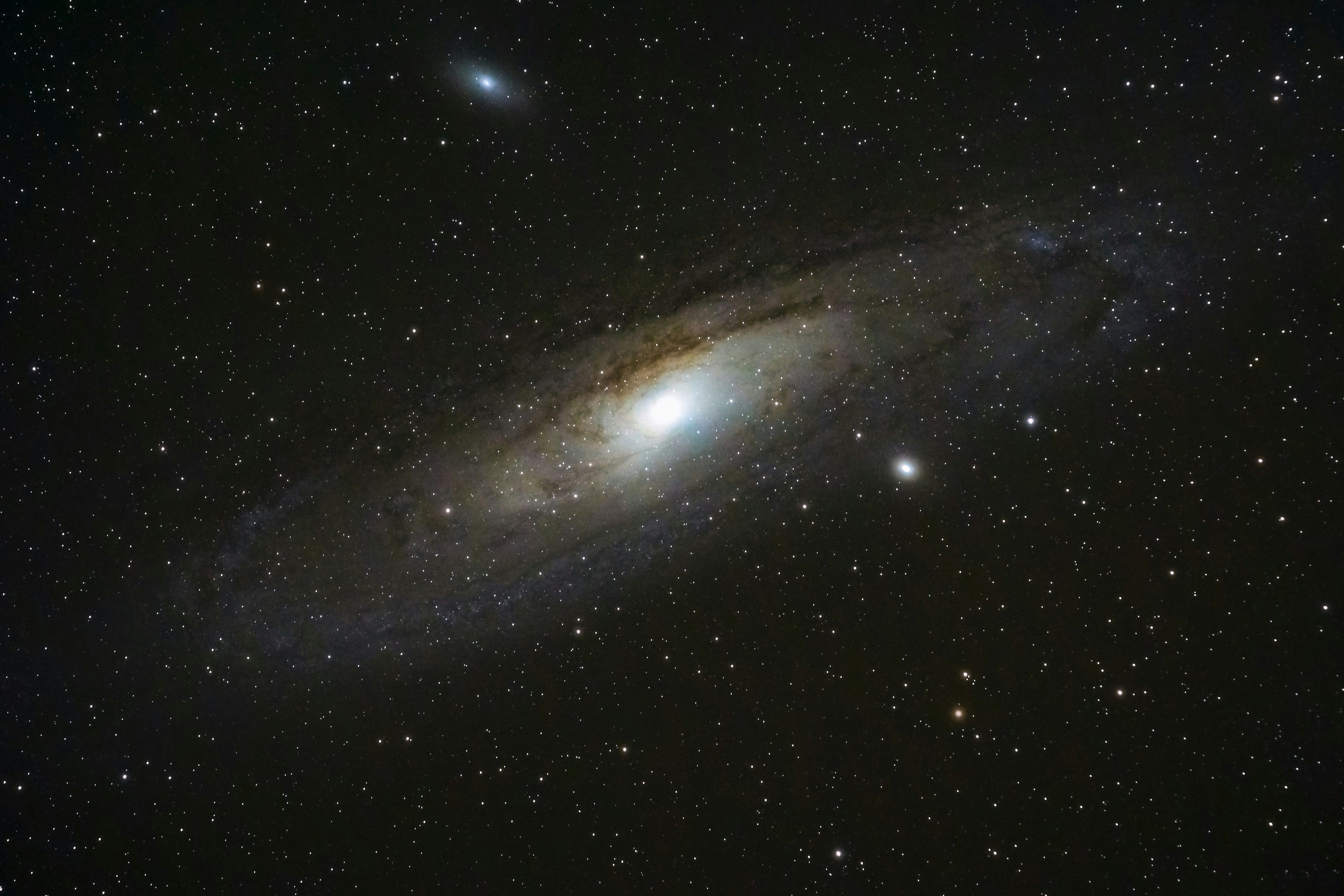

New Delhi: A new study from the Raman Research Institute (RRI), Bengaluru, has found that astronomers may be overestimating the mass of a galaxy’s outer gas envelope — a region crucial to understanding how galaxies grow and evolve. The reason, researchers say, is that gas from the vast space between galaxies may be mixing into measurements that were previously thought to belong entirely to the galaxy itself.
When we picture a galaxy, we usually imagine glowing stars arranged in spirals or clusters. But stars make up only a small part of a galaxy’s total mass. Surrounding every galaxy is a huge, faint halo that stretches up to 10-20 times beyond the visible galaxy. This halo contains dark matter — the invisible substance that holds galaxies together — and gas. The gaseous part of this halo is known as the circum-galactic medium, or CGM. Beyond this lies the inter-galactic medium (IGM), the thin gas that fills the space between galaxies.
Understanding the CGM is important because it acts like a gateway. It controls how gas flows into a galaxy to form new stars and how gas flows out due to events like supernova explosions. Astronomers estimate the mass of the CGM by measuring highly ionized oxygen — oxygen atoms stripped of several electrons — because this element is abundant and leaves clear signatures in light.
To detect this oxygen, astronomers observe light from extremely bright, distant galaxies or quasars. As this light travels toward Earth, it passes through gas around nearer galaxies, and certain wavelengths get absorbed. The problem, as highlighted by the new RRI study, is that this absorption includes oxygen from both the CGM and the IGM. Current methods cannot clearly separate the two.
New Findings
Using mathematical models, the researchers showed that a significant amount of the ionized oxygen attributed to the CGM may actually come from the surrounding inter-galactic gas.
Dr. Kartick Sarkar, an astrophysicist at RRI and one of the authors of the study published in The Astrophysical Journal, explains this using a simple analogy. A galaxy is like a street magician, and the CGM is like a crowd gathered around them. The crowd grows with the size of the magician, but beyond a certain boundary, people stop gathering. That outer region represents the IGM, which is not gravitationally bound to the galaxy but still lies along the same line of sight.
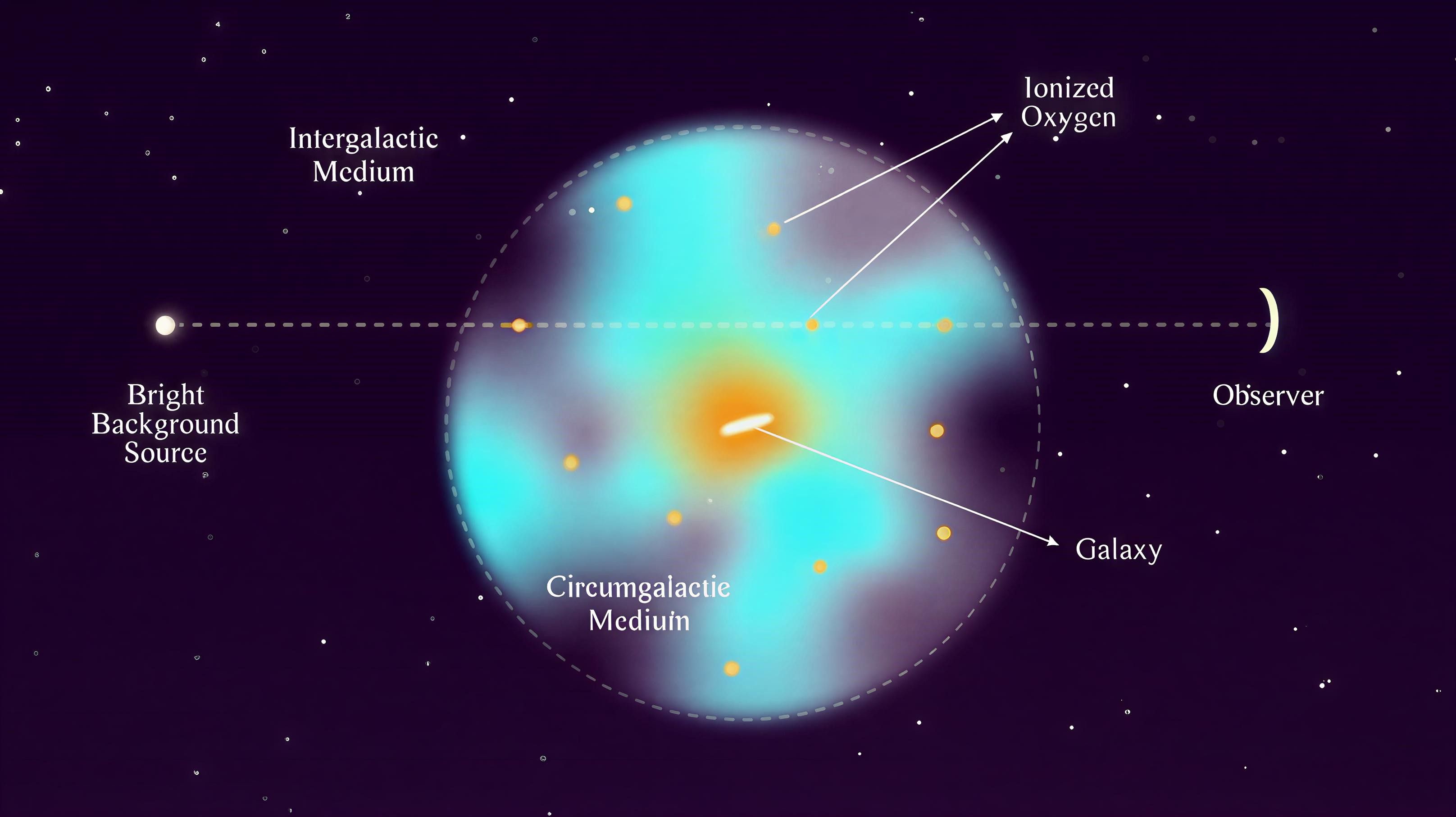
Artistic representation of the presence of ionized oxygen in the inter-galactic medium in the case of low-mass galaxies.
According to the study, this “blanket” of intergalactic gas can contaminate measurements, leading astronomers to think the CGM is more massive than it actually is. For large galaxies like the Milky Way, only about half of the observed ionized oxygen may belong to the CGM, with the rest coming from the IGM. For smaller galaxies, the CGM’s contribution could be as low as 30%.
The team first suspected something was wrong when models of CGM mass did not match observations, especially for low-mass galaxies. Their findings now offer a possible explanation for this mismatch and suggest that similar effects occur across galaxies of all sizes.
Researchers from RRI, along with collaborators from the Hebrew University of Jerusalem, are now working to refine their models to better account for this overlap. “We’re sure there’s a discrepancy,” says Dr. Sarkar. “Now we’re trying to quantify it exactly.”
The study underscores the need to rethink how astronomers interpret observations of the gas surrounding galaxies — a step that could reshape our understanding of how galaxies form and evolve.
(Cover photo by Bryan Goff on Unsplash)