
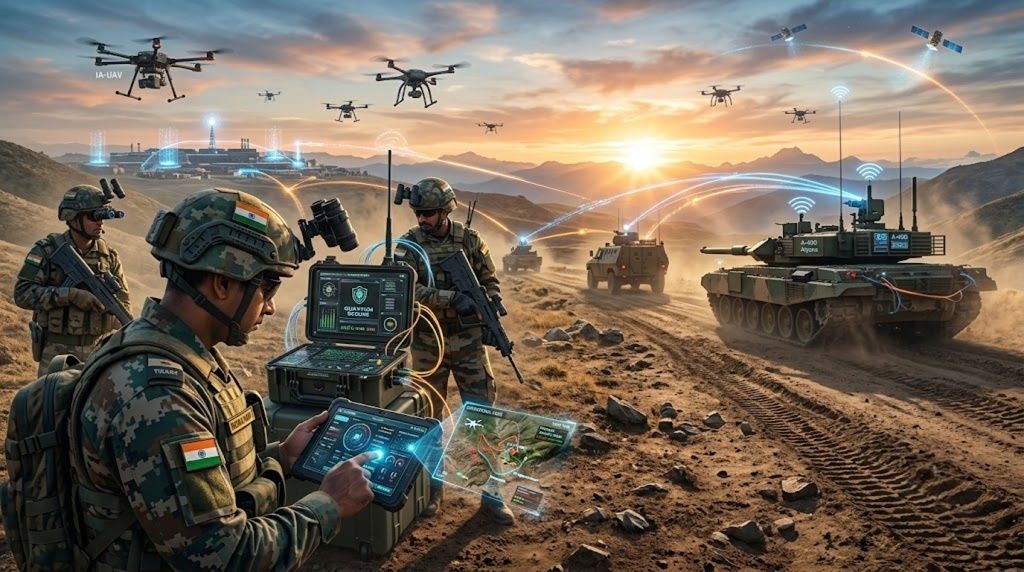

The nature of warfare is changing rapidly. Battles are no longer limited to traditional land, air and sea domains, with drones, cyberspace, artificial intelligence and space-based systems increasingly becoming part of military operations.
Against this backdrop, the Indian Army is building a technology-focused ecosystem aimed at strengthening its future operational capabilities.
According to the Parliamentary Standing Committee on Defence, the Army has identified 16 niche technology clusters covering 33 technologies for induction into the service. These include areas such as artificial intelligence, 6G, quantum computing, blockchain, 3D printing and other emerging technologies.
6G and the Future of Military Communications
For the military, next-generation connectivity could be about far more than faster internet.
The Army is involved in technology initiatives linked to 6G, while its Signals Technology Evaluation and Adaptation Group has been established to work with advanced communication technologies including 5G, 6G, artificial intelligence, machine learning, quantum computing and software-defined radio.
Such technologies could eventually support faster and more secure communication between soldiers, command centres, sensors, drones and other military platforms.
Quantum Technology for More Secure Communications
Quantum technology is another major part of India’s defence modernisation efforts.
Quantum technology is a field of science that uses the principles of quantum physics, the behaviour of particles at the smallest scale, to perform tasks that are impossible or extremely difficult for traditional systems. It can be used in computing, communication, sensing and encryption.
For example, in traditional military communication, messages are protected using mathematical encryption. If an enemy intercepts the message, they may try to break the code using powerful computers.
But in quantum communication, information is transmitted using quantum states. If an adversary attempts to intercept or measure the quantum signals, the act of measurement can disturb those states, allowing the communicating parties to detect a potential interception. This makes quantum communication particularly valuable for securing sensitive data.
For example, if two Army command centres are exchanging sensitive operational plans using Quantum Key Distribution (QKD), any attempt by an adversary to spy on the communication could disturb the quantum signals, allowing the communicating parties to detect a potential interception.
In January 2026, Chief of Defence Staff General Anil Chauhan released the Military Quantum Mission Policy Framework, outlining a roadmap for integrating quantum communication, quantum computing, quantum sensing and metrology, and quantum materials and devices into the armed forces.
The Army has already taken steps towards quantum-secure communications. In 2024, the Indian Army signed a contract for a Quantum Key Distribution (QKD) system aimed at strengthening the security of military communications.
AI Could Become the Backbone of the Digital Battlefield
Artificial intelligence is another central pillar of the Army’s transformation.
A high-performance computing AI cloud is being developed for all three services, with the Army taking the lead in the initiative. The Army has also established an Artificial Intelligence Incubation Centre in collaboration with Bharat Electronics Limited to accelerate the development and adoption of military AI applications.
The objective is not simply to introduce AI as another piece of equipment. The larger ambition is to make military operations increasingly data-centric, allowing information from different sources to be processed and used more effectively.
2026: The Army’s ‘Year of Networking and Data Centricity’
The technological shift is being reflected in the Army’s broader priorities.
The Army has designated 2026 as the ‘Year of Networking and Data Centricity’, signalling greater emphasis on connected systems, information sharing and the ability to use data for operational decision-making.
This represents a significant change in how future military capability could be built: not only through weapons and platforms, but through the networks and digital infrastructure connecting them.
From Conventional Warfare to a Connected Battlefield
The transformation comes as militaries around the world increasingly experiment with autonomous systems, drones, cyber capabilities, artificial intelligence and space-based technologies.
For India, the challenge is to develop these capabilities while also reducing dependence on foreign technology. The Army’s technology programmes therefore increasingly involve IITs, research institutions, startups and Indian defence companies.
The result could be a future Indian military in which secure networks, AI-powered systems, quantum-secured communications and advanced connectivity work alongside conventional weapons and platforms.
The technology may still be at different stages of research, development and induction. However, the direction is clear, the Indian Army is preparing for a battlefield where information, connectivity and computing power could be as strategically important as firepower.