
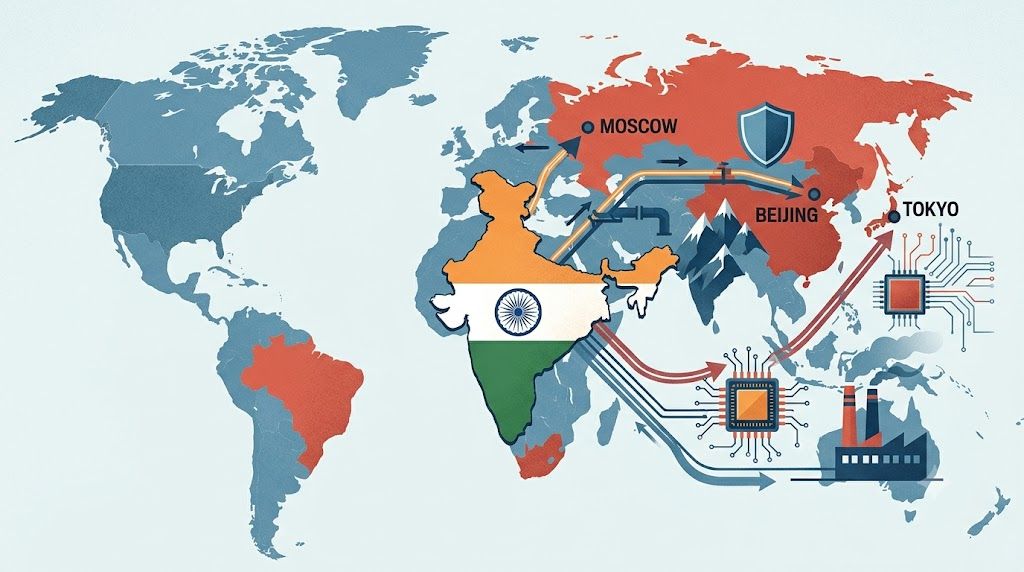

In the space of just a few days, three senior Indian policymakers were engaging three major powers, and the sequence is worth looking at as more than a coincidence.
National Security Adviser Ajit Doval was in Beijing for the 25th round of India-China Special Representatives talks. External Affairs Minister S. Jaishankar was in Moscow for the 27th India-Russia Inter-Governmental Commission. Commerce and Industry Minister Piyush Goyal led a 200-member business delegation to Japan.
Three capitals. Three different missions. Three different instruments of Indian statecraft.
Taken together, they reveal something important about how New Delhi is positioning itself in an increasingly divided global order.
India is not choosing between China, Russia and Japan. It is trying to extract strategic value from all three relationships, on different boards, for different purposes.
Board One: Beijing — Managing the Security Challenge
The first board is China, and here the priority is security.
On August 25, Doval and Chinese Foreign Minister Wang Yi held the 25th round of Special Representatives talks on the India-China boundary question in Beijing. The discussions covered the boundary issue, bilateral relations and the need to maintain peace and tranquillity along the border. Both sides also agreed to continue work towards a framework for a fair, reasonable and mutually acceptable boundary settlement.
But the timing gives the meeting greater significance.
India is preparing to host the BRICS summit in September as the bloc’s 2026 chair. The summit is scheduled for September 12–13, with Chinese President Xi Jinping expected to attend.
That creates a complicated diplomatic equation for New Delhi.
India needs to manage its most consequential security challenge while simultaneously preparing to host China within a multilateral grouping where Beijing is one of the most powerful members.
The message from Beijing, therefore, is not simply about the border.
It is about managing competition without allowing competition to shut down engagement.
For India, stabilising the border is not the same as resolving the entire relationship. But maintaining peace along the frontier creates space for diplomacy, trade and wider engagement to continue.
That is the first board: security and risk management.
Board Two: Moscow — Preserving Strategic Depth
The second board is Russia.
Jaishankar travelled to Moscow on August 23–24, where he co-chaired the 27th India-Russia Inter-Governmental Commission on Trade, Economic, Scientific, Technological and Cultural Cooperation with Russian First Deputy Prime Minister Denis Manturov. He also met Russian President Vladimir Putin and other senior Russian officials.
The relationship is no longer only about defence.
Energy, fertilisers, nuclear cooperation, technology, connectivity, payments and trade are increasingly central to the India-Russia equation.
But there is also a problem New Delhi wants to fix: the trade imbalance.
Jaishankar called for measures including reducing non-tariff barriers, strengthening payment mechanisms and progressing towards a Free Trade Agreement, with the shared objective of taking bilateral trade to $100 billion by 2030. The trade imbalance, meanwhile, has widened to more than $50 billion.
That makes Moscow a different kind of board from Beijing.
With China, India is primarily managing a security challenge.
With Russia, India is trying to preserve a longstanding strategic partnership while expanding its economic foundations.
And the BRICS connection matters here too.
Russia, like China, is one of the bloc’s most influential members. India will soon have to bring these major powers into the same room in New Delhi, while pursuing its own interests with each of them separately.
That is the second board: strategic depth and economic diversification.
Board Three: Tokyo — Building Economic Power
Then comes Japan, perhaps the most visibly economic of the three engagements.
Goyal travelled to Japan from August 24 to 27, leading India’s largest-ever business delegation to the country, with more than 200 representatives. The delegation covered sectors including manufacturing, semiconductors, clean energy, steel, automobiles, financial services, healthcare and startups.
Japan has also set a target of investing ¥10 trillion in India over the coming decade, adding another layer of significance to the visit.
The emphasis is increasingly on technology-intensive manufacturing and supply chains , areas such as semiconductors, artificial intelligence, electronics and next-generation industries.
This is where India’s broader economic strategy becomes visible.
New Delhi does not simply want foreign companies to access India’s huge consumer market.
It increasingly wants them to manufacture in India, invest in India and integrate India into global supply chains.
That makes Japan important not merely as an investment source but as a partner in India’s attempt to build technological and manufacturing capacity.
That is the third board: economic and technological power.
Three Powers, Three Objectives
Look at the three engagements together and a pattern emerges.
Beijing — security.
Moscow — strategic depth.
Tokyo — economic and technological firepower.
The approach is not about choosing one relationship over another.
India can simultaneously negotiate with China on the border, deepen its strategic and economic relationship with Russia, and attract Japanese capital and technology.
That is possible because these relationships serve different Indian interests.
And this is where India’s BRICS chairship becomes particularly significant.
New Delhi is not entering the BRICS summit as a country that has chosen one geopolitical camp. It is entering as a country trying to make room for multiple partnerships at once.
India’s 2026 BRICS agenda itself reflects that approach, with New Delhi pushing areas such as resilient supply chains, startups, innovation, green energy, greater trade in national currencies and reforms of global institutions.
The objective is therefore not to become the bridge between every rival power.
It is to ensure that India has enough relationships, economic options and strategic space to avoid becoming dependent on any single one.
India Is Not Picking a Camp
For years, India’s foreign policy has often been described through the language of balancing.
But “balancing” can sometimes make India’s strategy sound reactive, as though New Delhi is simply responding to what Washington, Beijing or Moscow does.
The recent sequence suggests something more deliberate.
India is engaging China where it must manage risk. It is engaging Russia where it wants strategic continuity and economic diversification. And it is engaging Japan where it wants investment, technology and manufacturing capacity. These relationships do not have to be identical. They do not even have to serve the same purpose. That is precisely the point.
India’s foreign policy is increasingly about issue-based partnerships rather than permanent alignment.
The three visits may have been separate diplomatic and economic engagements. But viewed together, they offer a snapshot of a larger strategy:
India isn’t picking a camp. It is building its own.