

New Delhi: India’s ambitions to emerge as a global innovation powerhouse are being undermined by a “systemic crisis” in research pursuits across its state universities. The country’s R&D ecosystem, spread across its vast university network, rests on a fragile foundation, marked by sharp disparities and chronic underperformance. The Niti Aayog report, Improving the Culture of Research and Development (R&D) in State Universities and Institutes, offers a diagnostic assessment of this structural weakness, revealing a widening gap between aspiration and capability.
At the heart of the problem lies a stark dichotomy. While India’s elite institutions have carved out global reputations for excellence, the overwhelming majority of state universities, despite their scale and reach, struggle to produce impactful research. The report notes that “the majority of traditional universities… encountered challenges in producing research of notable quality”, a reality that continues to weigh down India’s overall research output.
This imbalance is not merely academic; it has far-reaching implications for economic growth, technological advancement, and global competitiveness. R&D, as the report underscores, is not an optional add-on but “the cornerstone of academic institutions, serving as a catalyst for innovation, knowledge advancement, and societal progress”. Without a robust R&D culture, universities risk becoming “degree factories” rather than engines of innovation.
Despite policy interventions and targeted schemes such as FIST and PURSE, the broader ecosystem remains underpowered.
India’s position in the Global Innovation Index has improved — from 52 to 40 between 2019 and 2023, but the report cautions that this progress masks persistent structural deficiencies. “India still requires refinement in terms of institutes and infrastructure,” it observes, pointing to systemic gaps that cannot be bridged by incremental reforms alone.
A critical concern is the mismatch between demand and supply of quality research. The Niti Aayog report highlights “a discernible imbalance in the demand and supply of quality research output”, warning that this disconnect could derail India’s aspirations of becoming a global scientific leader. The challenge, therefore, is not just to increase research output but to fundamentally rewire the ecosystem that produces it.
Underinvestment, Structural Gaps
The scale of India’s higher education system is both its strength and its Achilles’ heel. As of March 31, 2022, the country had 54 central universities, 450 state public universities, and 409 state private universities, among others. This vast network should, in theory, serve as a fertile ground for research and innovation. In practice, however, it remains underutilised.
Gross Enrolment Ratio (GER) in higher education stands at 27.10%, indicating a growing base of students. Yet, this expansion has not been matched by a corresponding increase in research capacity or output. The report makes it clear that scaling access without strengthening research infrastructure risks diluting academic quality.
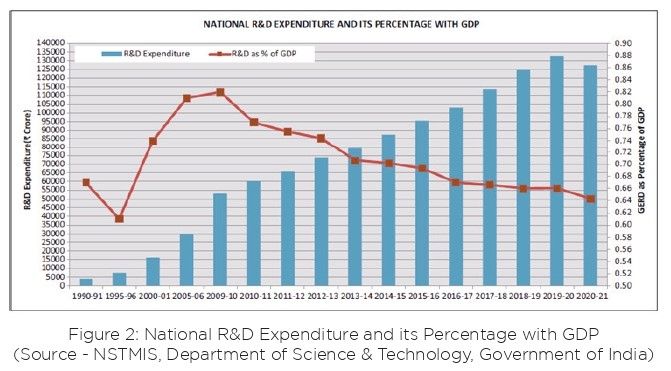
The most telling indicator of this imbalance is India’s R&D expenditure. While total spending has more than doubled — from ₹60,196.75 crore in 2010-11 to ₹127,380.96 crore in 2020-21 — the share of GDP devoted to R&D remains significantly low. The report is critical about the implications: “Despite witnessing annual increments… India’s Gross Domestic Expenditure on R&D (GERD) as a percentage of GDP hovers around 0.7%, significantly below the stipulated target.”. This, notably, is far below the 2% target envisioned in national policy frameworks. More significantly, the underinvestment places India at a disadvantage compared to global leaders like Germany and Japan, which consistently invest around 3% or more of their GDP in R&D.
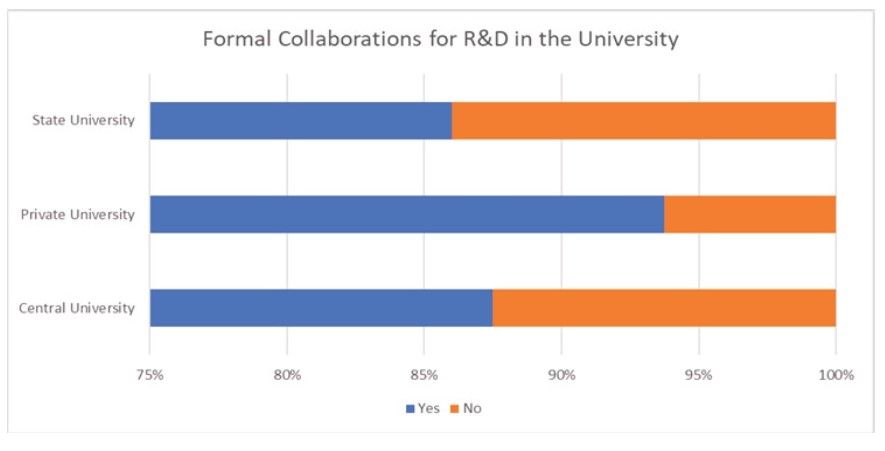
Equally concerning is the composition of this expenditure. The government remains the dominant contributor, while private sector participation lags. “To bridge the gap… there is a critical need to augment private sector investments,” the report argues, signalling a structural weakness in industry-academia collaboration.
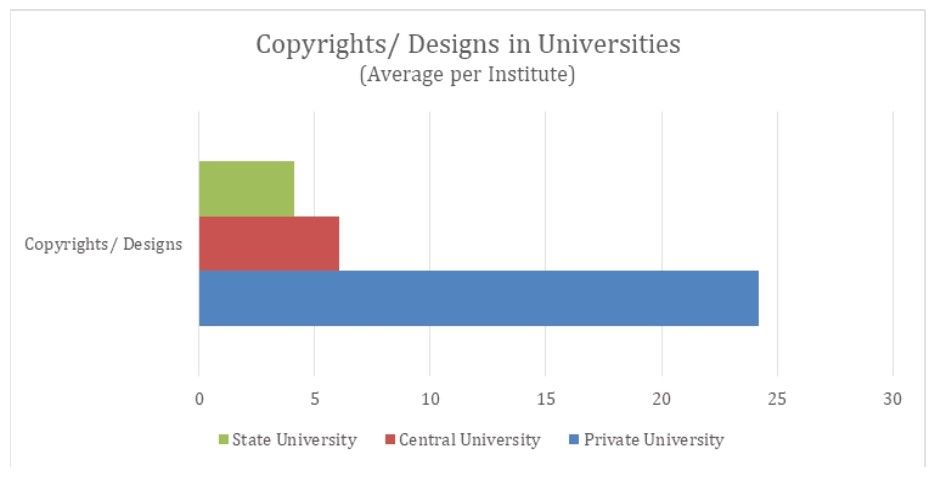
The consequences of these gaps are visible across multiple dimensions: low research output, limited patent generation, weak technology transfer mechanisms, and high attrition rates in doctoral programmes. Even where research exists, it often fails to translate into real-world applications, highlighting the disconnect between academic inquiry and industrial relevance.
The Niti Aayog report also flags deficiencies in institutional capacity. Many universities lack dedicated R&D cells, adequate funding mechanisms, and incentives for faculty engagement. This institutional inertia, combined with bureaucratic hurdles and fragmented governance, creates an environment where research struggles to thrive.
Road Ahead
If the diagnosis is stark, the report’s vision for reform is equally ambitious. It calls for a “systemic overhaul” that goes beyond incremental policy tweaks to address the structural roots of the problem.
Central to this vision is the idea of an integrated research ecosystem that seamlessly connects foundational research, translational research, and commercialisation. The report describes this progression as a “pivotal transformation… from fundamental scientific inquiry to the pragmatic application of discoveries in real-world scenarios”. This continuum is essential for ensuring that research not only generates knowledge but also drives economic and societal impact.
The National Education Policy (NEP) 2020 is identified as a key enabler of this transformation. It seeks to embed research at the core of higher education, fostering a culture where innovation is not incidental but integral. As the report puts it, NEP 2020 represents “a paradigm shift… where the synergy between education and research becomes the cornerstone of progress”.
However, policy intent must translate into institutional action. The report emphasises the need for robust R&D cells in universities, improved funding mechanisms, and stronger industry linkages. It also highlights the importance of interdisciplinary research, incubation centres, and innovation hubs in bridging the gap between academia and industry.
International benchmarks offer valuable lessons. Countries like Germany, Japan and Singapore have built thriving R&D ecosystems through sustained investment, strategic policy frameworks, and strong collaboration between academia and industry. These models underscore the importance of coherence and continuity in policy implementation.
The report also stresses the need for incentives, both financial and non-financial, to encourage participation from key stakeholders. “The government must institute compelling incentives for the primary stakeholders… to actively engage and invest in R&D endeavours,” it says. Without such incentives, even well-designed policies risk remaining ineffective.
Perhaps the most critical takeaway is the need for cultural change. Building a vibrant R&D ecosystem is not just about funding or infrastructure; it requires a shift in mindset across institutions, faculty and students. Research must be seen not as an obligation but as an opportunity: an avenue for discovery, innovation, and impact.
The stakes could not be higher. As the Niti Aayog report makes clear, India stands at a crossroads. With the right reforms, it has the potential to “ascend to the strata of a global leader in research and development”. Without them, it risks falling behind in an increasingly knowledge-driven global economy. The question now is whether policymakers, institutions and industry can rise to the challenge and turn ambition into action.
(Cover photo by National Cancer Institute on Unsplash)