


New Delhi: India’s digital commerce boom is confronting an uncomfortable truth. The same platforms driving the country’s online shopping revolution are also quietly extracting billions of rupees from consumers through manipulative interface designs that influence, pressure and confuse users into spending more than they intended.
A new industry report by Datum Intelligence estimates that so-called “dark patterns’ are costing Indian consumers ₹25,000-28,000 crore annually through hidden charges, pre-selected add-ons, forced subscriptions and deceptive checkout practices. The damage, however, extends far beyond direct consumer losses. Growing frustration and declining trust are putting another ₹55,000 crore in platform gross merchandise value (GMV) at risk as users reduce spending, compare prices more aggressively or abandon platforms altogether.
The report, Dark Patterns in India's Online Marketplaces: Consumer Perception, Economic Impact, and the Path Forward, argues that deceptive digital design has evolved from a user experience problem into a macroeconomic challenge for India’s rapidly expanding digital economy.
“Dark patterns are not a UX annoyance, they are a direct financial extraction mechanism operating at national scale,” the report said, adding that millions of consumers lose money every month to hidden fees, forced add-ons and subscription models designed to resist cancellation.
The findings arrive at a critical moment for India’s digital commerce ecosystem, which is projected to reach $266 billion by 2030. More than 300 million consumers already shop online across e-commerce, quick commerce and online travel, the three sectors covered by the study.
Conducted during the first quarter of 2026, the survey covered 2,596 consumers across 50 cities and assessed 12 leading platforms, including Amazon, Flipkart, Myntra, Nykaa, BigBasket, Zepto, Blinkit, Swiggy Instamart, MakeMyTrip, EaseMyTrip, ixigo and Cleartrip.
The numbers paint a worrying picture. Around 88% of India's estimated 304 million digital buyers have suffered measurable financial losses linked to dark patterns, with the average consumer losing ₹78-87 every month after adjusting for recall bias.
The financial hit can be significant. According to the report, 88% of consumers paid extra over the past year because of hidden fees, auto-enrolled subscriptions and prices that increased during checkout. While most users lost up to ₹2,500 annually, around 22% reported losses exceeding that amount.
The problem appears to be worsening despite regulatory scrutiny. Hidden charges or drip pricing now affect 63% of online payment users, up sharply from 52% in 2024. Nearly 73% of platforms deploy forced-action mechanisms that push consumers into decisions they may not otherwise make, while 69% continue to use drip pricing tactics that reveal additional charges only at the final stage of a transaction. More than half of the platforms surveyed were also found to use bait-and-switch techniques, where the final offer differs materially from the product, service or pricing originally advertised.
Perhaps the report's most striking conclusion is what it describes as the “awareness paradox”.
Consumer education alone appears to offer little protection. While 81% of respondents said they could identify dark patterns when shown examples, 85% admitted they had still been misled during actual transactions.
“Recognition is not protection. People can name the pattern, and it still works on them. A checkout flow tested against millions of users beats a single user’s recognition every time,” the report noted.
The Datum study argues that the issue is structural rather than informational. Consumers may understand they are being manipulated, but carefully engineered interfaces and repeated behavioural nudges continue to influence purchasing decisions.
The impact varies significantly across sectors. Online travel accounts for roughly 45% of direct consumer losses despite having a smaller user base, largely because higher-value transactions amplify the effect of drip pricing and auto-added services.
The long-term commercial consequences are already becoming visible. Rather than filing complaints, many consumers are simply voting with their wallets. Between 36% and 45% of users have reduced spending, cut usage or abandoned at least one platform after encountering dark patterns.
The report also highlights a significant consumer redress gap. Only 23% of users who lodge complaints receive satisfactory resolutions, reinforcing perceptions that deceptive practices carry limited consequences for businesses.
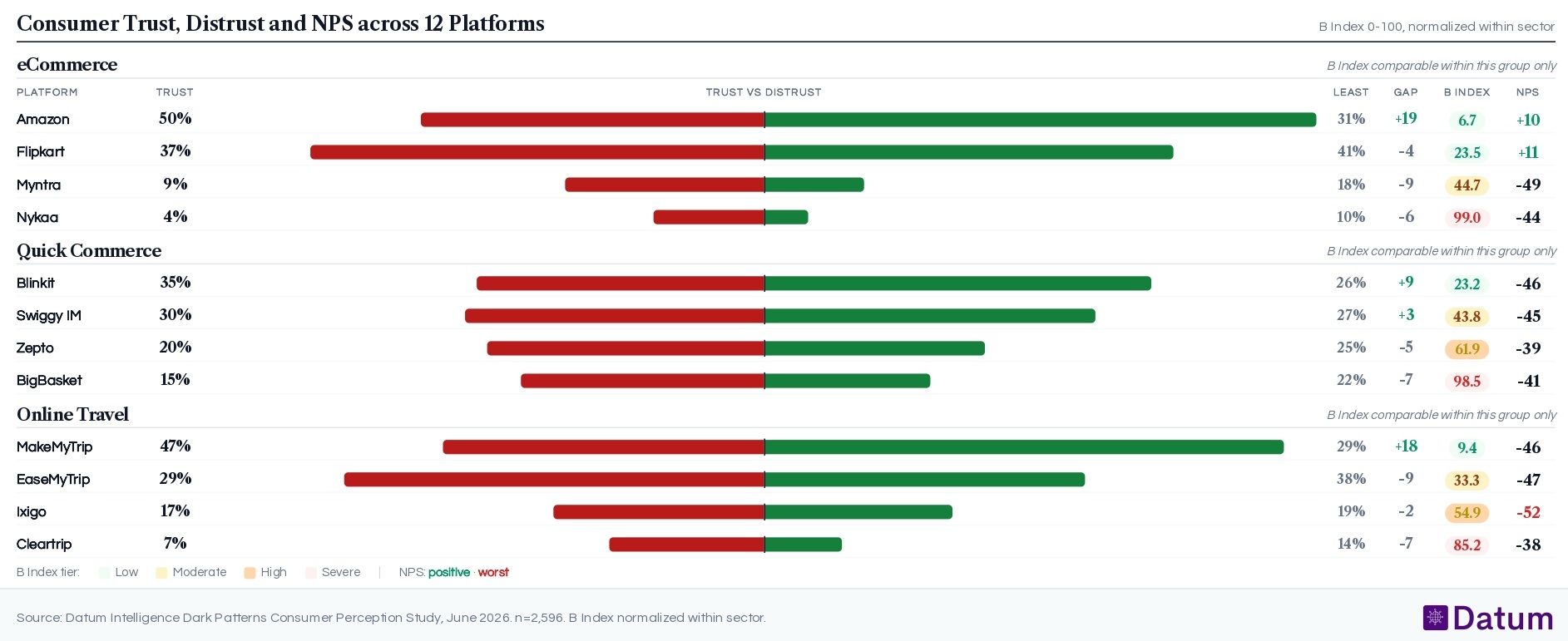
Platform rankings reveal substantial differences in consumer trust and financial harm despite widespread use of dark patterns across the industry.
In e-commerce, Amazon emerged as the most trusted marketplace, with 50% of users identifying it as their preferred platform for safe online shopping. The report said Amazon recorded the lowest B-Index score in the category at 6.7 and cited its fraud prevention systems, counterfeit detection measures and consumer awareness initiatives as examples of trust-focused investments.
“Amazon stands alone on consumer trust,” the report observed, while noting that Flipkart, Myntra and Nykaa all recorded net distrust scores. Although Flipkart’s trust deficit was narrower than its peers, the report linked this to higher financial extraction per consumer interaction.
In online travel, MakeMyTrip emerged as the safest platform with a positive trust balance, while Cleartrip ranked among the most harmful in terms of consumer impact. In quick commerce, BigBasket recorded one of the highest severity scores.
The gap between the best and worst-performing platforms stretched to 92 points, highlighting significant variations in how digital businesses approach customer experience and monetisation.
The report also points to examples of course correction. Zepto was cited as a rare case of corporate reform after facing action from the Central Consumer Protection Authority (CCPA) in late 2025. Following regulatory intervention, the company rolled back several pricing and checkout practices, with its CEO publicly acknowledging that the designs had been a mistake.
While India has established a regulatory framework to address the issue, enforcement remains a major weakness.
The CCPA identified 13 prohibited categories of dark patterns under binding guidelines notified in November 2023. Yet compliance remains patchy, with many platforms removing only those practices specifically flagged by regulators.
“India has the framework. It hasn’t built the machinery to enforce it,” the report said.
A separate regulatory audit cited in the study found that 97% of platforms violated at least one dark pattern guideline during the review period, while only a single monetary penalty had been imposed under the framework.
The report argues that existing penalties are too small to deter misconduct and that lengthy enforcement processes allow deceptive practices to continue generating revenue.
It also raises concerns over the ambiguity of current definitions and compliance standards, arguing that businesses need clearer distinctions between legitimate commercial persuasion and deceptive manipulation. The study points to the European Union's Digital Services Act as a possible reference model, where such boundaries are more clearly defined.
Crucially, the report challenges the assumption that aggressive monetisation strategies necessarily improve business performance.
Dark patterns may increase short-term revenue, but they ultimately erode consumer trust, weaken loyalty and reduce long-term spending. Combined direct consumer losses and behavioural changes create an estimated economic footprint of ₹80,000-83,000 crore, equivalent to 7.5-7.8% of India’s digital commerce market.
At the same time, the findings suggest that ethical design could become a competitive advantage. Nearly 74% of consumers said they would be willing to pay more for platforms that commit to transparent and fair digital practices.
As India’s digital commerce market races towards the $266 billion milestone, the report argues that eliminating dark patterns is no longer merely a consumer protection issue. It is increasingly a business imperative that will determine whether platforms can sustain growth without sacrificing the trust on which the digital economy ultimately depends.