
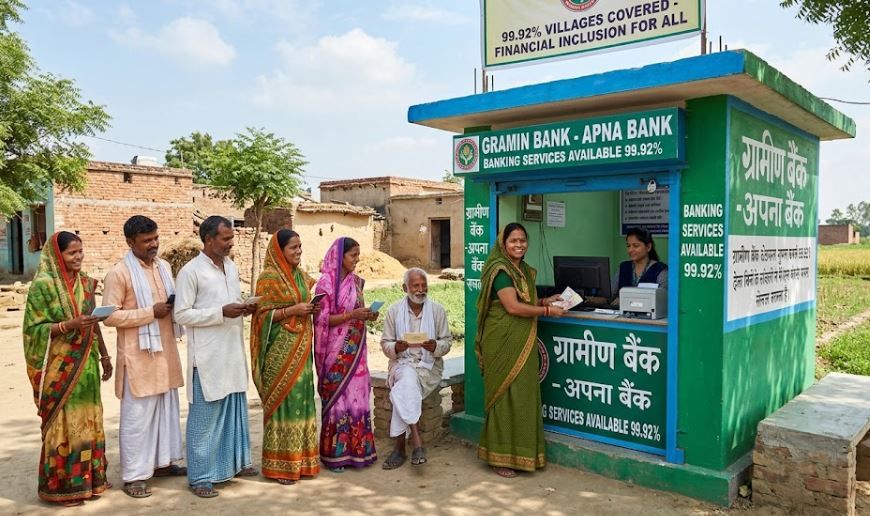

In a landmark development for the nation’s financial infrastructure, India has officially achieved near-universal banking coverage. As of early August 2026, data released by the Finance Ministry confirms that 99.92% of all inhabited villages across the country now have access to formal banking services. This milestone marks the culmination of a multi-year effort to bridge the rural-urban divide, ensuring that the vast majority of the population is integrated into the formal economy.
The 5-Kilometer Access Mandate
A critical component of this achievement is the proximity of services to the rural population. According to reports, the Finance Ministry has emphasized that these villages are now served within a 5-kilometer radius. This geographic benchmark is essential for ensuring that banking is not just available in name, but accessible in practice for elderly citizens, farmers, and small-scale rural entrepreneurs who previously faced significant travel hurdles to reach the nearest financial hub.
By establishing this 5-kilometer proximity, the government has effectively reduced the physical barriers to financial literacy and participation. The availability of these services within such a tight radius allows for more frequent transactions, better savings habits, and more immediate access to credit facilities that were once out of reach for remote settlements.
Strategic Expansion and Infrastructure Rollout
The drive toward 100% coverage has not slowed down despite reaching the 99.92% mark. The government is continuing to roll out additional banking outlets to cover the remaining fractional gap. This ongoing expansion suggests a commitment to absolute universality, targeting even the most geographically isolated or sparsely populated inhabited areas.
While the specific nature of these outlets, whether they are full-scale branches, mini-branches, or digital kiosks, varies by region, the primary goal remains consistent: providing a gateway to the formal financial system. This expansion is a central pillar of the current administration's economic strategy, aimed at ensuring that no village is left behind in the country's digital and financial growth story.
Implications for Financial Inclusion
The significance of achieving 99.92% coverage cannot be overstated in a country as geographically and demographically diverse as India. For years, "financial inclusion" was a goal that faced the uphill battle of infrastructure deficit.
With near-universal coverage, the government can more effectively implement direct benefit transfers and other social security schemes. The transition from "unbanked" to "banked" for nearly every inhabited village provides a robust foundation for future economic reforms. As the final 0.08% of villages are brought into the fold, the focus is expected to shift from physical access to the quality and depth of financial services provided to these newly included populations.