

New Delhi: India’s agricultural transformation is entering a decisive phase — one shaped less by the sheer volume of output and more by the quality of value it generates.
As highlighted in the Ficci report Accelerating High Value Horticulture for Atmanirbhar Bharat: Vision 2030 , the coming decade will not be defined by gains in bulk grain production, but by the rise of orchards, plantations, and high-value clusters capable of commanding premium prices in both domestic and global markets.
At the centre of this shift lies high-value horticulture, offering India one of its most compelling opportunities to enhance farm incomes, modernize value chains, and secure a more competitive foothold in global agri-trade, the report says.
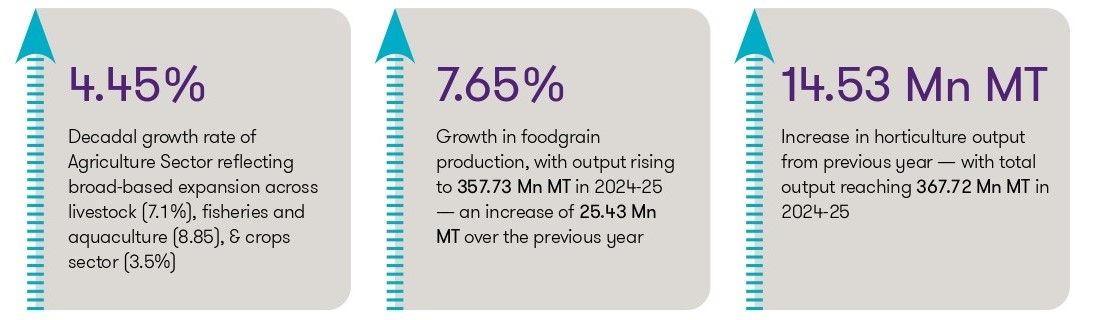
The scale and urgency of this transition is aptly underscored by India’s agricultural data. Horticulture today contributes nearly 33% of India’s agricultural Gross Value Added (GVA), and has already overtaken foodgrains in aggregate output.
“Rising consumer incomes, changing food habits, increasing demand for fresh and processed produce, and expanding export opportunities are further accelerating this transition. High-value horticulture presents significant opportunities to enhance farmer incomes, generate employment across the value chain, and promote inclusive rural development,” says Jyoti Vij, Director General, Ficci.
Total production has risen from approximately 281 million tonnes in 2013-14 to about 368 million tonnes in 2024-25, reflecting sustained growth driven by domestic demand and global market pull, as highlighted by Ficci. This expansion is broad-based, with fruits accounting for 114.51 million tonnes, vegetables for 219.67 million tonnes, and other horticultural crops contributing an additional 33.54 million tonnes.
Yet the real story lies not in production, but in value realisation. Unlike cereals, horticulture offers significantly higher returns per hectare and multiple harvest cycles, creating a more stable and lucrative income stream for farmers, emphasises the Ficci report. As profitability in staple crops declines, farmers are steadily shifting toward fruits, vegetables, plantation crops, and spices that respond more directly to market demand.
This transition is also demand-led. Rising incomes, urban consumption patterns, and a growing preference for nutrition-rich and premium produce are fuelling sustained demand for high-value horticulture, according to the report. At the same time, global markets are increasingly seeking safe, traceable, and value-added products — areas where India has natural advantages due to its agro-climatic diversity and year-round production capabilities.
India is already the world’s second-largest producer of fruits and vegetables, and a leading producer of crops such as cashew and coconut. This diversity allows the country to supply a wide spectrum of products across seasons, strengthening its appeal as a reliable sourcing destination.
Structural Faultlines
However, beneath this growth story lies a deeper structural paradox. India’s horticulture sector, despite its scale, remains trapped between underutilised domestic capacity and persistent import dependence in key high-value segments, a challenge outlined in the Ficci report. This misalignment between production quality and market requirements is the central challenge that must be addressed if the sector is to truly unlock its potential.
The promise of high-value horticulture is undeniable, but so are its constraints. India’s current ecosystem reveals a series of structural weaknesses that continue to limit competitiveness, suppress value realisation, and constrain export potential, the report says.
At the heart of the problem is a mismatch between upstream production systems and downstream market expectations. Chronic shortages of quality planting material, ageing orchards, and inconsistent farm practices have led to productivity gaps that often range between two to four times global benchmarks. In crops such as coconut, cashew and apple, an estimated 40-50% of plantation areas are ageing and low-yielding, further dragging down output quality.
These inefficiencies cascade through the value chain. Post-harvest losses remain significant, with India losing between 8% and 15% of horticulture output due to inadequate infrastructure and fragmented supply chains, reveals the Ficci report. Cold storage gaps, limited pack-house capacity, and weak logistics systems continue to erode both quality and shelf life, it adds.
The consequences are starkly visible in trade dynamics. India imports nearly 60% of its raw cashew requirement, even as domestic processing facilities operate at just 50-60% capacity, according to Ficci. Cocoa production meets less than 20% of domestic demand, forcing large-scale imports despite underutilised grinding capacity. Apple imports exceed 0.5 million tonnes annually, reflecting persistent gaps in grading, branding, and productivity.
The cashew sector illustrates this contradiction with particular clarity. India, despite being one of the world’s largest processors, imports more than half of its raw cashew requirement, with imports valued at over $1.6 billion, as noted in the report. Domestic production growth has lagged significantly behind demand, growing at around 2% CAGR compared to 6-7% for imports.
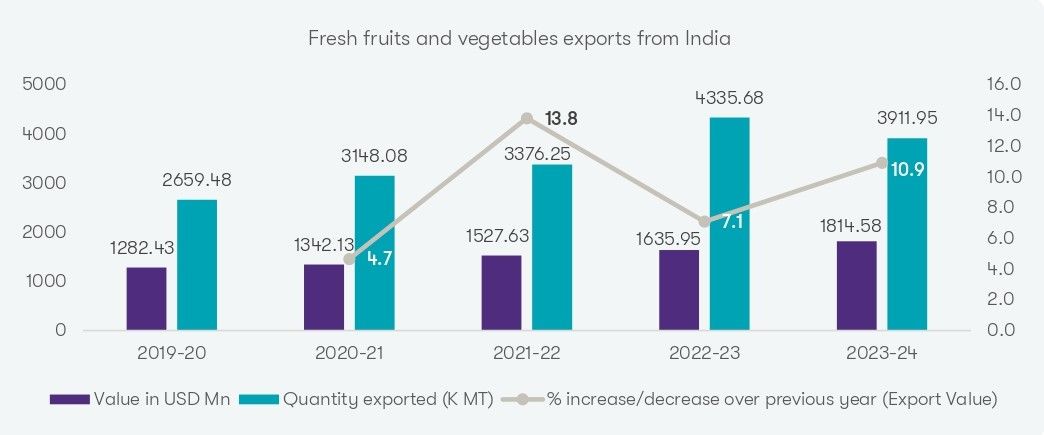
At the same time, export performance reveals both progress and limitations. Fresh fruits and vegetables exports have grown steadily, but penetration into premium markets remains limited due to inconsistent quality, weak traceability, and fragmented supply chains.

Technology adoption is beginning to address some of these issues. Precision farming, AI-driven advisory systems, IoT-based monitoring, and digital traceability tools are improving productivity, compliance, and transparency across the value chain, though adoption remains uneven.
Ultimately, the sector’s constraints are systemic rather than incremental. They require a coordinated, end-to-end transformation that aligns production, processing, logistics, and market access into a coherent, value-driven ecosystem, as emphasised in the report.
Premiumisation, Global Leadership
The roadmap to unlocking India’s high-value horticulture potential is both ambitious and structured. As outlined in the report, it is built around a three-phase transformation strategy that moves the sector from foundational reform to global premium positioning.
The first phase focuses on rebuilding the production base through clean planting material, R&D, certified nurseries, and rejuvenation of ageing orchards. Cluster-based development models will play a pivotal role in aligning production with market demand.
The second phase centres on scaling post-harvest infrastructure and processing capacity through micro-processing hubs, integrated cold chains, and advanced pack-houses, alongside policy reforms to encourage private sector participation.
Technology will act as a key enabler across these two phases, enhancing efficiency, consistency, and transparency across the value chain.
The final phase — premiumisation — focuses on integrating Indian horticulture into global value chains through branding, quality assurance, traceability, and long-term partnerships with global buyers.
“Realising the full potential of high-value horticulture will require strengthening the core enablers that support quality with productivity, scale, and market integration. Focused investments in R&D will improve varietal performance and planting material systems, while technology-driven practices across cultivation, post-harvest processes, and traceability systems will enhance consistency and compliance,” says Dr. Prabhat Kumar, Horticulture Commissioner, Department of Agriculture, & Farmer Welfare, Ministry of Agriculture & Farmers Welfare.
Institutional support will be critical, with initiatives such as product-specific clusters and digital traceability systems strengthening the export ecosystem.
The broader vision, as articulated in the Ficci report, is to shift India’s horticulture sector from a fragmented, scheme-driven model to a coherent, mission-mode platform that simultaneously scales productivity, quality, exports, and farmer incomes.
If executed effectively, this transformation could redefine the economics of Indian agriculture, moving it from subsistence to sophistication, from volume to value, and from domestic orientation to global competitiveness, the report says.
By 2030, the question will not be whether India can produce enough, but whether it can produce well enough to lead.
(Coover photo by Julia Zolotova on Unsplash)