

New Delhi: India’s green housing transition is often viewed as an environmental imperative. Increasingly, however, it is emerging as an affordability strategy. As urban populations surge, energy costs rise and climate-related disruptions intensify, homes designed to consume less power and water could prove significantly cheaper to own and operate over their lifetime than conventional housing.
The challenge for India’s residential real estate market is that green homes are still widely perceived as expensive. Yet evidence suggests the higher upfront investment may be outweighed by lower running costs, reduced resource consumption and greater resilience to climate shocks. In a country expected to add hundreds of millions of urban residents by mid-century, the economics of sustainable housing are becoming difficult to ignore.
The findings come from The Square Yards Green Living Index, a research publication jointly developed by Square Yards and sustainability advisory firm The Habitat Emprise. The report argues that sustainability is evolving from a niche consideration into a mainstream factor influencing long-term affordability, comfort, resilience and property value.
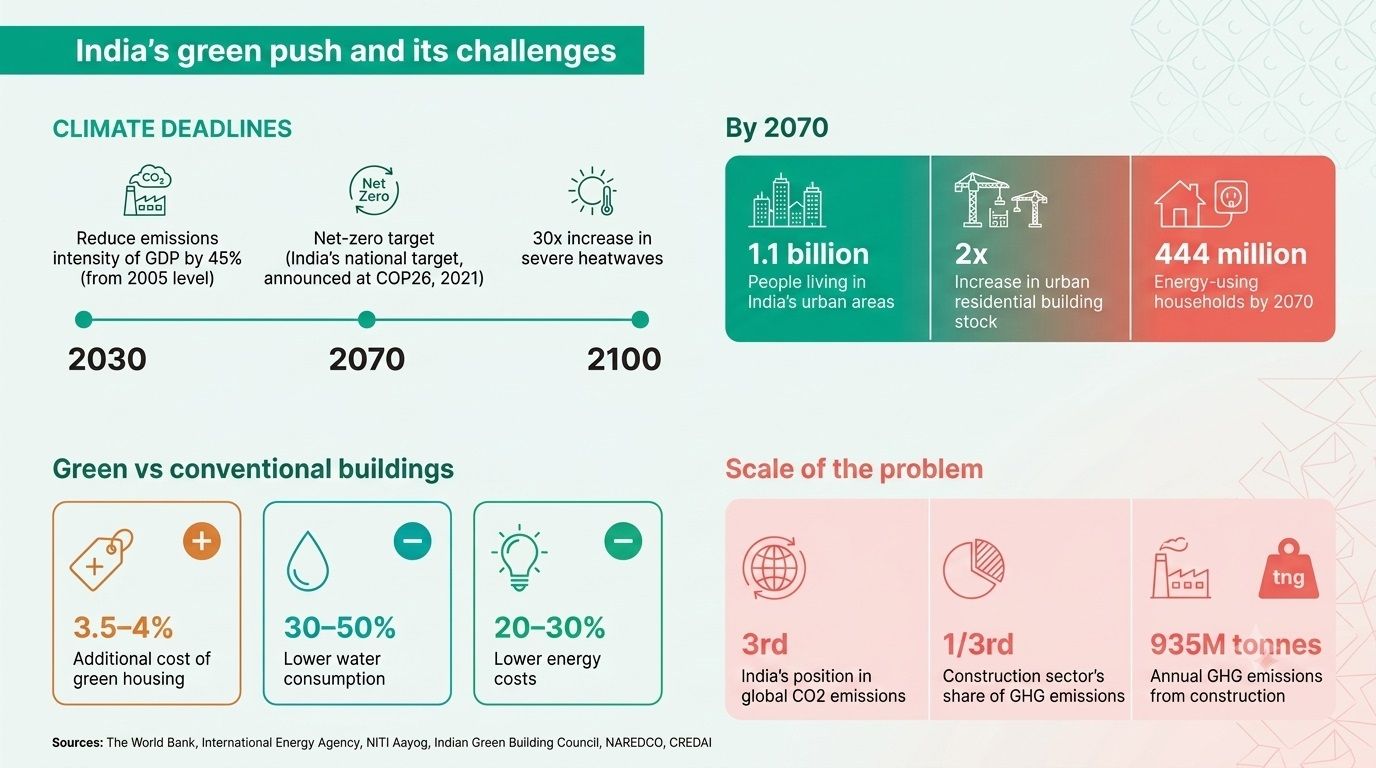
India’s housing challenge is enormous. The country is already the world’s third-largest emitter of carbon dioxide, while the construction sector accounts for roughly one-third of greenhouse-gas emissions. At the same time, urban residential building stock is projected to double by 2070, while the number of energy-consuming households could reach 444 million.
Against this backdrop, green housing appears less like an environmental luxury and more like an economic necessity. According to the report, green residential projects typically involve an additional construction cost of only 3.5-4%, yet can reduce water consumption by 30-50% and lower energy costs by 20-30%.
The Green ‘Premium’
The affordability debate around sustainable housing often focuses on acquisition costs rather than ownership costs. That distinction is becoming increasingly important as electricity tariffs, water scarcity and cooling requirements rise across India’s major cities.
The report notes that housing decisions are no longer being driven solely by location, configuration and amenities. Energy efficiency, water management, thermal comfort and climate resilience now have a direct impact on household finances and quality of life.
Tanuj Shori, Founder and CEO of Square Yards, notes, “The future of Indian housing will be defined not only by location and amenities, but by how intelligently homes respond to climate challenges, resource efficiency, and long-term affordability. Sustainability must become visible, measurable, and actionable for every homebuyer.”
That affordability angle is becoming increasingly relevant as Indian cities grapple with rising temperatures, water shortages and extreme weather events. These pressures directly affect household expenses through higher cooling bills, greater water costs and increased maintenance requirements.
The report identifies a ‘Green Housing Paradox’. Buyers increasingly want lower utility bills, healthier living environments and climate-resilient homes, yet often lack reliable information to compare projects on those parameters. Developers investing in sustainability therefore struggle to distinguish themselves from competitors relying on broad environmental claims.
Kanika Gupta Shori, Founder and COO of Square Yards, highlights the changing priorities of consumers. “Homebuyers today are asking more sophisticated questions than ever before. They want homes that are healthier, more efficient, and future-ready. Our goal is to provide reliable information that empowers consumers while encouraging the industry to raise standards across residential development.”
The shift mirrors developments in mature global property markets. In countries such as the UK, France, the US, Singapore and Australia, sustainability indicators ranging from energy ratings to climate-risk scores are increasingly integrated into property listings, enabling buyers to assess long-term operating costs before purchasing a home.
Transparency Drives Adoption
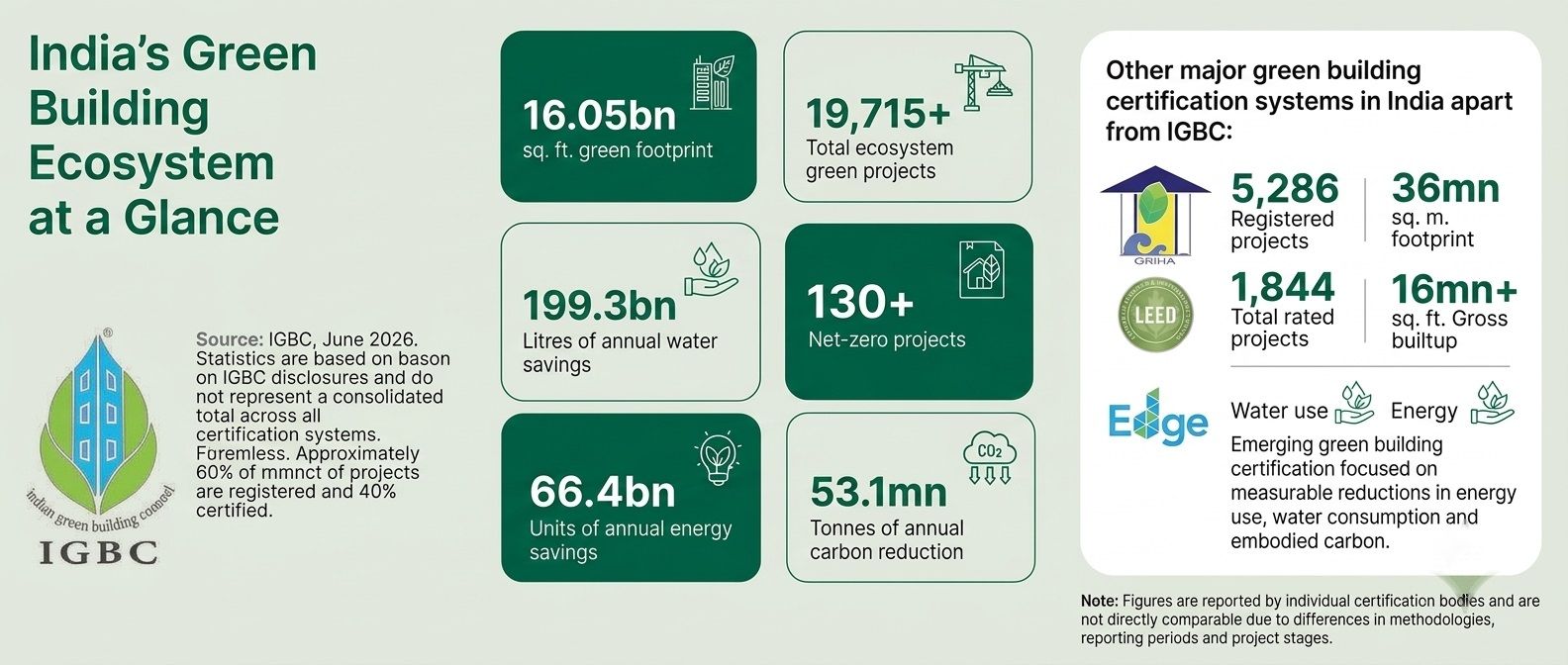
India is not lacking in green-building credentials. The country has more than 15.9 billion square feet of green-certified building space and one of the world’s largest sustainability ecosystems. Yet sustainability information remains fragmented and difficult for ordinary buyers to interpret.
The report argues that making sustainability transparent could accelerate adoption and improve affordability outcomes. Features such as passive cooling systems, rainwater harvesting, energy-efficient appliances, natural ventilation and climate-resilient infrastructure often remain invisible during the home-buying process despite their significant influence on long-term costs.
Dr. Priyanka Kochhar, CEO and Co-Founder of The Habitat Emprise, underscores this information gap. “One trend has become increasingly clear: while sustainability is now a major focus in commercial real estate, residential homebuyers often struggle to understand and compare the environmental performance of homes.”
To address this challenge, the report introduces the ‘Square Yards Green Living Index’, a framework designed to convert complex sustainability disclosures into a consumer-friendly score. By evaluating projects on resource efficiency, health and comfort, safety and resilience, and connectivity, the framework seeks to make environmental performance as visible as price and location.
The broader implication extends beyond homebuyers. Standardised sustainability information could eventually influence lending practices, green finance products and risk assessment models. As lenders and investors increasingly factor environmental performance into decision-making, homes that consume less energy and water may enjoy stronger long-term value propositions.
For India, the stakes are significant. By 2050, nearly 400 million additional people are expected to live in cities, placing unprecedented strain on resources and infrastructure. Sustainable housing offers a pathway to accommodate that growth while reducing operating costs for households and limiting environmental pressures.
The biggest takeaway from India’s green housing push may therefore be a simple one: the homes of the future are unlikely to be judged solely by how much they cost to buy. Increasingly, they will be valued by how much they cost to live in. And on that measure, green housing could turn out to be one of the country’s most effective long-term affordability tools.