


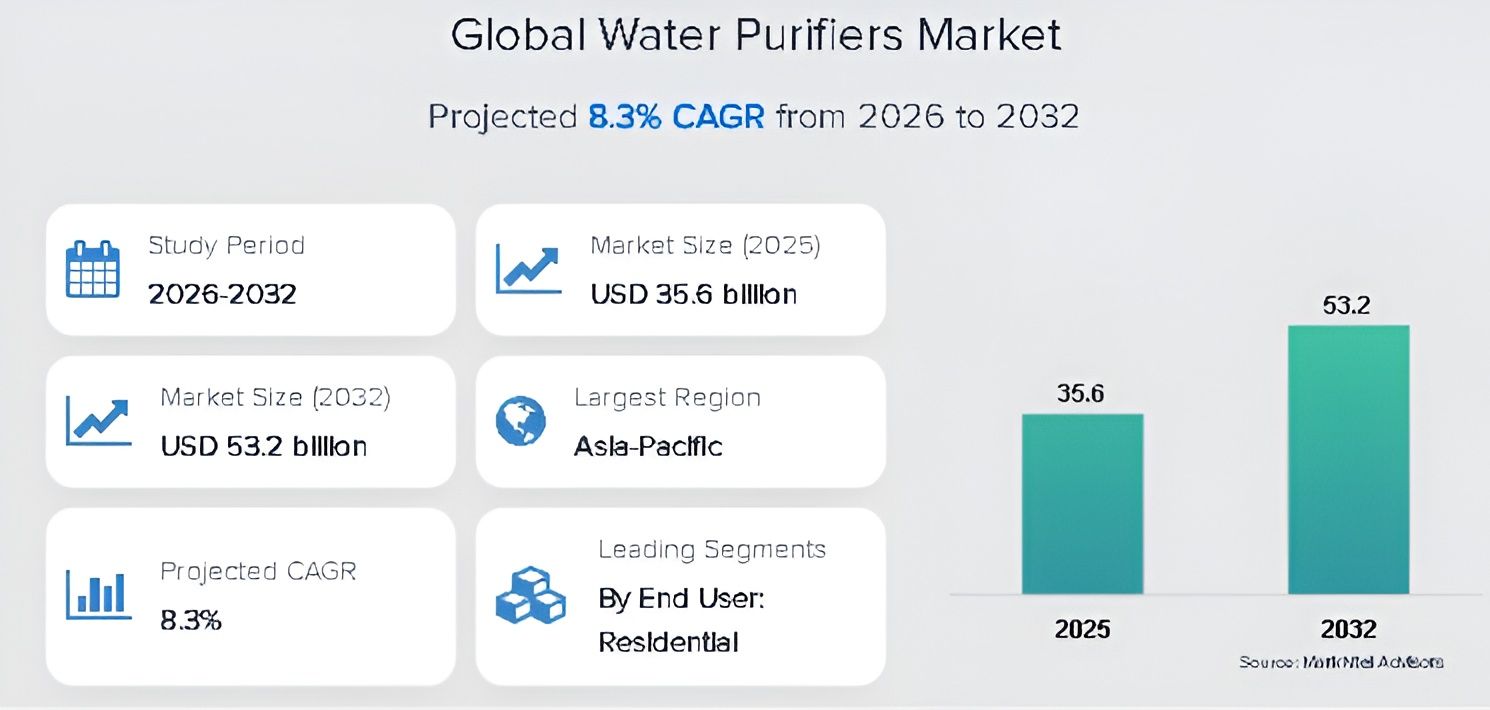
New Delhi: The global water purifier market is on a strong growth trajectory, with analysts estimating a compound annual growth rate (CAGR) of approximately 8.3% during the 2026-2032 period.
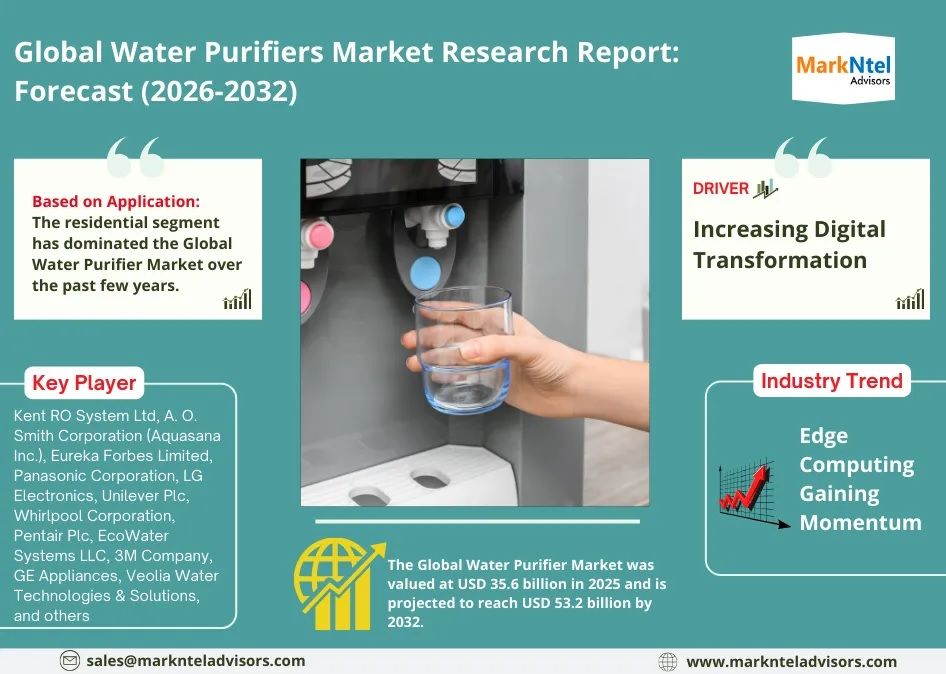
According to recent market analysis by by MarkNtel Advisors, the industry, valued at $35.6 billion in 2025, is projected to expand to $53.2 billion by 2032. This growth is being propelled by increasing awareness of waterborne diseases such as diarrhoea, hepatitis, and roundworm, alongside mounting concerns over the declining quality of groundwater and surface water due to industrial discharge and untreated sewage.
Globally, nearly 2.2 billion people still lack access to safely managed drinking water, while around 1.7 billion consume water contaminated with human waste, highlighting the scale of the water safety challenge driving purifier adoption.
Consumer Profile
Residential consumers remain the dominant end users, accounting for nearly 70% of total market demand in 2025. Rapid urban expansion, rising middle-class populations, and evolving lifestyles in high-growth markets such as India, Saudi Arabia, and the UAE have significantly increased household spending on water purification systems. Developers are increasingly integrating water purifiers as standard or value-added features in both mid-range and premium residential projects, reflecting growing health and wellness priorities.
By technology, reverse osmosis (RO) systems held approximately 55% of the market share in 2025, supported by their ability to remove heavy metals, dissolved salts, nitrates, and other harmful contaminants. Falling equipment costs, improved energy efficiency, and broader product availability across price points have further strengthened RO adoption despite ongoing concerns related to water wastage.
“RO purifiers dominate because of their comprehensive filtration capability, effectively removing heavy metals, chemicals, and microbes. Increasing contamination awareness fuels RO demand for superior purification. Multi-stage RO+UV+UF combinations enhance water safety, while continuous technological improvements minimize water wastage, making RO the preferred solution for thorough water purification globally,” the market analysis reveals.
Market Trends
The Asia-Pacific region accounted for nearly 60% of global water purifier revenues in 2025 and is expected to maintain its leadership throughout the forecast period.
Accelerated industrialization, population growth, and urbanization across China, India, Japan and South Korea have intensified pressure on water resources, while stricter government regulations on drinking water quality have increased penetration across residential, commercial, and industrial segments.
The region also benefits from the presence of major domestic and international manufacturers, including LG Electronics, Panasonic, Coway and Kent RO Systems, all of which continue to invest heavily in research and development to address region-specific water quality challenges.
“Leading water purifier companies are also focusing on AI-based predictive maintenance, automated filter life alerts, and custom mineralization to meet diverse regional water quality standards. Premium models are integrating app-based controls for monitoring Total Dissolved Solids (TDS) and optimizing filter replacement schedules,” says the MarkNtel research.
At the same time, declining per-capita water availability — exacerbated by climate change, irregular rainfall, prolonged droughts, and over-extraction of groundwater — is creating long-term opportunities for the market. Approximately 42% of global household wastewater remains untreated, contributing to rising contamination levels and reinforcing the need for point-of-use purification solutions.
Urban lifestyle changes are also influencing product design, with shrinking home sizes and higher property prices in countries such as India, Brazil, and Australia driving demand for slimmer, space-efficient water purifiers.
While limited awareness in rural and low-income populations continues to restrict adoption in some regions, increasing health consciousness, smart purifier innovations, and growing disposable incomes are expected to sustain robust market expansion through 2032.
(Cover photo by Ian Talmacs on Unsplash)