


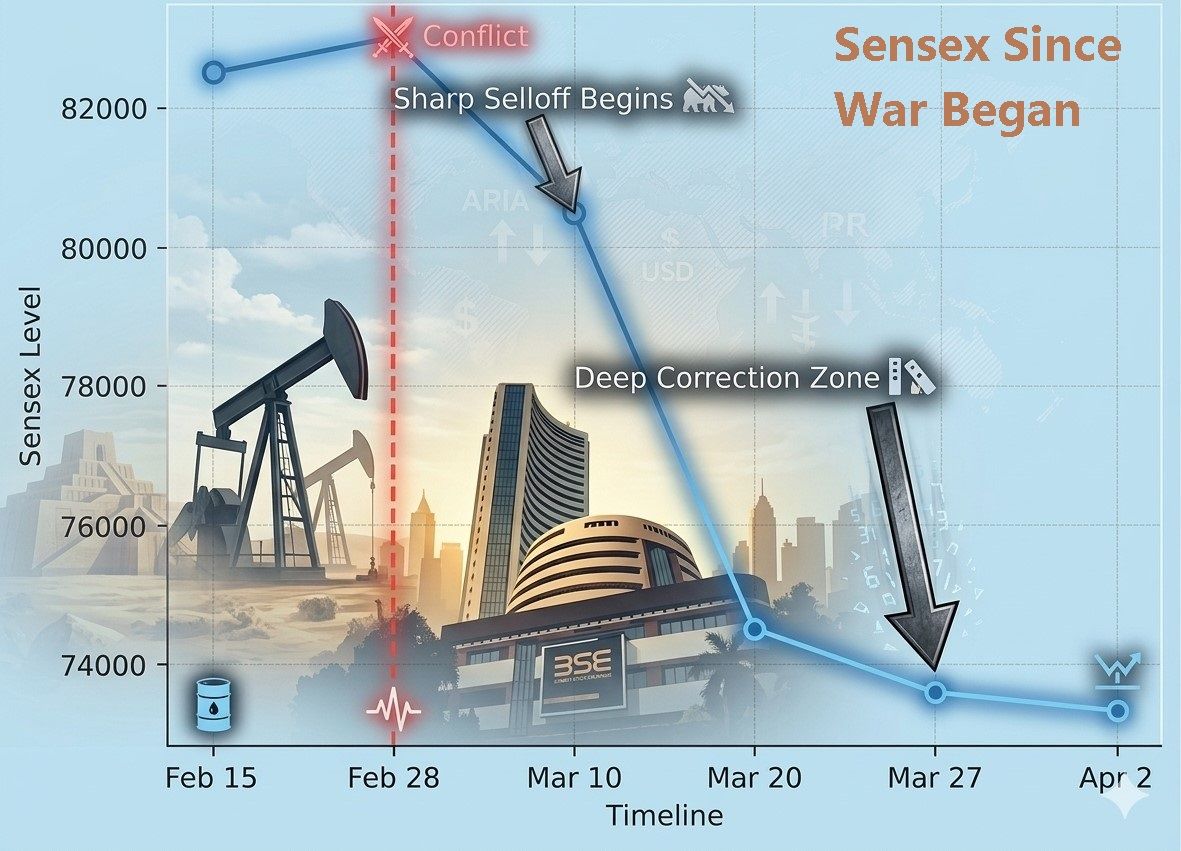
New Delhi: The escalating Iran-Israel conflict has triggered a sharp reset across Indian financial markets, pushing benchmark indices like the BSE Sensex and Nifty 50 into a correction exceeding 11%. A toxic mix of geopolitical uncertainty, surging crude prices, and foreign capital outflows has forced investors to rethink their strategies in real time.
For Indian investors, however, this isn’t merely a phase of panic; it’s a moment that demands urgent calculated rebalancing. With Brent crude flirting with the $110 mark and volatility dominating sentiment, the 2026 investment playbook is being rewritten on the fly. The focus now shifts from reacting emotionally to deploying capital with precision.
Market history shows that geopolitical crises tend to create sharp but temporary dislocations rather than long-term structural damage. From oil shocks to regional conflicts, the pattern has remained consistent: sudden selloffs followed by stabilization and the emergence of new sector leaders.
What sets this episode apart is speed. Information flows instantly, capital moves faster than ever, and recoveries are increasingly uneven. Beneath the headline panic lies a more subtle impact — rising logistics costs, delayed supply chains, and margin pressure across sectors. These second-order effects often outlast the crisis itself and shape earnings over the coming quarters.
Market experts suggest that in the current volatile environment, investors should stay flexible, avoid excessive leverage, and focus primarily on protecting capital. A cautious, hedged, and highly selective strategy, backed by disciplined risk management, is essential until market direction becomes clearer.
Oil Shock & Capital Flight
At its core, the ongoing market correction is a story of energy dependence and currency vulnerability. With India importing nearly 85% of its crude requirements, rising oil prices directly strain the economy. As tensions intensify around critical shipping routes like the Strait of Hormuz, foreign investors have responded by pulling capital out of emerging markets.
The result has been a sharp weakening of the rupee and a liquidity crunch that erased nearly ₹51 lakh crore in market value within weeks. Yet seasoned investors understand that volatility often represents opportunity. What looks like panic is frequently a transfer of wealth from impatient participants to disciplined ones.
An additional layer of complexity comes from central bank dynamics. The Reserve Bank of India now faces a delicate balancing act between controlling inflation and supporting growth. Elevated oil prices limit its ability to cut rates aggressively, while currency pressure may require periodic intervention in forex markets. This policy tightrope further contributes to uncertainty, as investors attempt to anticipate the central bank’s next move.
Precious Metals: Stability in Chaos
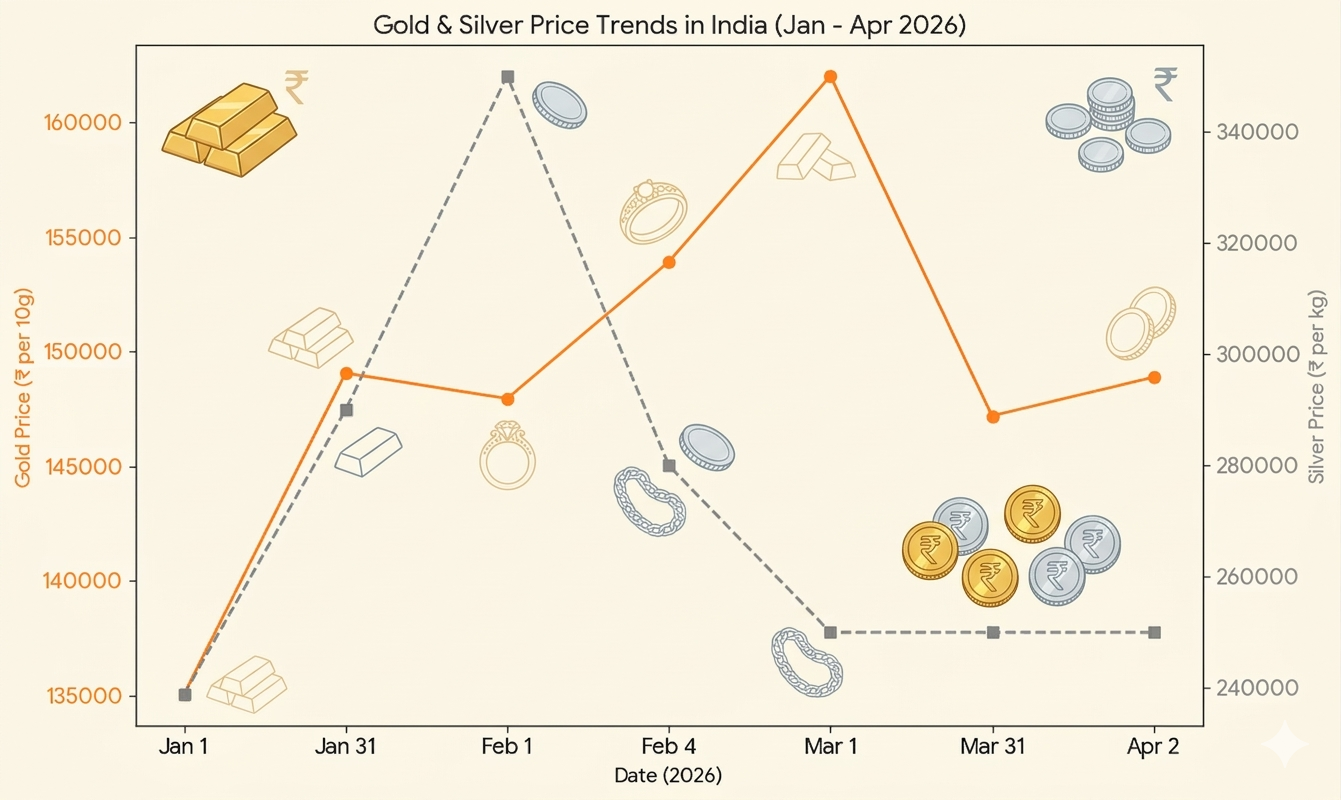
In times of crisis, gold has once again reinforced its role as a financial safe haven. Domestic prices have surged toward record highs, acting as a hedge against both currency depreciation and market instability.
But the real surprise has been silver. Driven by strong industrial demand, particularly from sectors like EVs and 5G, silver has outperformed gold on a percentage basis, albeit with higher volatility.
Experts believe equities remain a strong long-term wealth creator, but in periods of geopolitical stress, gold plays a crucial role in limiting downside risk and stabilizing portfolios.
Beyond fundamentals, there’s also a behavioural angle. Investors gravitate toward tangible, historically reliable assets during uncertain times. Gold and silver don’t just hedge risk, they provide psychological comfort when markets turn unpredictable.
Interestingly, institutional participation in commodity-linked instruments has also risen during this phase. Exchange-traded products tracking gold and silver are witnessing higher inflows, indicating that both retail and institutional investors are actively seeking diversification beyond traditional equity-heavy portfolios.
Equity: All Sectors Aren’t Equal
Despite the broad selloff, the correction has been far from uniform. Traditional sectors such as aviation, paints, and chemicals — they are heavily dependent on input costs — have borne the brunt of rising energy prices.
In contrast, IT services have emerged as relative outperformers. Companies like TCS and Infosys benefit directly from a weaker rupee, as their dollar-denominated revenues translate into stronger margins.
This divergence underscores a key principle: markets don’t decline uniformly… capital rotates. Even during corrections, pockets of resilience emerge, offering opportunities for investors who can identify them early.
Adding to this, defensive sectors such as pharmaceuticals and FMCG are beginning to attract attention. These industries tend to exhibit stable demand regardless of macroeconomic volatility, making them attractive during uncertain periods. While they may not deliver explosive returns, they provide consistency… an underrated asset in turbulent markets.
Meanwhile, the banking sector has shown notable resilience. With credit growth holding steady, leading banks are now trading at valuations reminiscent of earlier cycles. The distinction between a fundamentally weak business and a temporarily beaten-down stock has become more critical than ever.
According to experts, equities continue to be the primary driver of growth, gold serves as a reliable stabilizer during uncertainty, and silver offers higher return potential but comes with greater volatility.
Real Estate: From Ownership to Yield
The real estate narrative is also evolving. Rising input costs have pushed construction expenses higher, but demand for premium assets in major urban centres remains strong.
For modern investors, the shift is increasingly toward efficiency rather than ownership. Real Estate Investment Trusts (REITs) are gaining traction as they offer exposure to high-quality assets without the illiquidity associated with direct property investments.
With rental yields currently outpacing returns from instruments like the 10-year government bond, REITs are emerging as a viable option for income generation and portfolio stability.
Another emerging trend is the growing interest in fractional real estate ownership platforms, which allow investors to participate in commercial property deals with significantly lower capital. This democratization of real estate investing is expanding access while aligning with the broader shift toward liquidity and flexibility.
Tread with Caution
This is not a market for passive investing. The war-triggered volatility has created an environment where active allocation, diversification, and risk management are paramount.
Traditional safe havens like government bonds and gold are once again proving their worth, while selective opportunities continue to emerge within equities. Whether it’s discounted blue-chip stocks or momentum in commodities like silver, opportunities persist beneath the surface turbulence.
For investors, the message is clear: don’t fear the correction, analyze it. In every market downturn, there is a shift in leadership. The challenge is not avoiding volatility, but positioning ahead of the recovery that inevitably follows.
More importantly, this phase reinforces a timeless investing principle: resilience is built during downturns, not rallies. Portfolios constructed with balance, discipline, and foresight during uncertain times are often the ones that outperform when stability returns.